
In July 2022, Brazil stopped listening to a podcast that mixed urban mystery with social denunciation. “The Woman in the Abandoned House”, created by journalist Chico Felitti, began with an unusual scene: a decaying mansion in Higienópolis, one of São Paulo’s most affluent neighborhoods, inhabited by an eccentric woman who always walked around with her face covered in a thick layer of white ointment. For neighbors, she was a ghostlike, almost folkloric figure. But the investigation revealed a disturbing story that spanned decades and borders.
That woman was Margarida Maria Vicente de Azevedo Bonetti, heir to a traditional São Paulo family. In the 1970s, after marrying engineer Renê Bonetti, she moved to the United States. The couple took with them a Brazilian domestic worker, Hilda Rosa dos Santos, who would spend nearly twenty years in silence, living under degrading conditions.
The crime: forced labor and silent violence
According to FBI investigations and later reports, Hilda was kept in conditions akin to slavery: she slept in a basement, was fed scraps, denied medical care, and worked without fair pay. The confinement was so strict that the refrigerator was locked with a padlock to keep her from eating. Neighbors reported scenes of neglect and humiliation.
The case came to light in the early 2000s. In the United States, both Renê and Margarida were formally charged with labor exploitation and forced work. The American justice system recognized the severity of the case, but their fates turned out to be very different.

The trial and Margarida’s escape
Renê, who had become a naturalized U.S. citizen, was prosecuted, tried, and sentenced to six and a half years in prison, in addition to paying $110,000 in compensation to the victim. After serving his sentence, he returned to work as an engineer and today is employed by major aerospace companies in the U.S., including Northrop Grumman. He lives discreetly but managed to reintegrate professionally.
Margarida, however, had never become a naturalized American citizen. She remained exclusively Brazilian. This allowed her to flee before the trial concluded: she returned to Brazil and sought refuge in her family’s mansion in Higienópolis. By Brazilian law, nationals cannot be extradited, and the statute of limitations on her case has since expired. Thus, although considered a fugitive by U.S. authorities, Margarida was never tried or imprisoned. She still lives in seclusion in the once-grand mansion, now in ruins, which became a haunting metaphor for her fall from grace.
And the victim, Hilda Rosa dos Santos?
Hilda received the compensation awarded by the U.S. court. However, unlike what many might have expected, she never returned to Brazil. She remained in the United States, where she built a quiet life after finally freeing herself from the Bonetti family.
Why didn’t she come back? Several factors help explain:
- The deep trauma of her experience tied Brazil to memories of violence.
- The support she received in the U.S., both from protection agencies and local communities.
- The fear that, in Brazil, her story might be forgotten or minimized — something the podcast and later the documentary helped reverse by restoring her visibility.
Hilda still has relatives in Brazil but has chosen to stay in the U.S., where she has rebuilt her life. In 2025, she broke nearly three decades of silence when she appeared on camera for the first time in the Prime Video documentary, giving face and voice to the ordeal she had endured.
The house before the scandal
The mansion where Margarida still lives was not just another house in Higienópolis. It was built in the early 20th century by the Vicente de Azevedo family, descendants of the Baron of Bocaina, one of the last noble titles of the Brazilian Empire, tied to coffee, politics, and São Paulo’s development. Decades later, it was inhabited by Dr. Geraldo Vicente de Azevedo, a respected physician and Margarida’s father, known for his philanthropy.
In other words, the house carried a legacy of prestige and power. To see it fall into ruin, inhabited by a fugitive from an international crime, is part of what fascinates the public. What was once a symbol of status became a symbol of decay — littered with debris, subject to municipal fines for neglect, and a constant object of neighbors’ curiosity.

The couple’s son
Little is said about him, but Margarida and Renê had a single son, born in the U.S. He was never directly involved in the legal proceedings. He lives discreetly in the United States, away from the media and the scandal surrounding his parents. His identity has been preserved, and he has not appeared in interviews or the documentary.
The impact of the podcast
When Chico Felitti released “The Woman in the Abandoned House”, the podcast quickly became a cultural phenomenon. With millions of downloads, it topped national rankings and even reached international audiences. A story that might have been forgotten as a small newspaper report became global news.
Its fascination came from the combination of elements: the mystery of the eccentric woman, the decline of a once-grand mansion, the revelation of a brutal crime, and the glaring impunity. It was both a true crime narrative and a mirror of Brazil’s social inequalities and structural violence.
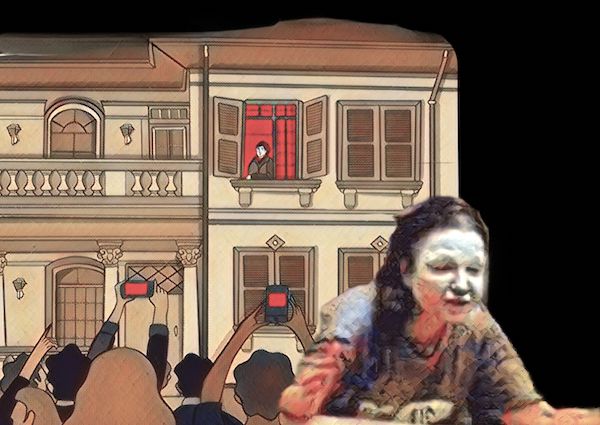
From audio to screen: the documentary
In 2025, the story gained a new dimension on Prime Video, with a three-part documentary series directed by Kátia Lund, alongside Lívia Gama and Yasmin Thayná. Unlike the podcast, the documentary expanded the scope, bringing new official documents, FBI testimonies, expert interviews, and above all, the long-awaited presence of Hilda.
The documentary’s greatest achievement lies in shifting the focus: while the podcast revolved around the mystery of Margarida, the series restores the victim’s protagonism. Hilda appears not just as a victim, but as a survivor who rebuilt her life.
Where things stand today
- Margarida Bonetti still lives in seclusion in the ruined Higienópolis mansion.
- Renê Bonetti, after serving his sentence, rebuilt his professional life in the U.S.
- Hilda Rosa dos Santos continues to live in the U.S., with her voice and story finally restored to the public eye.
- The mansion remains standing in Higienópolis, now a symbol of impunity and social decay in one of São Paulo’s wealthiest neighborhoods.
The story of The Woman in the Abandoned House cuts across time and formats: from an aristocratic mansion to a ruin; from a silenced victim to a survivor who now speaks; from a massively successful podcast to a global documentary. More than curiosity, the story of Margarida Bonetti, Renê Bonetti, and Hilda Rosa dos Santos is a reminder of how impunity can endure — but also of the power of journalism and memory to return dignity and voice to those who were silenced.
Descubra mais sobre
Assine para receber nossas notícias mais recentes por e-mail.
 miscelana.com