
On January 12, 1976, the world said goodbye to Agatha Christie at the age of 85. Fifty years later, the paradox still holds: few writers were as popular in life, and as inexhaustible after death. Christie did not simply write crime stories; she rewrote the rules, teaching generations of readers to distrust everything and everyone. Including herself.
Born on September 15, 1890, Agatha became the most successful novelist in history, with more than four billion books sold and translated into over 100 languages. Her career spanned 56 years, encompassing more than 80 books, 19 plays, and six novels published under the pseudonym Mary Westmacott, works often overlooked, yet essential to understanding her interest in psychology, emotional life, and the grey zones of human behavior.
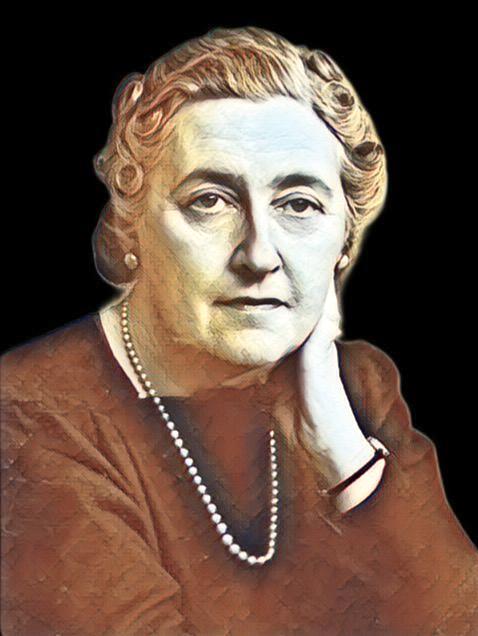
The woman behind the detectives
From her imagination emerged two of the greatest icons of crime fiction: Hercule Poirot, the meticulous Belgian who trusted his “little grey cells,” and Miss Marple, the seemingly harmless spinster who understood human nature better than any professional investigator. Opposites in method and temperament, both were equally ruthless.
Christie herself was a celebrity. So famous, in fact, that she lived through what may be the only real mystery of her career: in 1926, after discovering her husband Archibald Christie’s affair, she disappeared for 15 days. Her abandoned car was found with documents and personal belongings inside. The press speculated about murder. The country came to a standstill. When she was finally located at a hotel in northern England, she was using the surname of her husband’s lover and claimed to suffer from amnesia. She never spoke publicly about the episode again.
Theories multiplied — emotional revenge, psychological breakdown, a genuine accident, even a publicity stunt. None was ever proven. As in her novels, Christie left the clues… and exited the scene.
From personal loss to literary creation
Educated at home, Agatha lost her father at the age of 11 and grew up traveling with her mother. She dreamed of becoming an opera singer, but marriage drew her away from the stage. Writing, however, offered another kind of voice. During World War I, she worked as a nurse and pharmacist — an experience that made her an expert on poisons, a detail far from irrelevant in her fiction.
She wrote by hand, in notebooks, testing solutions, narrative traps, and false culprits before transferring the text to a typewriter. She drew inspiration from newspapers, travels, archaeological digs in Egypt, trains stranded by snow, and something harder to map: human curiosity about evil. Not by chance, she often remarked that readers were more interested in the murderer than in the victim.
The death of a character before the author
In 1975, Christie made a radical decision: she published “Curtain”, bringing Poirot’s story to an end. The impact was so great that The New York Times published an official obituary for the fictional detective — an unprecedented event. Months later, in January 1976, Agatha herself died at home, quietly, far from the spotlight she had increasingly avoided.
Cinema, theatre, and reinvention
Cinema fell in love with Christie early on. The first adaptation dates back to 1928. Oscars followed including Ingrid Bergman’s for Murder on the Orient Express, along with countless remakes. In the 21st century, Kenneth Branagh took on Poirot in Murder on the Orient Express (2017) and Death on the Nile (2022), reigniting interest in her work for a new generation.

A house, a museum, a lasting presence
The house Agatha admired as a child, Greenway, in Devon, was purchased once success granted her financial freedom. Today, it is a museum a space that materializes her obsession with observation, silence, and detail. Elements that remain alive in every reading.
Fifty years after her death, Agatha Christie continues to deceive us with elegance. Her books endure because they grasp something essential: crimes change, societies change, but human nature — vain, fragile, capable of tenderness and cruelty — remains. And as long as readers are willing to suspect everything, the Queen of Crime will remain immortal.
Descubra mais sobre
Assine para receber nossas notícias mais recentes por e-mail.

