
Few women of the Middle Ages have remained as vivid in history and imagination as Eleanor of Aquitaine. Heiress, queen, mother of kings, prisoner, and political strategist, she moved through the 12th century as the architect of her own legend — a figure who blended power, intellect, and art. She was queen of two nations — France and England, mistress of one of the largest feudal territories in Europe, and the gravitational force behind an age of ambition and betrayal that would define the English crown.
Born in 1122, Eleanor grew up in a cultured and audacious court. The duchy of Aquitaine valued troubadours, poetry, and philosophy — the cradle of courtly love, an ideal she would later spread across Europe. She first married Louis VII of France, a union that dissolved amid political and personal discord. In 1152, she married Henry Plantagenet, the future Henry II of England, and with him built (and later destroyed) an empire stretching from the Pyrenees to Scotland.

Between the Throne and the Prison
Her marriage to Henry II remains one of history’s most famous and tumultuous alliances. Eleanor was as intelligent and independent as Henry was authoritative and volatile. Together, they had ten children, including Richard the Lionheart and John Lackland — names that would shape England’s destiny and echo through centuries of song and legend. When Eleanor supported her sons in rebellion against their father, she paid dearly: sixteen years of imprisonment, confined to castles and convents until Richard freed her after Henry’s death.
During Richard’s reign, while he was absent on the Crusades, Eleanor effectively ruled England. She managed the kingdom, negotiated ransoms, signed treaties, and maintained stability in an empire on the brink of collapse. Even in old age, she mediated disputes between her sons and lived long enough to see the crown pass to the infamous King John — the same ruler who would later be immortalized as the villain of the Robin Hood legend.
The Link Between History and Legend
The legend of Robin Hood — the outlaw who “stole from the rich to give to the poor” — was born amid that turbulent transition from Richard’s to John’s reign. With the true king away and the people burdened by corrupt taxation, the ballads of the 13th century created in Sherwood Forest a hero who defied tyranny. Eleanor, the mother of both kings, became an invisible yet essential presence in that mythology — the matriarch who symbolized the vanished age of justice and chivalry.
If Richard is the absent king and Robin the people’s champion, Eleanor is memory itself: the keeper of lineage and nobility in a world slipping into chaos. Her court in Aquitaine had been the birthplace of the very ideals — honor, loyalty, and resistance to injustice — that later infused the tales of Robin Hood.

Katharine Hepburn: The Definitive Queen
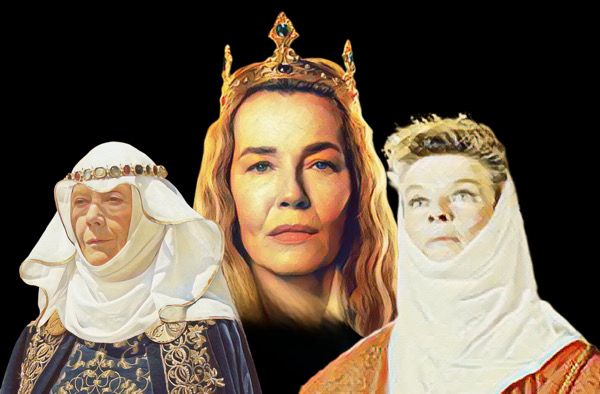
No one captured Eleanor’s complexity more magnificently than Katharine Hepburn in The Lion in Winter (1968). Opposite Peter O’Toole’s Henry II, she portrayed a queen still brilliant and biting after years of exile and loss. The film, set during the Christmas of 1183, unfolds as a verbal and emotional battlefield between husband, wife, and heirs. Hepburn’s Eleanor is wounded but razor-sharp — a woman who understands power, love, and cruelty better than any man at the table.
Her performance earned her the Academy Award for Best Actress, cementing the modern image of Eleanor as both mother and monarch, intellect and survivor. Every portrayal since — every scheming matriarch or elegant manipulator in medieval drama — carries an echo of Hepburn’s queen, and of the real Eleanor who inspired her.
The Queen in Robin Hood Adaptations
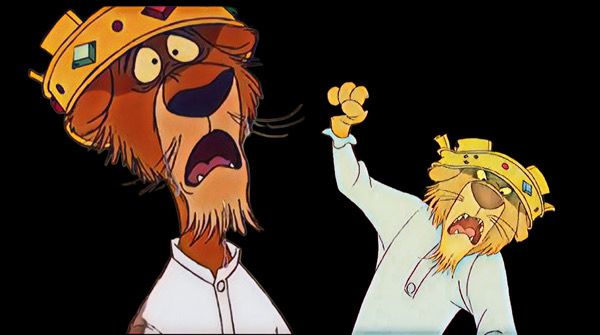
Eleanor’s presence in the Robin Hood myth has shifted with time. In some versions, she is only a shadow — the absent mother revered by Richard and despised by John. In Disney’s animated Robin Hood (1973), she never appears, yet Prince John laments that “Mother always did prefer Richard” — a comic exaggeration rooted in historical truth.
In Ridley Scott’s Robin Hood (2010), Eleanor of Aquitaine is portrayed by Eileen Atkins, an older, pragmatic queen who clashes with Isabella of Angoulême (Léa Seydoux), King John’s young wife, while Cate Blanchett plays Lady Marian. Atkins’ Eleanor is a study in restraint and quiet authority, a woman who sees power clearly but has learned to wield it from the edges of the throne.
In the MGM+ series Robin Hood (2025), Connie Nielsen embodies a new vision of Eleanor: commanding, mysterious, and unyielding. Her Eleanor is not a relic of the past but a strategist — a survivor whose presence bridges the mythic and the political. Nielsen’s performance captures the essence of the historical queen: enigmatic, sharp, and impossible to overlook.
Earlier Robin Hood films, including the Errol Flynn classics, often erased Eleanor altogether, focusing instead on romance and heroism. The newer portrayals restore her as what she was — the mind behind the myth, the living link between royal power and the rebellion that would define England’s legend
The Queen Who Became Immortal
Eleanor of Aquitaine died in 1204, at the remarkable age of eighty-two, in the convent she founded. She had outlived kings, wars, and dynasties — and became a legend in her own lifetime. She was queen, prisoner, mother of monarchs, patron of poets, and, unknowingly, the spiritual mother of the outlaw who would challenge power in her sons’ name.
Between history and myth, Eleanor is the invisible thread that binds crown and forest, court and rebellion, power and freedom — the queen who, more than any other, made the 12th century the cradle of England’s legend.
Descubra mais sobre
Assine para receber nossas notícias mais recentes por e-mail.
 miscelana.com
1 comentário Adicione o seu