
Disney’s guiding principle has always been that “dreams and wishes can come true.” It’s an idea sung throughout Snow White, Cinderella, Sleeping Beauty, and, of course, Pinocchio. But it is Pinocchio’s anthem, the now-eternal When You Wish Upon a Star, that crystallizes this spirit — a song that, in 2025, celebrated 85 years since its debut. Truly, who doesn’t feel moved when those first notes begin?
After changing film history with Snow White and the Seven Dwarfs, Pinocchio expanded — permanently — the possibilities of animation. Released on February 23, 1940, Disney’s second animated feature transformed the story of a wooden puppet longing to become a real boy into a fully realized work of art: emotional, sophisticated, and unforgettable. Celebrated for its stunning visuals and iconic songs, the film endures not only for its technical brilliance but also for the tenderness with which it speaks about dreams, choices, and humanity.

Inspired by the 1883 children’s novel The Adventures of Pinocchio by Carlo Collodi, the film conquered the world and cemented Disney as a creative powerhouse capable of reinventing the language of animation — and translating it into pure emotion.
A story of dreams, morality, and magic
At the heart of the film is a timeless journey of self-discovery, temptation, and redemption. Geppetto, a lonely woodcarver, looks up at a shining star and wishes that the puppet he crafted with such affection might come to life. The Blue Fairy grants his wish, but with a challenge: Pinocchio will only become a real boy if he proves himself honest, brave, and selfless.
With Jiminy Cricket spontaneously stepping into the role of conscience, Pinocchio sets off into a world where wonder and danger are constantly intertwined. Each detour teaches him something: the deceptive glitter of Stromboli’s stage, the seductive (and sinister) freedom of Pleasure Island, and the literal and symbolic depths he must navigate to save Geppetto from Monstro. Few animated films balance innocence and darkness with such precision.
A technical triumph with a musical heart
After the revolutionary impact of Snow White, Disney pushed even further. Pinocchio introduced some of the most sophisticated character animation of its era, along with impressive multiplane camera effects and water sequences that seemed impossible for 1940.


The visual ambition found its counterpart in the film’s score. The collaboration between Leigh Harline, Paul J. Smith, and Ned Washington produced a rich and emotionally resonant musical landscape. At its center is When You Wish Upon a Star, sung by Cliff Edwards in the calm, warm voice of Jiminy Cricket. The song won the Academy Award and became — permanently — Disney’s anthem: an ode to hope, longing, and transformation. The film also won the Oscar for Best Original Score, sealing its artistic brilliance.
Voices that brought imagination to life
The characters became immortal thanks to an extraordinary voice cast. Dickie Jones brought energy and innocence to Pinocchio; Christian Rub gave warmth to the gentle Geppetto; Cliff Edwards turned Jiminy Cricket into one of Disney’s most beloved creations; and Evelyn Venable gave the Blue Fairy her softness and luminosity.
It’s common — and I made this mistake myself — to see Marge Champion credited as the live-action reference for the Blue Fairy (with Evelyn providing the voice), but no… it was Evelyn entirely.

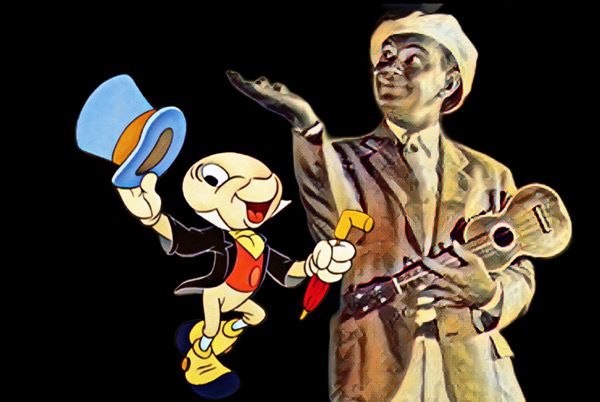
Another frequent misconception is that Fred Astaire inspired the design of Jiminy Cricket. In truth, he was modeled after his own voice actor, Cliff Edwards, known as Ukulele Ike, an American pop singer, musician, and actor famous for his ukulele performances and voice work. His career included vaudeville, numerous films, and additional Disney roles, including Dandy Crow in Dumbo.
On the moral opposite of the story, Charles Judels (as Stromboli and the Coachman) and Walter Catlett (as Honest John) injected humor, menace, and dramatic tension.
Scenes that became cinema history
Some sequences from Pinocchio have become embedded in collective memory. The transformation of mischievous boys into donkeys on Pleasure Island remains one of Disney’s most disturbing scenes — a true moral nightmare. The climax inside and outside Monstro blends emotion and spectacle, supported by animation that still feels modern today.
Although the film faced box-office challenges at its original release — mainly due to World War II limiting its international distribution — decades of re-releases allowed Pinocchio to find its audience and its value. Over time, it not only gained recognition, it became a definitive classic.


A legacy that does not fade
Despite its unstable beginnings, Pinocchio found renewed life in a meticulous 4K restoration now available on Disney+. It has inspired adaptations, reinterpretations, and even philosophical reflections on what it means to become human.
Today, Pinocchio stands as proof of the power of animation and the enduring strength of a well-told story. Its invitation to believe in something greater — honesty, courage, dreams — remains as vivid as it was in 1940. Eighty-five years later, the little wooden boy still shines brightly, like a star determined to light the way for anyone who looks up.
Descubra mais sobre
Assine para receber nossas notícias mais recentes por e-mail.
 miscelana.com
https://youtube.com/@farzaneansari-l5t?si=wf5jo8voTAvanXot
CurtirCurtir