
There is an almost invisible delicacy in the way twin brothers Bryce and Aaron Dessner drifted away — without ever losing one another — from the central axis of The National. After two decades defining what it meant to feel melancholy in an adult, ironic, profoundly human way, the brothers found horizons so wide that even the band seems, today, to exist at a different tempo. Nothing ended; nothing dissolved. It simply transformed.
The National breathes more slowly now, in long intervals, while its principal trio — Bryce, Aaron, and Matt Berninger — move along parallel routes, as if they needed to explore entire worlds before finding each other again.
Watching Bryce and Aaron work on separate projects is to understand something essential: some threads do not break. Even when one is in southern France and the other lives between New York and Long Pond, even when one dives into the orchestra and the other reshapes contemporary pop, even when their careers appear to point in opposite directions, their music keeps meeting in the middle — as if a fraternal gravity were always pulling them back together.
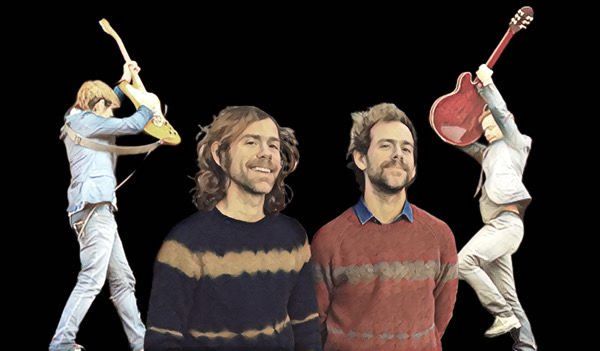
Collaboration as a native language
They share more than a band: they shared the same bedroom until they were eighteen. They grew up composing without knowing how to compose, improvising without knowing they were improvising. And to this day, they say the same thing: “When one of us isn’t there, something is missing.”
That instinct shaped everything.
The Brassland label, created with friends, was born from that philosophy: open doors, community, permeability. Bryce’s ensemble of Clogs became a creative nucleus that quickly seeped into the early years of the band. Then came the PEOPLE (37d03d) collective, co-founded with Justin Vernon, turning artistic residencies into living laboratories.
The result of this ethos? A constellation of musicians woven into their trajectories: Anaïs Mitchell, Sharon Van Etten, Robin Pecknold, Lisa Hannigan, Ben Howard, Taylor Swift — and the dozens of artists surrounding Big Red Machine.
Aaron Dessner and the emotional architecture of contemporary pop
Aaron has always carried an architect inside him. He built the harmonic backbone of The National’s songs, crafting sonic landscapes with patience, repetition, tension, and silence. It was only a matter of time before that instinct found other voices to inhabit.
When Aaron stepped beyond the band to produce, his vocation revealed itself fully. His creative encounter with Taylor Swift was more than a collaboration — it was a generational alignment. Folklore and Evermore didn’t just shift Taylor’s career; they altered the direction of pop music. They proved that intimacy can be monumental, that whispers can hold worlds, that melancholy, when precisely carved, becomes power.

From then on, Aaron became a gravitational center for artists seeking honesty. Long Pond turned into a near-sacred musical space. Ed Sheeran, Gracie Abrams, Sharon Van Etten — big names and emerging voices alike — were drawn to his ability to listen before reaching for anything grand. His work in 2025 reflects that resonance: he has become one of the defining producers of the decade, someone who restores humanity to sound, who creates music that breathes. And something is moving about watching him, far from The National’s stage, find a deeply personal mission — to make the world sound more honest.
Bryce Dessner and the restlessness that became landscape
If Aaron is architecture, Bryce is movement. Onstage, he folds into the guitar, nearly dances, throws himself into phrases with the energy of someone who never accepted stillness. It was natural that this restlessness spilled far beyond the band.
Bryce has become one of the most sought-after names in contemporary classical music. His works travel between orchestras, festivals, and galleries. He composes like someone watching the world through the lens of a restless, finely attuned mind. Collaborations with the Kronos Quartet, the Los Angeles Philharmonic, and major European orchestras show how his voice found its own terrain — expansive, sophisticated, instinctive.
But it was in the cinema that this aesthetic found its most resonant form.

Bryce writes film scores as someone crafting atmosphere. He doesn’t illustrate; he breathes. His music bends narrative, expands silence, ignites gestures. The Revenant placed him alongside Ryuichi Sakamoto and Alva Noto; The Two Popes revealed his spiritual sensitivity; C’mon, C’mon and Cyrano showed his elasticity; She Came to Me solidified his identity; and We Live in Time confirmed the arrival of an immediately recognizable signature.
And in 2025, Train Dreams marks perhaps his most mature phase. The score — delicate, sensory, guided by what remains unsaid — confirms him as one of the essential composers of contemporary cinema. His music carries wind, memory, and a tenderness that never fully reveals itself. He doesn’t accompany images. He transforms them.
The National is an ancestral home
The band never ended. It simply understood that, to keep existing, it needed to let its members expand. And it’s deeply moving to see it this way: while Aaron reshapes the emotional pulse of intimate pop and Bryce redraws the contours of classical and cinematic sound, The National becomes an ancestral home — a place they can always return to more complete, more expansive, more themselves.
The Dessner post-National era is not about separation, but unfolding. Aaron continues with his ear that turns intimacy into architecture, and Bryce continues with his restlessness that turns silence into a landscape.
And this expansion is precisely what makes their reunions onstage so powerful: two brothers, side by side, one with his solid-body guitar, the other with his hollow-body, meeting again not despite their paths, but because of them.

The band is built on two sets of brothers — the Dessners and the Devendorfs — and perhaps that is why it never imploded. While so many groups of their generation fractured, The National always moved with open doors: friends, collaborators, improvisers.
And now, in 2025, after long and fruitful parallel journeys, the brothers say they want something almost disarmingly simple: to return to loud, direct, primal rock. To return to the kind of songs that “just work,” even when no one can quite explain why.
As if everything they learned — the orchestras, the production, the film scores, the musicals — could now be given back to the band that shaped them.
In the end, Bryce and Aaron are this: a duo that expands the musical world only to bring it back home, to The National, where everything began. Two complete artists — somehow even better when they find each other again.
Descubra mais sobre
Assine para receber nossas notícias mais recentes por e-mail.
 miscelana.com