
Isabelle wakes up with a man beside her. When he tries to resume sex, she simply gets up and, without a word, throws him out of her bed. He obeys.
Rosamunde enters as soon as he leaves, praising the Marquise’s “vitality,” but quickly moves to what matters: did Isabelle receive the letter? Merteuil’s fate will be decided the following day, in Versailles.
Valmont’s aunt has little faith in her friend’s chances. According to her, Gercourt already has the King’s approval to strip Isabelle of everything. Nothing, however, shakes Merteuil’s confidence. Instead of fleeing to London, as advised, she decides to confront the King directly. Before that, she burns the checks Rosamunde had written for her. There will be no debt, no dependence.


Like vultures being vultures, Madame de Volanges arrives at Isabelle’s palace to inventory everything before the fall. Their exchange of insults is revealing: Volanges believes Isabelle deceived her brother, but, as she did with Rosamunde, the Marquise refuses to retreat.
Danceny comes to say goodbye to Rosamunde. They share a quiet, restrained moment, a brief emotional pause before the collapse.
Isabelle rehearses how to present herself as a victim in order to secure Valmont’s support. When she arrives at his palace, she finds him with Cécile — now his lover. Valmont resists; his position is far less dangerous than hers. When they are finally alone, he proposes marriage, officially this time. They are interrupted by Danceny, who challenges Valmont to a duel over Cécile. Isabelle, fearless as ever, dares Danceny to shoot her, since she was the one who encouraged Cécile to seek Valmont. Of course, he does not.
Cécile and Danceny reconcile. Valmont then hands Isabelle all the letters they exchanged — the very ones that incriminate her. He claims to be a changed man because he loves her. Isabelle doubts him. The series has strayed so far from the original story (which was perfect) that the final episode becomes nearly impossible to follow for anyone still expecting coherence.
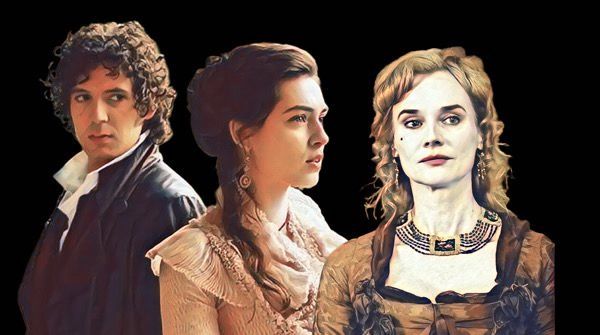
Still, Isabelle and Valmont kiss, passionately, and spend the night together. The same happens with Cécile and Danceny, though the musician demands details of her relationship with Valmont. Jealousy consumes him.
Isabelle dreams of marrying Valmont, but her guests are dressed in mourning. Awake, she wanders the house and encounters Cécile doing the same. She then discovers a letter from Valmont to Rosamunde, celebrating his victory and declaring true love. Valmont catches her reading it, but Isabelle’s interpretation is final: it was all a game. “I made you into a monster,” he says. Isabelle leaves him behind and heads to Versailles.
At the royal palace, Isabelle presents her version of events to the King — in a silent scene where we never hear her words. He absolves her, convinced of her sincerity. Yes, she is now, definitively, the Marquise de Merteuil. Gercourt seethes with rage. Rosamunde smiles, proud. The price is revealed: Isabelle becomes the new mistress of the King of France.


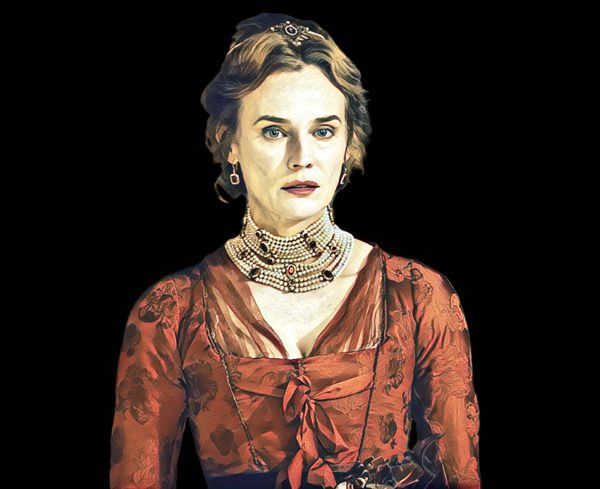
In a farewell letter to Valmont, we learn that he and Danceny dueled, as in the original story. The Viscount deliberately loses, having lost his will to live. His death scene is an homage to Stephen Frears’ film, only inverted: he does not die for Madame de Tourvel, but for the Marquise de Merteuil.
Is this really the version deemed “interesting” for a new audience?
Merteuil – Seduction stands alongside The Buccaneers as one of the greatest adaptation crimes of recent years. It adds nothing, updates nothing, and makes no sense. Not even Hallelujah playing over the final moments can salvage the embarrassment. At least it’s over.
Descubra mais sobre
Assine para receber nossas notícias mais recentes por e-mail.
 miscelana.com
My review of this series will be published in the next couple of days, hopefully.
I admit that I thought the final bit with Merteuil leaving letters on Valmont’s grave was rather moving. (But everything about this show is so ridiculous! Why does Valmont have a tiny tombstone in some cemetery in the woods? He’s a vicomte! He would be buried in the family crypt! But everything about this show is so bad. (I like Vartolomei and Lacoste, but their characters are NOT the Merteuil and Valmont we know from the novel.) And I really had to roll my eyes that they so shamelessly ripped off the “Valmont spaces out during the duel remembering tender moments with the woman he loves” concept from the Frears film, only putting Merteuil/Isabelle in place of Tourvel.
Total waste.
CurtirCurtido por 1 pessoa
Exactly! I had high expectations for an interesting prequel about Merteiul and Valmont, but it turned into a new take on a story that was already perfect from the start. Why does anyone assume they can change what the original author envisioned? It became messy, nonsensical, shallow, and to make matters worse, the acting was terrible. I won’t waste time mentioning the uninspired script or unmemorable lines.
The idea that Valmont loved Merteiul instead of De Tourvel made no sense at all; they even had to “steal”/invert everything he said and felt about one to the other. And quoting Frears’ beautiful scene, which always makes me cry, was almost offensive.
There’s incredible material to develop about Merteiul’s youth (if you use the play/film or the book), but for any adaptation/update, I would expect respect for the author in the sense of maintaining what he wanted to tell. Here he perfectly portrayed the amorality, almost sociopathy, of a bored, rich, and debauched elite, whose wickedness knew no bounds. Merteiul’s arc was to maintain her “wickedness.” There is room for modernization, I agree, because a woman of her time would be judged more harshly than a man (so much so that in the book she ends her days disfigured and ill, as if her inner rot had been externalized), while Valmont had an equally painful journey, but with hints of romanticism and even heroism. He was a victim of his own game, a narcissist who “recovers” after being transformed by pure Love and the remorse of having destroyed the life of an innocent. A shallow and quick summary, but it is in keeping with the writer’s intention: both are punished, but their transformation differs.
The fact that in the theatrical/filmed version Merteiul acts because she’s jealous and in love with Valmont (I disagree that it was “love”) or because, as a woman, she was offended by being passed over for someone who is her opposite, kind of “hinders” those who want to “update” Dangerous Liaisons. I still believe that Merteiul’s youth story has potential, but she wasn’t a prostitute (like the Starz series) or a social climber (like The Seduction). She was a noblewoman who learned the game of men and was dangerous precisely because she seemed “perfect” and was so cruel.
In short, The Seduction became the same mess as The Buccaneers. The writers deserved better!
CurtirCurtir
Hey, sorry I forgot to reply to you. A little late but here is my own review of the entire series!
https://www.thebulwark.com/p/the-marquise-de-metoo-the-seduction-hbo
CurtirCurtir