
You can pretend otherwise, but you can argue that the countless paparazzi photos of John F. Kennedy Jr. and Carolyn Bessette leaving parties and restaurants already tell the whole story. However, nothing compares to their legendary public physical fight. That sequence, captured by photographers, was not just a celebrity scandal. It felt like a preview of an entire culture built on exposing private lives, almost a rehearsal for the reality-TV era that would dominate the following decade. For that reason, among all episodes of Love Story, this was always the one audiences were waiting for.

The series does try to protect its protagonists, softening or omitting aspects of real life that still intrigue those who followed their story closely, including the murky overlap between John’s relationship with Daryl Hannah and the beginning of his involvement with Carolyn. Even so, one idea remains intact and runs through the entire episode: marrying into the Kennedy family means stepping into a global arena of permanent judgment. The warning often attributed to Jackie, that such a fate is not for everyone, plays less like melodrama in hindsight and more like a diagnosis. “Battery Park,” the fifth episode, turns that premise into a narrative.
When we reunite with John and Carolyn, they seem to be in the most seductive yet most fragile phase of a relationship. They are living together, already sharing small domestic rituals with their dog, Friday, behaving like an established couple, yet still clinging to the illusion that they can manage their public image. The episode explores this contradiction through everyday gestures. Carolyn learns to anticipate John’s absent-mindedness, grabbing the wallet he would otherwise forget, and she also learns the almost military logistics of leaving the building without feeding the paparazzi frenzy. They exit separately. John serves as a distraction while she walks to work alone, trying to preserve a sense of normalcy that no longer exists.
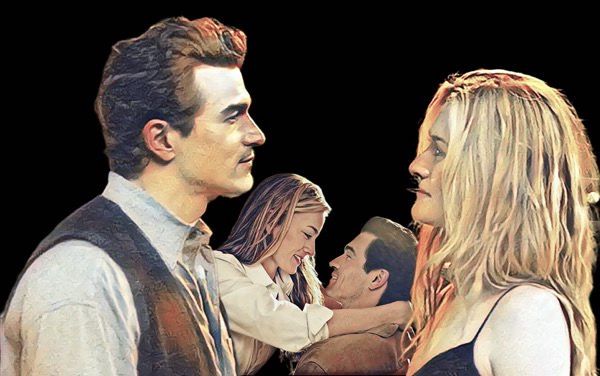
For a brief moment, the tactic seems to work, which makes it all the more unsettling. This isn’t only about the invasion of privacy but about what we would now call narrative control. The press decides when to see you and when to erase you. Inside Calvin Klein, that becomes both a practical and symbolic irritation. Friends complain not just about the lack of photos but about tabloids repeatedly misspelling her name, as if she were interchangeable. The comparison to an “American Diana” emerges as inevitable rather than complimentary. It speaks not of glamour but of pursuit.
The pressure, however, does not come solely from outside. It also comes from work and from the way John responds when life demands discipline instead of charm. While Carolyn prepares to meet the family in Hyannis Port, Michael Berman is exhausting himself to launch George magazine. The contrast works because it is understated. John can postpone, promise, and trust that everything will fall into place, while his partner absorbs the real burden of the project. It is not merely about personal responsibility. It is a portrait of someone whose life has always allowed others to hold the structure together behind the scenes. Love Story touches this vulnerable point in the myth of the “American prince” without spelling it out.
Hyannis Port then becomes an initiation ritual stripped of romance. The episode makes clear that loving John inevitably means confronting an institution far larger than him. Ethel Kennedy assumes the role of matriarch and turns a family dinner into something resembling an informal political examination. The discomfort comes not only from the difficulty of answering but from the lack of warning. John knows the unspoken rules but does not prepare Carolyn for them. She discovers that private scrutiny can be just as unforgiving as public scrutiny.

This behavior highlights one of the episode’s most compelling aspects. John is not portrayed as a villain, but as someone so shaped by his environment that he no longer perceives how hostile it can be to outsiders. The show hints at obliviousness, yet the repetition makes it feel less like innocence and more like an unconscious test. The outcome is the same: Carolyn must prove she can endure.
It is in this already emotionally draining context that the proposal occurs. The setting is meaningful, the gesture steeped in memory, and the proposal feels driven more by emotional urgency than careful planning. For Carolyn, however, the question is not simply whether she loves John. It is what becoming part of that family and its public mythology would demand of her identity. Her hesitation reflects not lack of feeling but excess of clarity.
When her uncertainty leaks to the press, the private crisis instantly becomes a public and professional one. Days before the magazine’s launch, narrative control becomes paramount, and John chooses to deny the engagement in an official statement. The decision is devastating precisely because it contradicts his promise to protect their private life. Carolyn watches alone as their relationship is reframed as a communications strategy. When he returns home, she pretends to be asleep. It is a small detail that encapsulates a profound rupture of trust.

The explosion in Battery Park follows as an inevitable consequence. The series reconstructs the fight immortalized in photographs, with shouting, shoving, and insults exchanged under the gaze of a distant camera. New York, a city known for granting anonymity amid chaos, offers them no such refuge. The conflict becomes spectacle in real time.
In parallel, the episode suggests a mirror between Carolyn and the marriage of Kelly and Calvin, implying how relationships shaped by power imbalances can reduce a woman to a secondary role within her own life. It works as social commentary, though at times it feels somewhat overemphasized, as if the series wants to ensure the metaphor is unmistakable.
The ending leaves a lingering unease. Carolyn accepts the proposal, yet the narrative does not clearly articulate what shifted within her after the relationship’s most traumatic moment. It feels as though the script must arrive at the historical milestone familiar to audiences and then attempt to fill the emotional gaps afterward.
Still, “Battery Park” succeeds in one crucial respect. By turning the fight into a consumable event and positioning viewers as witnesses to exposed intimacy, the episode raises an uncomfortable question about the consumption of personal tragedy. It is not only about condemning photographers. It is about acknowledging the demand that sustained those images. Ultimately, the series suggests that John and Carolyn’s story was not merely destroyed by exposure. It was also fueled by it, until love and public punishment became indistinguishable.
Descubra mais sobre
Assine para receber nossas notícias mais recentes por e-mail.
 miscelana.com