
Ten years later, what impresses me most about The Crown is not its budget, nor its Emmys, nor even the meticulous production design that became one of the show’s signatures. It is the way the series chose to end.
There is something deeply coherent in the fact that the story does not conclude with the death of Elizabeth II. Instead, it stops earlier, in 2005, with the wedding of Charles III and Camilla. It ends at the moment when the institution, after decades of scandals, losses, and public crises, attempts to stabilize itself once again. The choice is not evasive. It is conceptual.

Peter Morgan has always said he needed to maintain distance from the present. The series, he often explained, moved like a train advancing roughly a decade each season, but it should never arrive at the station of the present day. The original intention was to cover the longest-reigning British monarch, since Elizabeth II spent no less than 70 years on the throne, and conclude somewhere around the Platinum Jubilee. But then the pandemic intervened, production slowed, and events inside the royal family began to unravel in ways that made the present far more dramatic, and perhaps more tempting for dramatization, than the past the series had set out to explore.
So when Elizabeth died in 2022, while the final season was still being filmed, the present quite literally entered the set. The final episode had to be reconsidered. Not to include her death, but to acknowledge that it was already there, hovering like a shadow.
Even before that ending, however, The Crown had already done something significant in the way it portrayed figures who remain central to the monarchy today. The series offered a far more sympathetic portrait of the young Charles than the one that dominated public imagination for decades. The prince depicted on screen is often insecure, emotionally pressured by institutional expectations, and caught between duty and desire. The long-standing image of a cold man who deliberately broke the heart of Diana Spencer was softened. This does not absolve his choices, but it contextualizes them. At a moment when the current king’s popularity remains relatively modest, that reinterpretation had a real cultural effect. For many viewers, The Crown helped reintroduce Charles as a tragic figure before he was perceived as a villain.

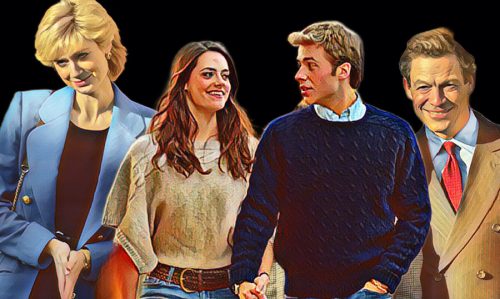
Diana’s inevitable passage through the series was also handled with unusual care. The show avoided the trap of turning the story into a moral tribunal. Unlike many recent cinematic portrayals, such as Spencer or Diana, The Crown attempted to balance the forces at play. Diana appears vulnerable, charismatic, and profoundly lonely, but also caught within a family and institutional dynamic that no one seemed capable of managing. That refusal to fully vilify either side may be one of the series’s greatest dramatic achievements.
It was also within this arc that some of the production’s most memorable talents were either discovered or cemented. Josh O’Connor created a young Charles filled with fragility and restrained ambition. Emma Corrin, then virtually unknown, turned Diana into a luminous and restless presence. Later came Elizabeth Debicki, whose portrayal of the princess reached an almost uncanny level of emotional resemblance. And there was also the striking presence of Emerald Fennell as the young Camilla Shand, capturing the blend of irony and determination that would define the character’s path.
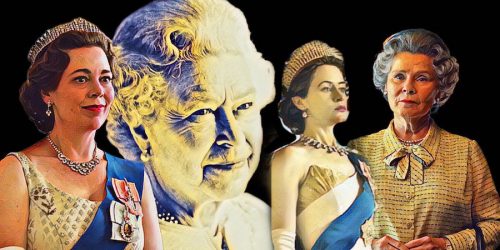
Yet perhaps the first major acting impact of the series came even earlier, with Claire Foy. Her portrayal of the young Elizabeth established the emotional tone that the entire show would follow. Among the three actresses who played the queen, Foy ultimately drew the most immediate critical attention when the series first premiered. There was something almost paradoxical in her performance. She was portraying a woman destined for the grandest institutional stage in the world, yet she did so with restraint, introspection, and a deeply accessible humanity. That approach was decisive in allowing audiences to connect with the character. The later performances by Olivia Colman and Imelda Staunton brought new layers and remarkable sophistication, but it was Foy who defined the interpretive key of the series and, in many ways, set the standard that the others would inherit.
Curiously, while The Crown showed great willingness to explore emotional conflicts within the monarchy, it was also selective about which scandals it chose to emphasize. The problems involving Prince Andrew and Sarah Ferguson appear only briefly, despite the fact that they were already known during the period the show depicts. Today, those controversies are often cited as part of the monarchy’s most serious institutional crisis since Diana’s death. The series chose not to make them a central narrative axis, a decision that reveals both a dramatic preference and a certain political caution.
There is also a kind of parallel universe that the series might have explored more directly. In recent years, especially after the memoir published by Prince Harry, much has been written about tensions between him, his father, and his brother. Although The Crown hints at some of these fractures, it avoids dramatizing them too explicitly. At the same time, the show presents a relatively sympathetic portrait of Prince William and Catherine, Princess of Wales, framing them as part of a younger generation capable of renewing the monarchy’s public image.
What the series ultimately does, then, is something more sophisticated than depicting a biographical ending. It stages the awareness of an ending. The preparation for the funeral, the protocol of Operation London Bridge, the meticulous miniature model of the procession, the soldiers in reduced scale, every regiment, every medal. The technical obsession is not merely production flourish. It is a metaphor. The monarchy is precisely this: a system capable of organizing even its own farewell.
And then comes the scene that, for me, encapsulates the entire project. The three queens are in the same room. Claire Foy, Olivia Colman, and Imelda Staunton are staging an internal dialogue. It is not fan service. It is a dramaturgical thesis.
The young Elizabeth insists that duty is not optional. The middle-aged Elizabeth recognizes the exhaustion. The older Elizabeth wonders whether it might finally be time to abdicate. Abdication never happened in real life. But the doubt, as an idea, matters more than the fact. Because what is being dramatized here is not a historical event. It is an intimate conflict: whether to continue when your entire life has been defined by continuity.
That scene works because the series, from the very beginning, accepted something that almost no production dares to accept: characters change bodies. Identity is not fixed. By replacing its cast every two seasons, The Crown turned time itself into language. It did not try to disguise youth with makeup or freeze a single performance. It aged. It restarted. It reinterpreted. And, in the end, it turned that very structure into its farewell.
There is also something deeply delicate in the choice to conclude with Elizabeth and Philip talking about being buried together. After sixty episodes about power, politics, empire, constitutional crises, and scandal, the final gesture is intimate. Two people reflecting on what remains when the office is no longer the center. It reveals the true obsession of the series: not pomp, but cost.

The piece “Sleep, Dearie, Sleep,” suggested in the episode as a possible lament, was in fact played at the queen’s funeral in 2022. That coincidence creates a fascinating fracture between fiction and reality. The series did not reach the end of the queen’s life within its chronology, yet symbolically it reached the ritual. As if it understood that British power ultimately rests on ceremony, and that ceremony is where past and present quietly merge.
If anything defines these ten years, it is this. The Crown did not simply tell the story of a monarch. It shaped how a generation understands that story. It turned archival history into emotion. It converted protocol into drama. And by ending before the biographical conclusion, it made a rare gesture: it refused the spectacle of death and chose instead to reflect on time.
In a world that demands explosive endings, it chose an internal debate.
And perhaps that is its greatest elegance.
Descubra mais sobre
Assine para receber nossas notícias mais recentes por e-mail.
 miscelana.com