
What you need to know
Zelda is the woman from Tommy Shelby’s past with whom he had a child before World War I. Her story is first revealed in the final season of the series. It resurfaces in Peaky Blinders: The Immortal Man through her sister, Kaulo, reconnecting the film to the Romani world and to a forgotten part of the Shelby origins.

Among the narrative additions in Peaky Blinders: The Immortal Man, the twins are the one character in particular who appears almost like an apparition from the past. Played by Rebecca Ferguson, she is connected to the Romani world that has always hovered around Tommy Shelby’s story but was rarely explored in depth throughout the series. Her name is Kaulo Chirklo, and her presence opens a new layer of the Shelby family mythology by revealing a figure who had until now only been hinted at: Zelda, the Romani woman who had a child with Tommy before the First World War.
The distinction between Kaulo and Zelda is essential to understanding this part of the narrative. Kaulo is the character who appears in the present timeline. Zelda belongs to the past. The two are sisters and come from the same itinerant Romani community that has existed on the margins of the series’ social world since the first season. It was within that environment that Tommy had a relationship with Zelda while he was still very young, before leaving for war in 1914.

From that relationship was born Erasmus “Duke” Shelby.
For years, Duke grew up far from the Shelby family’s world. While Tommy built his criminal empire in Birmingham and later became increasingly involved in politics, war, and economic power, the boy was raised within Romani communities living on the fringes of industrial cities. Zelda raised him far from that world and far from Tommy himself.
Her death changes that balance.
When Zelda dies, Duke continues to grow up within the Romani community, surrounded by people who know his origins and his story. This detail helps explain something that always seemed somewhat mysterious in the series: how Esme Shelby was able to find Duke and why she appeared to know so much about the young man’s past when she finally introduces him to Tommy in the sixth season.
Esme belongs to that same Romani world. After John Shelby’s death, she leaves Birmingham and returns to an itinerant life. Within that context, she remains connected to the stories, family ties,s and secrets Tommy left behind. Duke was never a stranger to that world.
Kaulo’s appearance in the film expands that dimension even further.
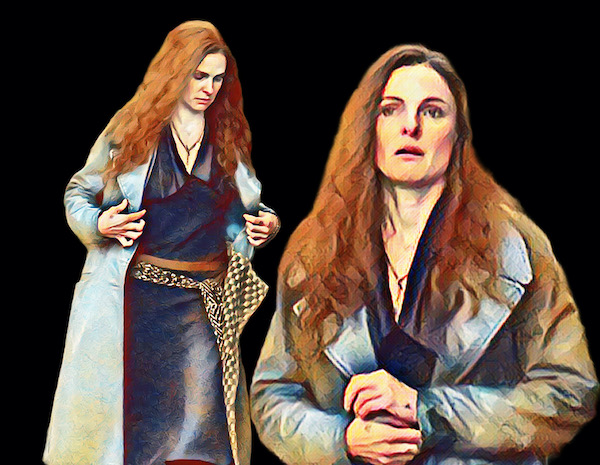

As Zelda’s sister, Kaulo has direct knowledge of Tommy’s past. She also knows Duke’s story from before he ever entered the Shelby world. Her position within the narrative is not only familial, but also symbolic. The character is tied to the spiritual dimension of Romani tradition that the series frequently invokes, but rarely fully develops.
It is precisely at this point, however, that the construction begins to reveal its fragility. Kaulo’s presence carries clear symbolic weight, but her motivation within the story remains diffuse. The film suggests that her connection to Duke is natural, almost inevitable, as if blood and belonging alone were enough to justify her intervention. And yet, it avoids answering the most basic — and most necessary — question: what does she stand to gain by acting now?
This absence does not invalidate the character’s function, but it does alter the way she holds together dramatically. Kaulo operates more as a key to reading the past than as an agent with her own interests in the present. Her presence reshapes the meaning of the story, but does not, in itself, generate new conflict.
From its earliest seasons, Peaky Blinders suggests that Tommy Shelby lives divided between two worlds. On one side lies the modern, industrial universe of Birmingham, where money, politics, and violence structure power. On the other hand lies the Romani heritage, which appears through rituals, omens, and stories of curses passed down through generations.
Kaulo clearly belongs to this second world.
Her presence in the narrative serves almost as a reminder that Tommy never completely severed his ties to his origins. Throughout the series, he moves further and further away from Romani traditions, often treating them as superstition or folklore. Yet it is precisely that world that returns at the most decisive moments of his life.
It happened with the omens surrounding Ruby. It happened with the story of the blue sapphire. And it happens again when Zelda’s past returns through Kaulo.

The character also reinforces an important element in Duke’s story. The young man has always been presented as different from the other Shelbys. He grew up outside the family structure dominated by Tommy and his brothers. His upbringing took place in an environment far closer to Romani tradition than to the violent and entrepreneurial logic that shaped Birmingham in the decades after the war.
This means that Duke carries an identity that Tommy, in many ways, abandoned.
By introducing Kaulo into the story, the film also brings back this forgotten part of the Shelby history. She becomes a bridge between past and present, between Zelda and Duke, between the Romani world and the empire Tommy built far away from it.
There is also a symbolic dimension to this narrative choice. Zelda, the woman who had a child with Tommy before the war, belongs to a moment in his life before he transformed into the man who would dominate Birmingham. Kaulo, her sister, appears years later to confront him with that memory.

Her presence makes it impossible to ignore that part of Tommy Shelby’s story has always existed outside the control he tries to exert over the world.
And that may be precisely why Duke becomes so important at the end of this journey. He does not simply represent a new heir to the Shelby name. He represents the connection to a past Tommy spent his life trying to leave behind, but which keeps returning, as if it has always been waiting to be acknowledged.
In the end, Kaulo functions less as a character who actively drives the narrative and more as a presence that reinterprets it. Through her, The Immortal Man revisits a part of Tommy Shelby’s past that had remained at the margins, bringing it back into focus with undeniable symbolic force. And yet, it is precisely in this imbalance between meaning and action that the film reveals one of its most ambiguous choices. By privileging Kaulo as a vessel of memory rather than as a fully realized agent, the story gains resonance but loses dramatic tension, leaving behind a character who is compelling to read, even if not entirely convincing to follow.
What is at stake here is not only the story itself, but the way it is constructed, perceived, and ultimately understood. Narrative is never neutral; it is shaped by choices, by omissions, by what is allowed to surface and what remains just out of reach. Read more here.
Descubra mais sobre
Assine para receber nossas notícias mais recentes por e-mail.
 miscelana.com
1 comentário Adicione o seu