
As published in Bravo Magazine
The Oscar season is usually dominated by debates about performances and directors, but there is a category that quietly reveals a great deal about the state of cinema: music. The nominations for Best Original Score and Best Original Song at the 2026 Oscars offer a curious snapshot of the industry. On one side are composers already well established within the Academy; on the other are artists arriving at the ceremony for the first time after years influencing the sound of contemporary cinema.
Among this year’s nominees are names such as Ludwig Göransson, Alexandre Desplat, Jonny Greenwood, Jerskin Fendrix, and Max Richter. Each represents a different moment in the recent history of film music.

Fendrix is probably the least familiar name on the list. Before reaching the Oscars, he built a career within Britain’s experimental music scene and caught the attention of filmmakers through his collaboration with director Yorgos Lanthimos on Poor Things. His nomination now signals the arrival of a new generation of composers who come to cinema from indie, electronic, and contemporary classical music.
The most emblematic case may be Göransson. The Swedish composer has become one of the central figures in Hollywood over the past decade and has already won the Oscar for Best Original Score twice. The first came with Black Panther in 2019, a score celebrated for the way it incorporated African rhythms and instruments into Hollywood’s symphonic tradition. The second arrived only a few years later with Oppenheimer, whose music — built around solo violin and electronic textures — became one of the film’s most memorable elements.
That track record helps explain why many analysts consider Göransson the favorite once again, now with the score for Sinners. The Academy often rewards composers who enter a kind of dominant phase, something that has happened in the past with figures such as Alan Menken during the peak years of Disney animation, or with Alexandre Desplat himself.

If Göransson represents the composer at the height of his consolidation in 2026, the veteran Alexandre Desplat symbolizes the opposite: he has become almost a permanent presence in awards races. The French composer, who has also won two Oscars — for The Grand Budapest Hotel and The Shape of Water — has spent more than a decade as a constant figure in the category. His nomination this year for Frankenstein reaffirms that position.
For indie rock fans, another recurring name in the race is Jonny Greenwood, known worldwide as the guitarist of Radiohead. Over the past fifteen years, he has established himself as one of cinema’s most innovative composers. His scores for directors such as Paul Thomas Anderson have redefined the use of strings and experimental textures in film narrative. His compositions are rarely “easy” or guided by memorable melodies, and despite two previous nominations, Greenwood has yet to win an Oscar — a detail that often fuels the expectation that the Academy will eventually recognize his contribution.
Among the nominees, however, there is also a presence that many consider long overdue: Max Richter. If I had a vote, he would be my choice for Hamnet.
Max Richter and the nomination that took years to arrive
For a long time, Max Richter seemed like one of those composers whose influence was greater than his recognition in awards. Born in Germany and raised in the United Kingdom, he built his career in the territory of contemporary classical music, blending minimalism, electronics, and orchestral writing.
His work became widely known long before any Oscar nomination. Pieces such as “On the Nature of Daylight” began appearing in numerous films and television series, while ambitious projects such as the album Sleep — an eight-hour composition designed to be listened to while sleeping — transformed his name into a reference point within contemporary music.

In audiovisual storytelling, Richter had already left a mark on major productions such as The Leftovers, whose minimalist score became a central element of the series’ emotional identity, as well as films like Mary Queen of Scots and Ad Astra.
Even so, his official entry into the Oscar race only happens now, with the score for Hamnet. For many industry observers, the nomination functions almost as a gesture of recognition for a career that has already profoundly influenced the sound of contemporary cinema.
The problem? The film’s most striking scene uses “On the Nature of Daylight”, one of Richter’s earlier compositions. Purists may argue that the piece was not originally written for Hamnet and that it has already had a similar impact in films such as Shutter Island and Arrival.
I would very much like to see Richter — or Greenwood — recognized on Oscar night, but neither appears among the current favorites.
The other race: original songs
If the score category often reflects the state of film music, Best Original Song reveals another dynamic: the intersection between cinema, the music industry, and pop culture. Because it includes live performances, the category often produces some of the ceremony’s most memorable moments — and, already this year, controversial ones.
“For time reasons” — and because “we have a new category (Best Casting)” — the Academy decided that only two of the five nominated songs in 2026 will be performed live on stage, confirming that the real competition lies between them: Golden and I Lied to You. According to the producers, the remaining songs will be presented “through a personalized package built from images of the film for which [the song] was written, firmly anchoring the music in its cinematic purpose.”
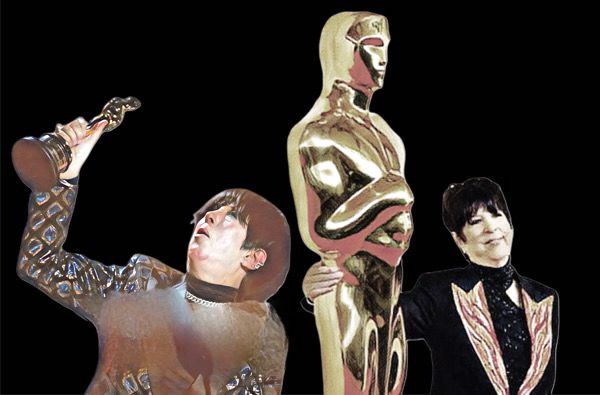
The decision angered Diane Warren, a frequent presence at the ceremony now receiving her 17th nomination. “It’s unfair to my fellow nominees and to me,” she said. “Put all the songs on. Either all of us or none of us — that’s how it should be. You should be fair to all the artists.” Warren has never won competitively, although she received an honorary Oscar in recognition of her career a few years ago, and she remains one of the most influential figures in American pop songwriting.

The “cut” also means that we will not see Nick Cave and Bryce Dessner, of the band The National, on stage. Their collaboration for Train Dreams marks the first nomination for both artists. Nor will there be a live performance of the operatic Sweet Dreams of Joy, composed by Nicholas Pike for the documentary Viva Verdi!. The piece was originally written in 2017, but managed to enter the final list after it was proven that this version had been specifically created for the film.
With this strategic decision, the Oscars effectively confirm that the race appears concentrated between Golden, from the film KPop Demon Hunters — which has already won the Grammy — and I Lied to You, from the film Sinners. In particular, the latter musical number will feature several guest performers, including ballerina Misty Copeland, suggesting that the production intends to recreate on stage the film’s most impressive sequence.
It is worth remembering that I Lied to You is much more than simply a musical number in Sinners. The song functions as the symbolic center of the story and helps explain several of the screenplay’s themes, presenting the blues as the spiritual and cultural root of Black American music and connecting past, present, and future within a single sequence. It will likely become one of the night’s most memorable moments.
Still, with a Grammy already under its belt, it will be difficult to defeat the global fever of K-pop.

A portrait of cinema’s current moment
Taken together, the musical nominations of the 2026 Oscars reveal an interesting moment of transition in Hollywood. Composers such as Göransson share space with veterans like Desplat and with artists coming from other musical worlds, such as Greenwood and Richter — something that is also reflected in the Best Original Song nominees.
It is a balance that says a great deal about contemporary cinema. Film music remains deeply connected to the symphonic tradition that defined Hollywood in the twentieth century, but it increasingly incorporates influences from minimalism, electronic music, indie culture, and even global pop.
In other words, this year’s Oscar music race is not merely a competition between scores and songs. It is also a small portrait of cinema’s own sonic transformation.
Descubra mais sobre
Assine para receber nossas notícias mais recentes por e-mail.
 miscelana.com