
Moulin Rouge! turns 25 as one of the films that best capture a shift in cinematic language in the 2000s. When it premiered in 2001, the musical felt like a displaced genre, tied to another era and to different forms of staging. Baz Luhrmann not only brings it back, but also reshapes it through a contemporary lens, blending references, accelerating the editing, and bringing cinema closer to the aesthetics of pop music.
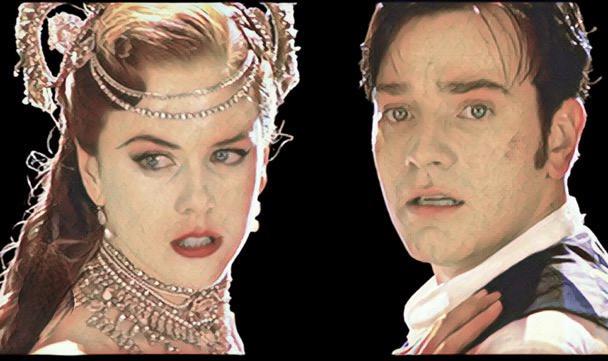
It is no coincidence that this anniversary arrives with a symbolic gesture that reinforces that reading. In March 2026, Nicole Kidman and Ewan McGregor reunited on the Oscar stage and performed “All You Need Is Love,” one of the film’s most emblematic moments. The scene does not function merely as nostalgia. It reframes Moulin Rouge! within a clearer historical line, as a turning point between the classical musical and everything that followed.
Before it, the genre survived in fragmented form, often confined to Disney animation or to films where music existed more as accompaniment than as narrative structure. Moulin Rouge! reorganizes that logic by embracing a musical that does not try to look classical, nor ask for permission to exist. It asserts itself as excess, as collage, as spectacle.

This aesthetic choice does not emerge in isolation. Luhrmann draws from opera, especially La Bohème, from literary melodrama, from European cabaret, and from classical cinema, but filters everything through a sensibility shaped by 1990s music videos and global pop culture. The result is a film that operates as a kind of emotional translation across centuries, in which a drama set in 1899 is told through songs the audience immediately recognizes.
It is in this gesture that Moulin Rouge! redefines the musical. By using pre-existing popular songs, the film builds a jukebox musical that does not depend on the novelty of its music, but on the way those songs are re-signified within the narrative. Elton John, Madonna, Nirvana, Queen, and David Bowie coexist within the same story, creating an immediate sense of recognition that brings the audience closer and dissolves any historical distance.
This strategy not only updates the genre but also reshapes the relationship between performance and camera. Unlike classical musicals, which favored long takes to preserve the integrity of dance, Moulin Rouge! embraces rapid cuts, fragmentation, and a visual energy that directly echoes MTV language. The average shot length, under two seconds, creates a sense of vertigo that turns each musical number into a sensory experience.
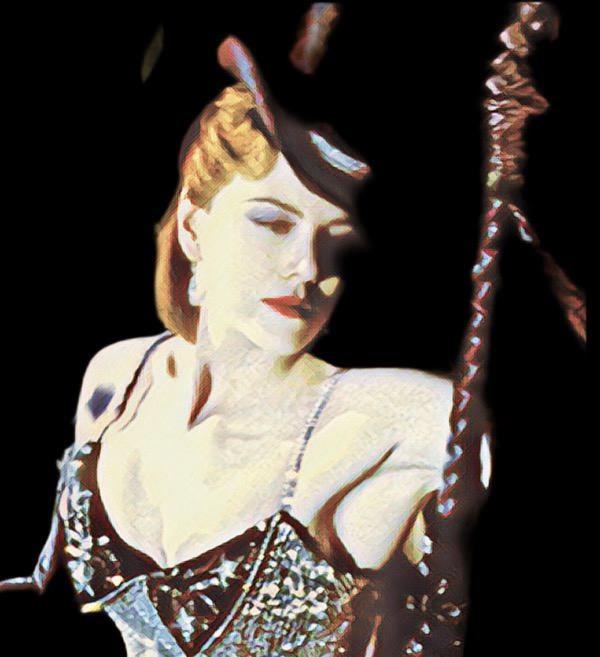
Within this universe, Nicole Kidman finds a turning point in one of her finest roles. Until then, often defined in relation to her public image, including her relationship with Tom Cruise, she takes on Satine as a role of total exposure. She sings, dances, endures intense physical demands, and builds a character suspended between glamour and extreme fragility. During production, largely shot in Australia, Kidman broke ribs, suffered a knee injury, and still sustained the performance’s intensity.
That effort translates into immediate recognition. Her Academy Award nomination for Best Actress repositions her career and opens the path to more complex roles in the years that followed. More than that, Moulin Rouge! shifts the industry’s perception of what major film actors could do. Singing and dancing cease to be exceptions and become a viable part of mainstream cinema.
The casting of Ewan McGregor as Christian follows the same logic of transformation. Before him, names like Leonardo DiCaprio and Heath Ledger were considered, but Luhrmann was looking for someone who could sustain both the romantic and musical dimensions of the role. McGregor delivers that balance and becomes the emotional anchor of a film that, by design, flirts with excess.
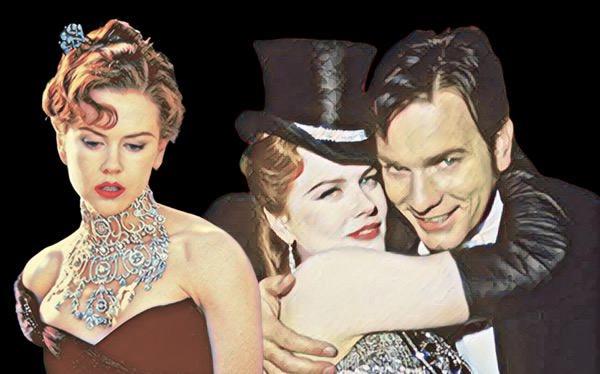
Around them, the film builds numbers that would quickly become iconic. “Lady Marmalade” opens the spectacle as a visual manifesto. “Elephant Love Medley” encapsulates the film’s logic by stitching together decades of pop music in a single sequence. “El Tango de Roxanne” translates jealousy into choreography. And “Come What May” becomes the emotional core, even though it was originally written for another Luhrmann project, the movie Romeo+Juliet, which made it ineligible for the Best Original Song Oscar.
These moments help explain why Moulin Rouge! is not only a critical and commercial success, but also a work constantly revisited and reinterpreted. Released in 2001, the film grossed around 179 million dollars worldwide and received eight Academy Award nominations, winning for production design and costume design. More important than the numbers, however, is the way it repositions the musical within the industry.
In the years that followed, its impact became increasingly clear. Chicago, Dreamgirls, La La Land, and even more recent productions all engage, directly or indirectly, with the aesthetic freedom of Moulin Rouge! introduced. The idea that a musical could be simultaneously classical and pop, sophisticated and accessible, begins to define a new phase of the genre.
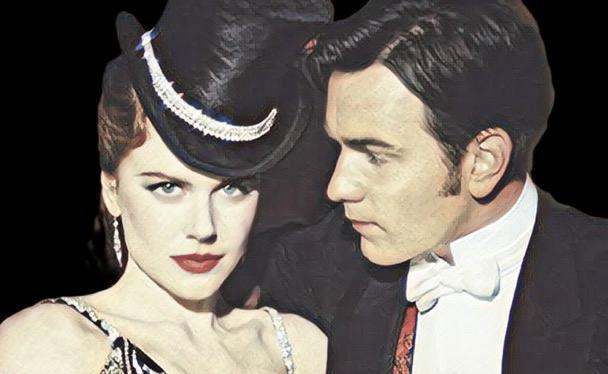
Twenty-five years later, that legacy feels even more visible. Its return to theaters in 2026, with special screenings across Europe, and the reunion of its main cast at the Oscars are not just celebrations. They act as confirmation that Moulin Rouge! was not an isolated stylistic outlier, but the beginning of a new way of thinking about the musical in cinema.
At the center of it all remains the same promise the film transforms into a credo: that love can be lived as spectacle, but also as loss. And that is when the story ends, what remains is not only the memory of what was lived, but the way we choose to tell it.
If Moulin Rouge! helped redefine what a movie musical could be, it also helps explain why the genre remains in constant reinvention, sometimes getting it right, sometimes getting lost between reverence and excess. It is a movement that becomes clear when we look at more recent productions and at the difficulty of balancing music, narrative, and identity, as we discuss in this other Miscelana piece.
Descubra mais sobre
Assine para receber nossas notícias mais recentes por e-mail.
 miscelana.com