
As published on Caderno B+
There is something curious about Brazilian football talk shows. They still occupy an important place in sports coverage, yet they often seem trapped in a formula that has barely changed in decades. The image remains familiar: commentators gathered to discuss lineups, refereeing decisions, tactical systems, and players’ statements while audiences, increasingly accustomed to the speed of social media and fragmented attention spans, look elsewhere to join the conversation.
That may be why That Championship (Aquele Campeonato), Porta dos Fundos’ new project for the 2026 World Cup, is one of the most interesting initiatives to emerge around the tournament so far.
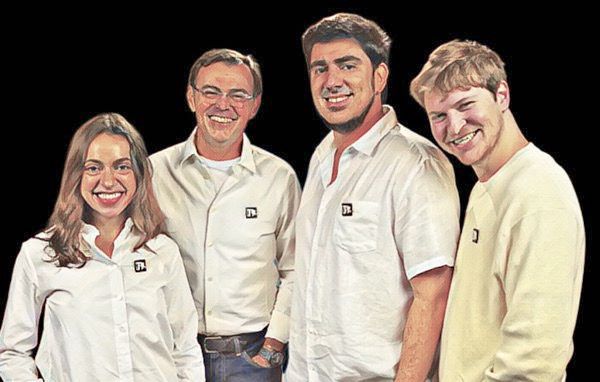
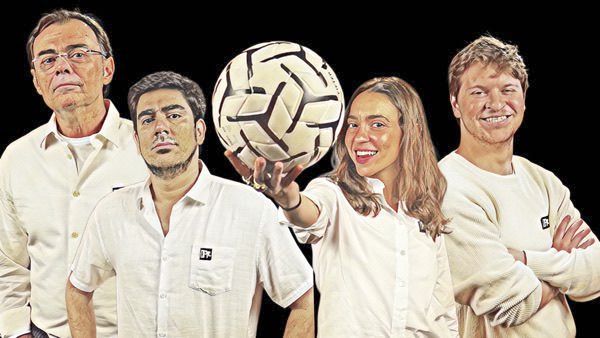
At first glance, the premise sounds simple. Bring together Tino Marcos, Marcelo Adnet, Rafael Saraiva, Valentina Bandeira, and Leandro Ramos to comment on the World Cup in a show airing every Monday, Wednesday, and Friday at noon, distributed through Porta dos Fundos’ YouTube channel, Porta TV, Spotify, and social media clips.
What makes the project fascinating, however, is not the cast or the platform. It is the limitation that gave birth to it.
Without official rights to the competition, the group decided to transform the absence of authorized images, branding, and references into part of the show’s very language. According to Daniel Nascimento, Porta dos Fundos’ Head of Content, the team discovered that they could not even use certain terms associated with the tournament.
“We’re commenting on the biggest football event in the world without being able to say the name of the event, without showing any footage and without being allowed to use some of the competition’s official terms.”
That impossibility is precisely where That Championship got its name. The title works as a joke, but also as a mission statement. Rather than pretending those restrictions do not exist, Porta decided to place them at the center of the concept.
The discussion became even more interesting when it moved beyond football and into the nature of comedy itself. Asked about turning legal limitations into a creative tool, Marcelo Adnet argued that scarcity often produces more interesting results than abundance.
“Humor works better with limitations.”
He recalled that much of comedy is born from the need to find unexpected solutions to seemingly impossible problems.
That observation helps explain why the project feels closer to digital culture than to traditional sports television. While many programs still try to reproduce a model designed for a different era, That Championship starts from the premise that the World Cup is not merely a sporting event. It is a cultural, social, and behavioral phenomenon.
The makeup of the cast reflects that idea. Valentina Bandeira noted during the press conference that she has spent the last several years covering major sporting events without necessarily focusing on the games themselves. Her interest lies in the side stories, the human narratives, and the conversations that emerge around the competition. Rafael Saraiva echoed that perspective, saying the show intends to explore supporters, behavior, culture, and the small narratives that transform a sporting tournament into a global event.
Perhaps no one summarized this shift in perspective better than Tino Marcos himself.
After decades of participating in broadcasts, reports, and sports panels, the veteran journalist admitted that part of traditional sports coverage has lost its freshness.
“From my point of view, my bubble has become a little boring. The format has become a little tired.”
The statement is striking precisely because it comes from someone who helped shape the way Brazilians consumed football for decades. And perhaps it is that experience that allows Tino to recognize a change that is already underway. Audiences remain deeply interested in the World Cup, but they are not always interested in hearing the same discussions repeated endlessly across different channels.
The most revealing moment of the press conference, however, came when the conversation shifted away from the pitch and toward the people covering the event.
Asked about the romanticization of World Cup coverage, Tino dismantled one of the most persistent myths surrounding the tournament. Many viewers imagine that journalists sent to the World Cup enjoy a privileged experience, fully immersed in the atmosphere and closely following every match. According to him, reality is often quite different.
“Reporters don’t actually watch the World Cup.”
He went on to explain that between live hits, recordings, press conferences, special programs and the demands of multiple platforms, there is very little time left to watch what is happening on the field. In many cases, the people covering the World Cup end up seeing less of the tournament than those watching from home.
That may be why the journalist appeared so enthusiastic about the new project.
“I’m going to love sleeping in my own house, being able to watch the World Cup matches and still sit alongside these wonderful people.”
The line may sound like a joke, but it reveals something larger. In 2026, the most innovative thing about sports coverage may not be having more access, more footage, or more information. It may simply be accepting that the World Cup has always been bigger than all of that.
It is a sporting event, certainly. But it is also a collective ritual, a national conversation, an explosion of identity, belonging, humor, and memory. And perhaps the greatest insight behind That Championship is the recognition that talking about the World Cup without being able to show the World Cup may end up revealing aspects of the tournament that traditional coverage stopped noticing a long time ago.
Descubra mais sobre
Assine para receber nossas notícias mais recentes por e-mail.
 miscelana.com