
Nearly 50 years ago, a group of London actors who had first met while working on Hair debuted a small, low-budget musical that satirized classic sci-fi and horror films. They struck gold.
The Rocky Horror Show, written by actor and composer Richard O’Brien, became a phenomenon almost as soon as it opened at the Royal Court Theatre. With limited seating and sold-out performances, everyone wanted to see the show that was openly camp, transgressive, violent, and fun.
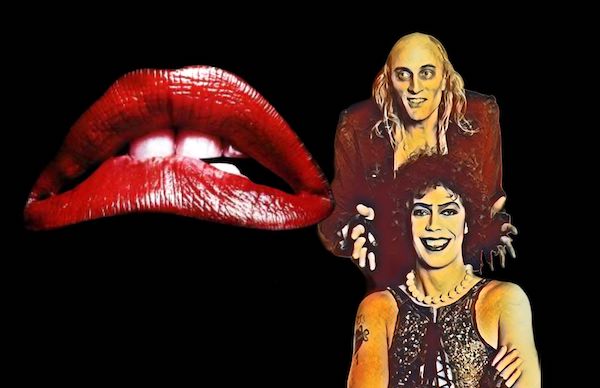
The original Rocky Horror Show cast in London, 1973
The story follows Brad Majors and Janet Weiss, two young fiancés hoping to ask their professor, Dr. Everett Scott, to be the best man at their wedding. On the way, their car breaks down, forcing them to seek help at a castle. But it turns out to be no ordinary night: they are welcomed by the mad, flamboyant scientist Dr. Frank ’n Furter; his servants and lovers Riff Raff and Magenta; his assistant Columbia; and a group of bizarre guests. By morning, Brad and Janet will have lost not only their innocence, but much more.
The catchy melodies — RHS, as fans affectionately call it — combined with its geek references and explicit sexual transgressions, were crucial to its impact. But at its heart was always its greatest star: Tim Curry.


His deep voice, sexual fluidity, and ability to shift from humorous to terrifying to moving made his performance as Dr. Frank ’n Furter unforgettable. Curry deservedly became a theater star, though he almost gave up acting altogether to pursue a music career.
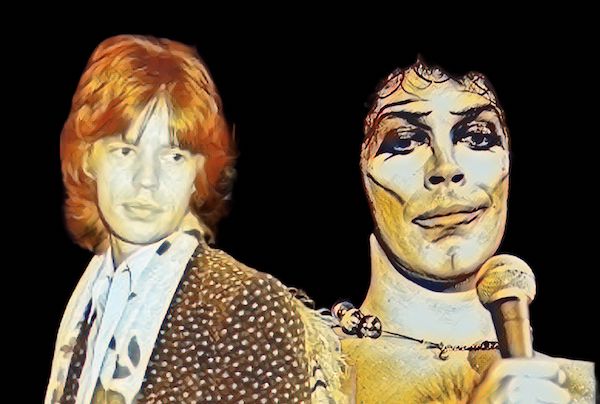
After the London run, he took the show to Los Angeles, where he was idolized. But Broadway was a disaster: the musical closed after only 45 performances, despite Curry earning a Tony nomination. The disappointment was so deep that he considered walking away from acting. It was during this brief period that Mick Jagger was reportedly considered for the film role of Frank ’n Furter. Thankfully, Curry returned — and forever defined the character.

For the film adaptation, only the roles of Brad and Janet were recast. Steve Martin auditioned for Brad but lost out to Barry Bostwick, while Janet went to a young, then-unknown Susan Sarandon.
Behind the scenes, there was little drama. Patricia Quinn (Magenta) was frustrated when her main song, Science Fiction, was reassigned to Richard O’Brien himself, leaving her only to lip-sync it in the opening credits. Ironically, her lips went on to become one of pop culture’s most enduring images.
Even Prince Charles got involved in the story: Patricia, who later became Lady Quinn-Stephens, revealed that the future king admitted to being a fan of Rocky Horror Show.
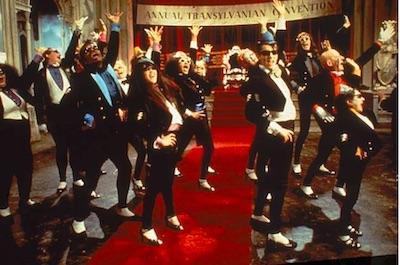

From stage to screen
Like the stage play, the 1975 film was deliberately “cheap,” with the exaggerated style of the B-horror movies it was parodying. Its messages were shockingly bold for the time — Don’t Dream It, Be It became a liberating anthem — but it was the Time Warp dance sequence that cemented Rocky Horror as a cultural landmark.
The costumes and makeup also left their mark, influencing punk fashion. But it was the tradition of midnight screenings that transformed the film into a cult phenomenon.
Despite being panned by critics — musicals were out of fashion, and its themes were considered “too much” for the time — The Rocky Horror Picture Show was rescued by its fans. In New York, audiences not only flocked to midnight shows but began interacting with the screen: repeating lines, throwing rice, lighting candles, raising umbrellas to simulate rain, and, of course, dressing up as their favorite characters.

These interactive screenings created a participatory artistic phenomenon that spread worldwide, long before social media existed. Thanks to its audience, Rocky Horror has remained in continuous release at select theaters to this day, holding the undisputed record for the longest-running film in cinema history.
Every Halloween, it remains a go-to source of costume inspiration and one of the most screened films. In 2016, it was reimagined in a TV special with Laverne Cox as Frank ’n Furter. Though brilliant, it’s nearly impossible to surpass Tim Curry’s legendary performance.
Curry himself took part in the production, appearing in a wheelchair and with limited speech after a stroke in 2012. In 2020, he was announced as a guest for an online event celebrating the film’s 45th anniversary — a reunion guaranteed to stir emotion.
Descubra mais sobre
Assine para receber nossas notícias mais recentes por e-mail.
 miscelana.com
1 comentário Adicione o seu