
There are two Sundays left until the 2024 Oscars, on March 10th. If I asked you which actresses have won awards in the last 10 years, would you be able to say?
Don’t worry if you forgot! There are lots of prizes!

Who are the 2024 nominees?
The Best Actress category this year is one of the most disputed and uncertain at many Oscars. Emma Stone and Lily Gladstone are technically tied, with Lily having a slight advantage having won the SAG Awards. At this point, the other nominees, Anette Benning (Nyad), Carey Mulligan (Maestro), and Sandra Hüller (Anatomy of a Fall), are just going to applaud.
The Best Supporting Actress category has never been so announced. Da’Vine Joy Randolph has won every award so far for The Holdovers. The Oscar is hers. And as it’s the first major category, you’ll celebrate early.
Do you remember the previous winners?
In the last 10 years, we have had History being made, on more than one occasion. Some surprises too… shall we recap?
2024/ 2015: Historic speeches and records set
In 2014, Cate Blanchett became the sixth actress to win both female acting awards in her career. Ten years earlier, in 2004, she won her first Best Supporting Actress award for The Aviator, and in 2014, she was awarded in the main category for Woody Allen‘s film Blue Jasmine.

There is no performance by Cate without being spectacular and in Blue Jasmine she is a kind of Blanche Dubois from A Streetcar Named Desire. At the time there was a lot of pressure for the director to cancel, but Cate was so unanimous that not even that stopped her from deservedly taking home her Oscar.
In 2015, it was finally Julianne Moore‘s turn with a moving performance as a teacher suffering from Alzheimer’s in Still Alice.
But in the two years in a row, 2014 and 2015, it was in the Best Supporting Actress category that the Oscar was most beautiful with remarkable moments.
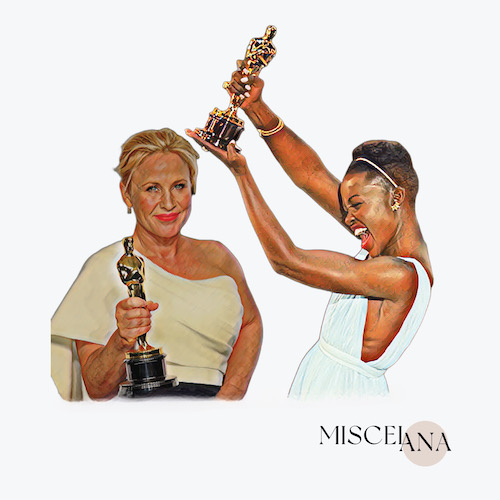
First Lupita Nyong’o, who stole the show in 12 Years a Slave, was the sixteenth actress in all 90 years of Oscars to win in her debut film. If that wasn’t enough, she was the ninth Best Supporting Actress winner to achieve this feat, in addition to being the first Nigerian to win an Oscar as an actress. Choose your ‘firsts’ and add that she was also one of the most elegant not only of the night but of all the Oscars. In addition to being in the unforgettable moment of presenter Ellen DeGeneres’ selfie.
In 2015, the film Birdman, one of the big winners of the night, was Emma Stone‘s first nomination, as Supporting, but the winner of the category was Patrícia Arquette for Boyhood. Her politicized speech called for pay equity for actresses, and raised awareness among female audiences, with iconic support from Meryl Streep and Jeniffer Lopez.
2016 and 2017: The new generation
Amid criticism of lack of inclusion and other issues, between 2016 and 2017 the Oscars maintained a very clear Hollywood record: youth and beauty counted as much as talent.
In 2016, the “year of La La Land”, Emma Stone was expected to win and, the following year, Brie Larson caused no surprise when she took the award for Best Actress for Jack’s Room.
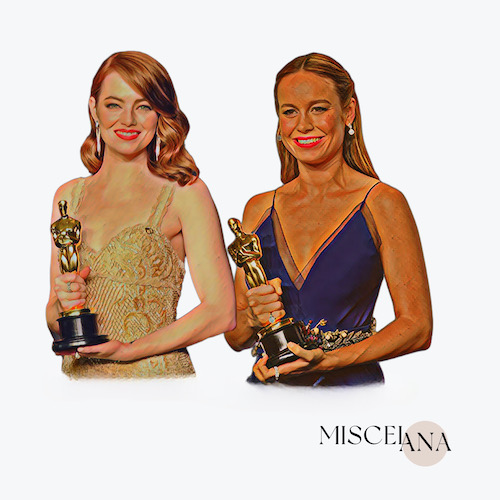
Viola Davis‘ much-celebrated victory in 2017, for the film directed by Denzel Washington, Fences, was more exciting than Alicia Vikander‘s victory in the previous year, 2016, for her great performance as a supporting actress in The Danish Girl.

2018-2019: A record, a new star
In 2018, Frances McDormand won her second Academy Award for Best Actress for Three Billboards Outside Ebbing, Missouri, in a performance that some might claim was her signature (smart, bitter woman), but was deserved.
In 2019 the campaign was: “Glenn Close’s turn has come”, the favorite of the night. Until then, with seven nominations (in 2021 she was nominated again) and a spectacular performance in The Wife, it was really supposed to be “her turn”. However, the name announced on the envelope was Olivia Colman for – no joke – The Favourite.

The irony of the film’s name does not represent the gigantic surprise of the night, although the victory was deserved. The best part was hearing one of the most entertaining acceptance speeches in Oscar history. Olivia was already a popular star in the UK, but after that night, she became one of the most sought-after and beloved international actresses.
In the supporting actresses category, 2018 and 2019 were years of recognition for veterans. Alison Janney was the bear of the night with a deliciously cruel job in I, Tonya. And in 2019, Regina King was recognized for her work on If Beale Street Could Talk, bringing the audience to tears with her heartfelt gratitude.

2020 and 2021: Years of Pandemic, virtual and historic Oscars
And in 2020, just days before the lockdown due to the Covid-19 pandemic, actress Renée Zellweger joined the same club as Cate Blanchett, receiving her second Oscar (the first was in 2003 in a supporting role for Cold Mountain), now for Best Actress in a stupendous performance as Judy Garland in Judy where she was not dubbed and delivered one of the most moving performances in biopics.

Having been missing for many years, Frances McDormand returned to theaters with a vengeance. Just two years after joining the select group of actresses with two Oscars, on the same night she joined the ranks with FOUR, something very rare in Hollywood. This time for the little Nomadland (which made more history by rewarding its director, Chloé Zao), where she was elected Best Actress and also served as producer when the film was Best of the Year.

In 2020, Laura Dern, daughter of two stars who never won an Oscar (Bruce Dern and Diane Ladd), won her first statuette in her third nomination, this time for Marriage Story.
Actress Yuh-Jung Youn made history when she won in 2021 for Minari, for her role as the matriarch of a Korean-American family who moves to Arkansas in search of the American dream. Her victory marked the first time a Korean actress won an Oscar, and no one will forget her laughing thank you to Brad Pitt (he’s the film’s producer). One of the greatest moments of the Oscars.
2022 and 2023: the years of inclusion
Little by little, over the last decade, it has been possible to follow the change in nominees and winners, with some sign of inclusion seeming to determine the favorites.
At the Oscar for “Will Smith’s Slap”, Jessica Chastain‘s victory for The Eyes of Tammy Faye barely generated any repercussions as the night was marked by violence, scandal, and Will Smith‘s tears. She faced off against other veterans such as Nicole Kidman, Olivia Colman, and Penelope Cruz, sharing favoritism with Kristen Stewart as Princess Diana in Spencer. Jessica has already been nominated twice before and is one of the best American actresses at the moment.

And, last year, who took the stage was none other than Michele Yeoh, the first Asian actress to win in the category and a hugely celebrated victory for her long career and representation of inclusion at the Oscars.
Among the supporting actors, the last two years have also been full of news. In 2021, Ariana Grande was the second Latin American actress to win in the category, ironically for the same role and film, that of Anita in West Side Story, which was by Rita Moreno in 1961.
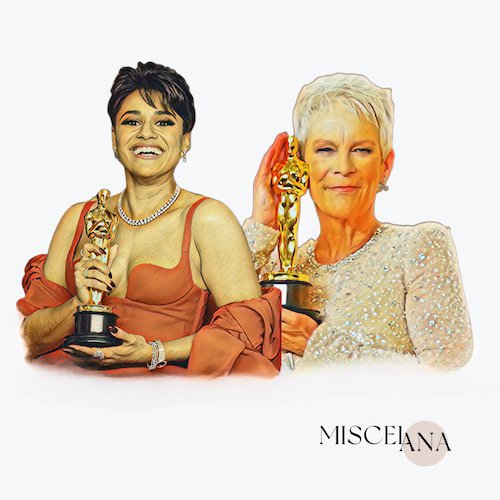
Jamie Lee Curtis, like Laura Dern three years earlier, also represented her famous parents (actors Tony Curtis and Janet Leigh) by winning Best Supporting Actress for Everything in Everywhere at Once.
Did the list refresh your memory? In two weeks we will have it updated with the 2024 winners. Let’s follow!
Descubra mais sobre
Assine para receber nossas notícias mais recentes por e-mail.
 miscelana.com
1 comentário Adicione o seu