
Legendary in the land of so many others, Bette Davis still stands out today, 35 years after her death, as one of the greatest actresses who ever lived. A reference that she was proud of, a reputation that came with a recognized and assumed strong and difficult personality, a reputation that she was proud of and that she built with consistency. “Larger than life”, in his own words, but mortal like us. On October 6, 1989, when she was in France but on her way to the San Sebastián Festival in Spain, she beat the cancer she had been fighting for years. Bette was 81 years old.
Songs were written in her honor, from the quote in Vogue by Madonna (released immediately after her death and in which the singer declared “Bette Davis, we love you”) to Bette Davis Eyes, an anthem of the 1980s, without forgetting that the first season of Feud was about behind the scenes about her fight with Joan Crawford, Bette left as a legacy a unique filmography that continues to influence cinema and acting to this day. She is remembered not only for her memorable performances, but also for her contribution to the evolution of the film industry forgetting that she received two Oscars for Best Actress, gave her name to the statuette, led impactful labor changes in business, and, above all, left unforgettable characters. As she.
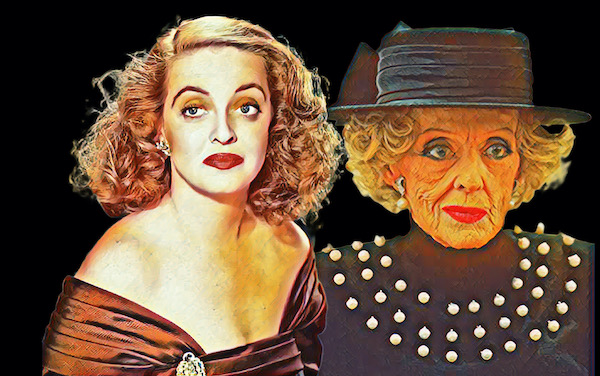
From the moment she arrived in Hollywood, she made it clear that she was going to be “THE” star
Born as Ruth Elizabeth Davis on April 5, 1908, in Lowell, Massachusetts, Bette always commented that her parents’ divorce when she was just 7 years old left her scarred for life, witnessing her mother raise her children alone in very difficult times. difficult. Instead of using her first name, she decided that she would sign using the nickname of her middle name, following the suggestion of a friend of her mother’s, who read Balzac’s La Cousine Bette, and insisted that the Frenchized spelling of the nickname – Bette, instead of “Beth” or “Betty”, would “set her apart”. Certainly, she never was or would be like the others, but Bette Davis was her name before she even stepped on stage.
Always determined to be an actress, she had her mother’s support and prepared herself for it, fighting against the rigid beauty standards of the time that did not include Bette among its highlights. Her eyes, sung years later, and her signature, “were too big”, they said, but the actress soon learned to exploit them to her advantage.
On Broadway, she gained prominence and at just 21 years old she was already recognized, which helped her. This is because in the meantime cinema started to be talked about and Hollywood eagerly sought out Broadway actors and actresses who had good voices and good looks to supply the “new” professional they needed. And Bette was called to audition. It was decades before she returned to the theater after that.
With a $300-a-week contract from Universal Pictures, Bette Davis arrived in Los Angeles, accompanied by her mother, in 1930. She debuted in a supporting role, alongside another newcomer Humphrey Bogart, in the film Bad Sister, in 1931. It didn’t catch anyone’s attention, but when she was about to be fired, the film’s director of photography, Karl Freund, told studio bosses that “Davis has beautiful eyes” and that earned her another 13 weeks on her contract.

It should be noted that at that time, film releases in cinemas were gigantic, so it is impressive by today’s standards that she participated in six films for Universal without catching anyone’s attention. When she was about to give up, a phone call from actor George Arliss changed her route. He cast her as his leading lady in The Man Who Played God, and with that success, Bette began her long and turbulent relationship with Warner Brothers.
Without taking any bullshit, Bette soon earned her reputation as “difficult.”
In the first three years, she was in no less than 14 titles, sharing the screen with other legends such as Barbara Stanwyck and Spencer Tracy, among others. Bette, who wasn’t known as sweet or beautiful, was certainly fearless. Without caring about personal marketing that reflected her personal life like the characters she played, she soon established that she would be famous for her professionalism and talent above all, embracing unsympathetic and villainous characters if they gave her the chance to challenge herself and stand out. Today it sounds common, but at the time it was a completely revolutionary attitude.
With the respect of technicians and directors, even without the sympathy of her peers, Bette worked hard to have the scene her way and be in the projects she wanted. Of course, with a contract where Warner “owned” her and decided where and what she should do, this attitude earned her suspensions and fights, but she remained firm.
One of the common “punishments” was to “lend” its stars to other studios, but when Warner did this, it was given to RKO to play the cruel and slovenly waitress Mildred in Of Human Bondage, alongside Leslie Howard, she was elated. The adaptation of W. Somerset Maughham’s classic guaranteed Bette her “first unforgettable villain” and thus solidified her brand as an Actress, not just a star. And yes, her first nomination for the Academy Award, which she would call the “Oscar” the following year for the film, when she won it. In fact, let’s talk about this indication.
Bette wanted the role of Mildred Rodgers because she knew it would change her career. As Warner was already irritated by her bellicose behavior on the sets, they “ceded” her to RKO only because they were sure it would be a failure. When Of Human Bondage was successful and everyone was talking about an Oscar for her – well, it wasn’t an “Oscar” yet, it was the Academy Award – Warner didn’t like it, even though she was one of their “stars”. And it wasn’t because it would be prestige for RKO! It was not giving Bette the satisfaction of being right.

So, as she became known, Warner began a campaign of spite, encouraging academy members not to vote for her. At the time, voting campaigns and the counting of results were carried out by the heads of the academy (of which Warner was a member). Obviously, it “worked”. The actress was initially snubbed and left off the list of nominees, but her supporters and the public were outraged, starting a campaign that reversed the situation.
The effort was kind of in vain because Bette was nominated, but lost to Claudette Colbert in It Happened One Night (1934). Still, as a result of this incident, the Academy decided to change voting practices and turn over the counting of results to the independent accounting firm Price, Waterhouse & Co. (now PricewaterhouseCoopers), which 90 years later still does the official counting. Bette would win her Oscar the following year, for Dangerous, but we’ll talk about that later.
A “Spartacus” of skirts that changed the business model
The awards experience was only salt in the open wound of Bette Davis‘ long fight against the Hollywood system, correctly described by her as the “contract slavery system”. The studios not only controlled 100% of the work for which she cast her stars, but they interfered in their personal lives as well.
This transformed the actress’ relationship into one of “love and hate”, with historic fights and suspensions when she refused to act in what she considered inferior films. Eventually, she went to court to break her ties with Warner, becoming autonomous at a time when no one – not even men – dared to think about being in the market without “the protection” of a studio. But if today it is unthinkable to have an exclusive contract where the executives choose the projects, the artistic class has to thank Bette, the “Spartacus in skirts” who was not afraid of anyone.
In 1936, to challenge her “owners”, I mean, “bosses”, Bette agreed to shoot two films in England without Warner’s consent and it was to be imagined that she considered the feat an example, but she reported that her courage did not come. painless. You’re wrong if you think it was financial, nothing like that. Bette wanted the role that every actress of the late 1930s dreamed of: that of Scarlett O’Hara in Gone with the Wind. According to her, to convince her to stay, Jack Warner alluded that he was negotiating the purchase of the rights and one of the “greatest roles of all time in cinema”, as she said years later, without realizing that it was precisely the best-seller of the film. time. “But I didn’t know that,” she commented, remembering that the studio owner begged “‘Please don’t leave. I just bought you a wonderful book”, to which she shrugged as a bluff.

Not Scarlett, not London. Upon arriving in England she was sued by Warner Brothers, who managed to prevent her from working as she was still under contract with them. In the process, the studios presented the fight as a purely financial dispute and that “the slavery contract” earned her a large sum for the time, more than a thousand dollars a week. “If anyone wants to place me in perpetual servitude based on this remuneration, I will be prepared to consider it,” she replied, without being understood by the public or the courts, needing to go back and submit.
Freedom of decision didn’t come, but she managed to reduce the demand for how many films she needed to make and yes, an even higher salary. As consolation for losing Scarlett, Bette won Jezebel, a Southern drama even more dramatic than Gone with the Wind, for which she received her second Oscar for Best Actress.
And since 1939 was the best year in Hollywood history, it’s no surprise that Bette Davis was in many of the critical and box office hits, with at least four films: Dark Victory, Juarez, The Old Maid, and The Private Lives of Elizabeth and Essex.

If she continued citing her filmography, she would write a book. What is worth noting is that in 1942 she starred in one of the best romantic films of all time, Now, Voyager, her biggest commercial success and one of the most iconic (sweet) roles in her legacy. Of course, how can we forget the line “Why ask for the moon if we have the stars?” which is one of the most legendary in Cinema?
The year before the film, in 1941, she had become the first female president of the Academy of Motion Picture Arts and Sciences, but her strong temper picked up so many fights that, faced with the committee’s disapproval and resistance to her proposals, she resigned. Politics has never been her strong point.
Her relationship with Warner, which lasted 19 years, came to an end with the turn of the 1950s. Many point out that Bette Davis’s other period was precisely the one she spent with the studio, the 1930s and 1940s, but she would prove to many that she still had more to deliver and we know that Margot Channing from All About Eve and Baby Jane came later, much later…
Troubled personal life, suspicious deaths, and family dramas
Bette was married four times and had well-known romances with directors and celebrities, but she said that the trauma of her parent’s divorce spoiled her for romantic relationships. According to herself, the nickname for the Academy statuette as “Oscar” was her idea. When she received her first statuette, she looked at it and thought that “her backside resembled Oscar’s”, which was her husband’s middle name at the time, Harmon Oscar Nelson. The Academy ignores this version, of course, saying that it was Margaret Herrick who thought the image reminded her of “her uncle Oscar” and her name stuck.
Some place Bette in the middle of a true crime scenario when she became a widow in 1943, because her second husband, Arthur Farnsworth, collapsed while walking down a Hollywood street and died two days later. An autopsy revealed that his fall was caused by a skull fracture he had suffered two weeks earlier.
In the investigation that investigated what happened, the actress denied knowing about an event that could have caused the injury, although a fall from a ladder was later cited as the possible cause of the injury. In any case, it was officially an accident and the suspicion was never completely clarified.
Just as Joan Crawford‘s daughter, Christina, did in the 1980s, Bette’s daughter – Barbara Davis Sherry – also wrote a biography alluding to her mother’s mistreatment and problems, something that deeply hurt Bette. “I was a legendary terror,” she acknowledged. “I was unbearably rude and rude in cultivating my career. I didn’t have time for pleasantries. I said what I was thinking and it wasn’t always possible to print. I have been uncompromising, spicy, intractable, monomaniacal, tactless, volatile, and often unpleasant. I suppose I’m larger than life,” Bette once declared. But she didn’t expect her daughter’s criticism.
If Joan was dead when Mommy Dearest arrived in stores, without being able to defend herself or know about Christina’s revenge, My Mother’s Keeper took Bette by surprise. She, who never hid that she was temperamental, stubborn, and difficult to get along with, was portrayed as abusive, domineering, and an alcoholic, something that shocked her. The answer came in the publication of her autobiography, years later, where she defended herself by illustrating her daughter as a liar and ungrateful. Obviously, their relationship never recovered, but the actress herself famously said one day: “I know what I want as an epitaph,” she warned her. “Here lies Ruth Elizabeth Davis – she did it the hard way.”
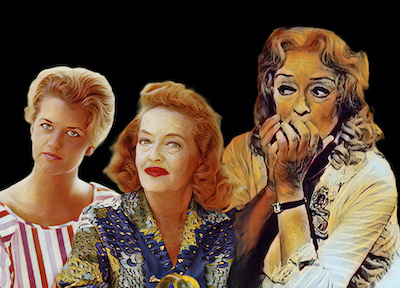
Freelancer and still landing great roles
When she became an actress without a fixed contract with any studio, Bette was already “ripe” for Hollywood and with that, she had fewer job offers. Still, in 1951 she replaced Claudette Colbert in the film All About Eve and played Margo Channing in one of the biggest roles of her career, if not the most famous.
Margo Channing, at 40, was Bette herself, the fading Broadway star being imitated and surpassed by a younger fame-aspirant, Eve (Anne Baxter). It is not possible to praise the perfection of the film enough.
Even with her success, at the age of 45, Bette left the cinema that didn’t want her and returned to the stage, later moving on to TV. In the early 1960s, with the success of Whatever Happened to Baby Jane? She was again nominated and praised, but never again in the same status.
Although the series Feud reinforces the legend of behind-the-scenes fights, officially Bette has always denied having problems with Joan. “I never fought with Joan Crawford. During ‘Baby Jane’ the whole world expected us to fight, but we didn’t. We were both professionals,” she said in 1982.

But no one was convinced that Bette’s perfectionism and extreme “sincerity”, translated into fights and rudeness, hid a person the sweet one. Bette was impossible. And a workaholic: the only reason I saw the point in living was being active. “My terror was that I would never work again,” she said later, “because I always loved working.”
A heavy smoker like many of her time, she fought cancer for years, but in 1989 she broke down. She was going to be honored at the San Sebastián Film Festival, but she couldn’t get there, being admitted to Paris and dying in the hospital days after landing in France.
Her legacy of striking and strong roles, with 10 Oscar nominations and countless awards (which she loved to collect without any guilt), confirms that Bette Davis achieved her goal.
If today we look at her performance as considered exaggerated and grandiose, there is still a calculated brilliance and was against any “natural” interpretation. “That’s not the point of acting,” she argued. “The public must believe in us. Have I ever tried to be discreet? Never never never! I fought this from the beginning. I think acting should be larger than life.”
Larger than life. Yes, she repeated this wish in more than one interview. And yes, she is bigger than her life. She is one of the biggest stars of all time.
Descubra mais sobre
Assine para receber nossas notícias mais recentes por e-mail.
 miscelana.com
1 comentário Adicione o seu