
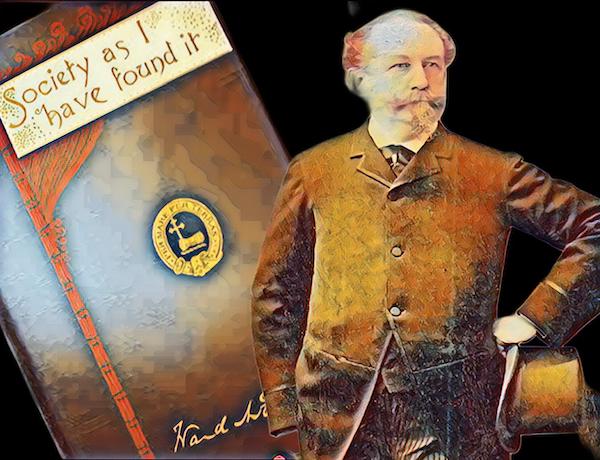
I held on to a few real-life facts depicted in The Gilded Age until they were confirmed, and one of the most anticipated ones featured prominently in the Season 3 trailer: the release of the book Society as I Found It by Ward McAllister. The work can be seen as a precursor to Truman Capote, whose book Answered Prayers was considered a “social suicide” 85 years later—and all the drama inspired the excellent Capote vs. the Swans.
Published in 1890, Society as I Found It was controversial and, much like what would happen to Capote decades later, had catastrophic consequences for the author’s social standing. Both McAllister and Capote positioned themselves as intimate chroniclers of a class that tolerated them as long as they remained useful and discreet — but quickly rejected them once their words began to expose too much. A more specific parallel is promised later. For now, let’s talk about the “innocent” memoir of a vain man who, as we’ll see in the series, played with fire and got burned.
Until He Published The Book
Throughout the first two seasons of The Gilded Age, Ward McAllister’s influence and importance in New York society became more than clear — so much so that Bertha Russell (Carrie Coon) does everything in her power to secure him as a friend and mentor. “Make sure it’s a success,” says Aurora Fane (Kelli O’Hara) to Bertha. “He won’t give you a second chance,” she warns. After all, he was the self-proclaimed social arbiter of New York’s high society, played in the series by Nathan Lane.
Let’s not forget that we’re talking about one of the most controversial and influential men in American high society during what came to be known as the Gilded Age. Born in Savannah, Georgia, in 1827, McAllister studied law and worked as a lawyer in California during the Gold Rush. While still young, he traveled to Europe, where he closely observed the customs and ceremonies of aristocratic courts — an experience that profoundly shaped his views on etiquette, prestige, and social distinction.

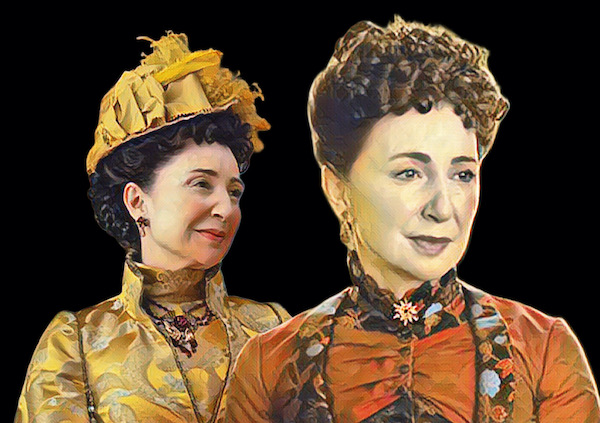
Upon returning to the United States, he settled in New York, the new financial and cultural capital of the country, and devoted himself to crafting a social career as strategic as any business venture. Around the 1870s, he was the architect of the idea of an American aristocracy founded not just on wealth but also on behavior, good manners, and a tightly knit web of relationships. He became the right-hand man and “master of ceremonies” to Caroline Astor (Donna Murphy) — the famous Mrs. Astor — matriarch of New York society and key figure in deciding who was or wasn’t accepted in the upper echelons.
“Why, there are only about 400 people in fashionable New York society. If you go outside that group, you encounter people who feel uncomfortable in a ballroom — or make others feel uncomfortable. Do you see the point?”
— Ward McAllister
McAllister coined the term The Four Hundred, referring to the 400 people who, according to him, made up the most exclusive circle of New York’s elite. The number referenced the capacity of the Astor ballroom but also carried symbolic weight: a rigid and nearly aristocratic cut-off line within a society that, at least in theory, prided itself on mobility and meritocracy. This invention fed the public’s fascination with exclusivity lists and social rankings — direct predecessors to Forbes lists and modern-day society columns.
Charismatic, sharp, and acutely aware of social codes, McAllister was admired for his command of etiquette but also mocked for his pretension and vanity. His insistence on presenting himself as the ultimate arbiter of taste and prestige made him a figure of ridicule among many elites he helped sustain. Still, his influence was undeniable: he organized balls, recommended guests, referred luxury suppliers, chefs, and wines, and wrote letters of introduction — all in the name of preserving a “proper” social order at a time when newly rich industrialists threatened to disrupt traditional hierarchies. All of this is portrayed in The Gilded Age.
Until He Published The Book
In 1890, McAllister published Society as I Have Found It, a kind of social memoir in which he candidly — and, to many, indiscreetly — detailed the inner workings of New York’s elite. The book offers detailed observations about parties, meals, consumer habits, social types, and even advice on what to drink, how to behave at dinners, how to hire a good cook, or how to avoid social blunders. Ambitious as it was, the book had a devastating effect on his reputation: many of those he mentioned — directly or indirectly — began to see him as a traitor to the code of silence and discretion that upheld high society. The press mocked the publication, and McAllister was gradually excluded from the very circles he helped create.
His death in 1895 occurred in relative obscurity. Yet his figure endures as a symbol of a unique moment in American history, when elites sought to imitate European aristocratic traditions while facing the chaotic rise of a new social order. With his blend of vanity, social intelligence, and normative rigor, Ward McAllister represents the attempt to impose rules and elegance on a transforming world — and his story is also a study of the limits of individual influence within volatile structures of prestige.
Among the most controversial or indiscreet revelations are:
1. Exposing The Four Hundred
McAllister openly boasted about having coined the idea that only 400 people truly “mattered” in New York society, based on the number of guests the Astor ballroom could hold. Although he did not publish an official list in the book, everyone knew who he meant — names circulated in society columns and unofficial lists — and his insistence on the concept was seen as exclusionary, offensive, and pretentious by many who found themselves on the outside. For the emerging elite of industrial millionaires (the so-called nouveaux riches), it was a veiled insult. For old-guard families, the idea that McAllister — a Southerner with no noble lineage — was in a position to define this aristocracy was intolerable.
2. Details About Parties and Guests
McAllister revealed, in what was then seen as gross detail, the inner workings of balls, dinners, and social gatherings. He commented on invitations, who deserved to be invited, behind-the-scenes intrigues, and even offered personal opinions on the sophistication (or lack thereof) of certain hosts. He described, for example, dinners where “big names” didn’t know how to use their cutlery or committed etiquette faux pas — not naming names, but hinting just enough for informed readers to catch the allusions.
3. Critiques of New Wealth
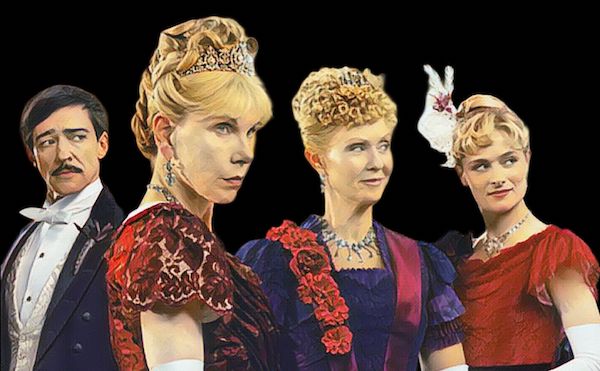
A recurring theme in the book is McAllister’s discomfort with newly rich millionaires trying to buy their way into society through ostentation. He mocked their excesses, noting their over-the-top parties, the hiring of French cooks who barely spoke English, and homes lavishly decorated with imported luxury — but lacking “taste.” Although he had acted as a gatekeeper for these social climbers, his criticisms came off as hypocritical and offensive — a self-inflicted wound that caused deep resentment.
4. (Nearly) Direct Mentions of Real Figures
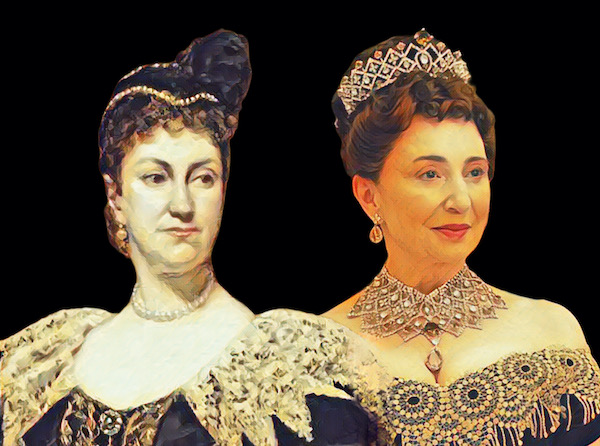
Although McAllister tried to avoid lawsuits, he cited and described real people using full names or easily identifiable pseudonyms. Targets included Mrs. Astor herself, with whom he had a symbiotic but tense relationship. Writing about her in a possessive and celebratory tone — calling her “Queen of Society” — he exposed the mechanics behind her authority, weakening her mystique. Other names mentioned include members of the Vanderbilt, Schermerhorn, Rhinelander, and Goelet families. Even though he rarely offended outright, the mere act of publicly writing about these people was considered a betrayal.
5. Details About Customs and Habits
McAllister described private routines and customs with an air of superiority and moral prescription. He wrote about the ideal number of courses at an elegant dinner, how to receive foreign guests (like European princes), and criticized those who ignored proper protocol — including some of the nouveaux riches. In doing so, he revealed the tensions between tradition and modernity, exposing the fragility of an elite obsessed with appearances and social validation.
6. Vanity and Self-Promotion
Perhaps the most enduring scandal was the tone of the book itself. McAllister wrote as if he were the sole authority on etiquette and social hierarchy. He portrayed himself as a mentor, guide, legislator, and even moral arbiter, which many saw as a mix of arrogance and absurdity. The book is filled with self-praise and declarations of his own influence, such as when he claims that, without him, New York society would have devolved into a “chaos of vulgarity.”
The impact was immediate and devastating. McAllister was ridiculed in the press, satirized in caricatures, and excluded from the inner circles of the elite who had once tolerated or used him. Even Mrs. Astor distanced herself from him after the publication. The book not only cost him his reputation, but also symbolically marked the beginning of the end of his era as the “master of ceremonies of society.” Still, his work is now a rich historical source: a testament to the effort to aristocratize a young, unequal, and rapidly changing nation. His “gossip” reveals as much about individuals as it does about the system of prestige, exclusion, and performance that upheld the American elite of the 19th century.

What he revealed about Caroline Astor — and why it was scandalous
In his book, McAllister publicly confirmed that Caroline Astor was the sovereign of New York society. Until then, her dominance had been tacit, an “open secret” circulating only among insiders. By explicitly declaring that she was “the true leader of society” and the main figure among the “Four Hundred,” McAllister gave a name and a face to America’s informal aristocracy — something many considered inelegant, vulgar, and even dangerous. He treated her as a social monarch, describing how invitations to her balls were coveted and how she “legitimized” families and individuals through her approval.
Part of this ritual was explored in the two seasons of The Gilded Age, with Bertha aggressively trying to obtain Mrs. Astor’s approval at the ball that ends the first season, as well as the clash between the two during the so-called Opera War — a conflict from which Bertha (standing in for Alva Vanderbilt) emerged victorious.

As I’ve mentioned more than once, the fact that McAllister revealed the behind-the-scenes creation of the Four Hundred was the final straw in his betrayal. Although he claimed the number came from the capacity of Mrs. Astor’s ballroom, it became clear that it was an exclusive and rigidly curated list. McAllister admitted that he and Mrs. Astor decided together who deserved entry into this circle — an admission of nepotism and social control. This shattered the myth of merit and revealed that society was a deliberate construction, not a natural order.
To make matters worse, he detailed the criteria for acceptance, describing in meticulous detail what he considered “good manners,” “lineage,” and “acceptable behavior” — indirectly revealing what Caroline Astor expected from her peers. This laid bare that many of the nouveaux riches were systematically excluded not for lack of refinement, but due to pure class prejudice.
What the innocent and snobbish text makes clear is that he was a sycophant — and this sparked revulsion. Even while praising Mrs. Astor, the way he did so — exalting every detail of her bearing, her parties, her judgments — was seen as vain, servile, and compromising for both. He turned Mrs. Astor into a public character at a time when discretion was the ultimate luxury.

To many readers of the time, it seemed as if he wanted to use her prestige to reaffirm his own power — as if to say, “Look, I am the queen’s advisor.”
The most humiliating part was that McAllister made the mechanism of social control public by explaining how Mrs. Astor could “save” or “banish” entire families with a single gesture. In doing so, he revealed that the glamour of high society was sustained by harsh dynamics of exclusion, humiliation, and strategic diplomacy — a system resembling an absolutist court, only without a crown.
Although she never criticized him publicly, Mrs. Astor severed ties with McAllister after the book’s publication. His name was gradually erased from the society he had helped shape, and he came to be seen as a vain, opportunistic, and outdated old man — unable to recognize that he had crossed the line of what could be revealed, especially about a figure considered nearly sacred. When he died five years after the book was published, McAllister had fallen so far into disgrace that almost no one attended his funeral — including Mrs. Astor. She had dinner plans that night.
Thus, although he didn’t do what Truman Capote later would — publishing explicit gossip about affairs, bankruptcies, or personal humiliations — Ward McAllister revealed something even more unforgivable by Gilded Age standards: he exposed the backstage of power. He made public what was meant to remain secret — and in that world governed by appearances, this was more scandalous than any sexual betrayal. Because, by lifting the veil, he didn’t just betray Caroline Astor — he betrayed the very myth that upheld the entire elite.
Descubra mais sobre
Assine para receber nossas notícias mais recentes por e-mail.
 miscelana.com
2 comentários Adicione o seu