
The disappearance of the mother of journalist Savannah Guthrie has become one of the most disturbing and persistent criminal cases in recent American television history, a story that for several weeks has dominated national headlines, interrupted live programming, and mobilized federal authorities without, so far, producing a clear explanation, a publicly identified suspect, or even proof of life. For an international audience unfamiliar with Savannah, it is important to understand that she is not a tabloid celebrity but one of the most recognizable figures in American broadcast journalism, co-anchor of the morning program Today on NBC, a cultural institution that blends hard news, political interviews, international coverage, and a tone of domestic familiarity capable of reaching millions of viewers every morning. In the United States, presenters of this kind occupy an unusual space between journalist and household presence, someone who accompanies the country’s daily routine over breakfast, which is why her personal tragedy immediately assumes national proportions.
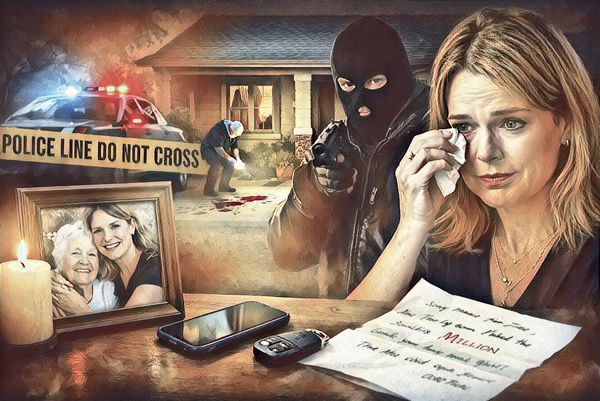
Savannah Guthrie built her career as a legal and political journalist with a sober public profile, known for firm interviews and an on-air demeanor that avoids theatrics or sensationalism, reinforcing the sense of normalcy and credibility audiences expect from a network anchor. Although American political polarization often pressures journalists to adopt explicit ideological identities, Savannah is not publicly aligned with either the Democratic or Republican Party, a position relatively common among anchors at major networks who seek to preserve an image of institutional neutrality. Nevertheless, because she works for NBC, a network often perceived by conservative audiences as leaning toward socially liberal urban perspectives, she is sometimes informally categorized as part of the media establishment associated with centrist or moderate progressive views, a label that reflects the broader American political climate more than any explicit statement from the journalist herself.
What makes the case especially unsettling is that the victim is not Savannah but her elderly mother, a woman without public prominence who disappeared under circumstances suggesting a violent abduction from her own home. Investigators found signs of forced entry, biological evidence, and indications that she did not leave voluntarily, shifting the narrative from a missing-person case to that of a deliberate crime. The leading hypothesis is an indirect financial kidnapping in which the true target would be the famous daughter, while the perpetrators seized the most vulnerable member of the family, a dynamic that resonates deeply in American culture, where public visibility is often seen as exposing relatives to risk. The situation acquired even darker overtones after messages attributed to alleged kidnappers surfaced without definitive confirmation of authenticity, some reportedly sent to media outlets before law enforcement, a detail that uncomfortably blurs the boundary between crime and spectacle.

Since then, the story has unfolded less as a conventional investigation and more as an extended suspense narrative without resolution, sustained by cautious police briefings, emotional appeals from the family, and continuous coverage by 24-hour news networks. Savannah herself, accustomed to interviewing victims and officials, suddenly found herself on the opposite side of the narrative, visibly shaken in public appearances and forced to balance her role as journalist with that of a daughter in crisis, a reversal that intensifies the emotional impact of the story. In the United States, where morning television cultivates a sense of intimate familiarity, this exposure transforms a private tragedy into a collective drama, reinforcing the perception that something profoundly wrong and inexplicable has occurred within a family long viewed as stable and discreet.
The absence of concrete answers after so many weeks keeps the case alive in the news because it defies the comforting narrative patterns in which a suspect is quickly identified or a plausible motive emerges to restore order to chaos. Here, there is only silence, speculation, and the increasingly troubling possibility that the outcome could be tragic. For foreign observers, the persistence of this story in American media reveals not only a fascination with real-life crime but also the vulnerability of public figures who, despite appearing omnipresent and protected by fame, remain exposed through those they love. It is this combination of indirect celebrity, invasive domestic violence, and absolute uncertainty that has made the disappearance of Savannah Guthrie’s mother one of the most bizarre and emotionally charged narratives in contemporary American television.
Descubra mais sobre
Assine para receber nossas notícias mais recentes por e-mail.
 miscelana.com