
When the narrative arrives before the facts
The case involving Blake Lively and Justin Baldoni became central not only because of what is being discussed in court, but because of how quickly its interpretation was organized outside it, converting an ongoing legal process into what feels like a resolved story, with defined characters and assigned motivations.
This anticipation does not happen by accident. The digital environment no longer follows events; it reorganizes them, selecting fragments, repeating frames and distributing meaning before there is enough material to sustain more stable conclusions. Once that narrative consolidates, the discussion no longer revolves around what happened, but around what has been established as the dominant version.
This shift is precisely what makes the central question so difficult to answer, because it is no longer purely factual and begins to demand contextual reading: what is at stake here can be understood as defamation, as a smear campaign, as a legitimate dispute of versions, or as a set of layers that do not cancel each other out and continue operating at the same time.
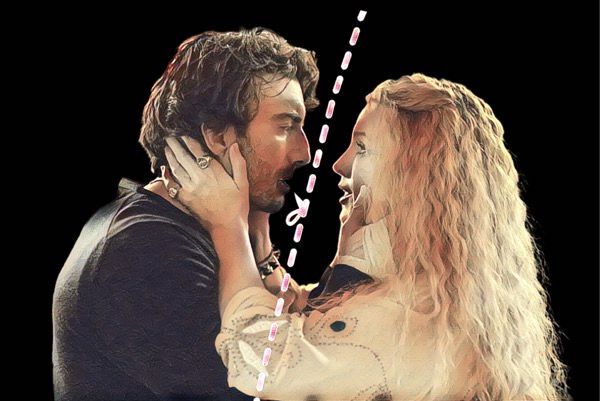
Defamation is not enough: how a smear campaign works
The word defamation still has its place, especially in legal contexts, where it refers to the false attribution of wrongdoing, but it proves insufficient when applied to the digital environment, where reputational damage rarely depends on a single, clear accusation.
The expression “smear campaign” comes from a simple verb, to smear, meaning to stain, to blur, to spread something in a way that removes its clarity. When applied to people, the meaning remains close: it is about staining a reputation until it begins to be perceived through a single negative frame, even when that frame is built from partial fragments.
The most delicate aspect is that, in some cases, this construction is not merely spontaneous. Court documents, internal messages and communication strategies reveal that public perception can be shaped with professional logic, creating the impression of an organic movement that is, in practice, being strategically guided and amplified.
This does not turn all criticism into manipulation, but it does prevent public reaction from being read as entirely neutral or disinterested.

When debate stops being analysis and becomes erosion
Recognizing a smear campaign does not depend on a single piece of proof, but on recurring patterns that, when observed together, indicate that the nature of the discussion has shifted.
A framing that spreads almost simultaneously across different profiles, moral certainty growing faster than available evidence, ambiguities treated as conclusions, fragments presented as totality, and a shift in tone where analysis gives way to exposure and humiliation combine to transform discussion into a continuous process of erosion.
This type of dynamic has been identified across different contexts as particularly aggressive toward women in public positions, not only because of the content of the criticism, but because of how those criticisms are organized, reiterated and transformed into dominant interpretation.
What actually happened with Blake Lively
The case was not extinguished. Retaliation claims remain, along with the possibility that a jury may evaluate whether there was an attempt to damage her reputation or deliberately weaken her professional standing. This detail prevents a linear reading, because the case was both reduced and preserved in central aspects.
The discomfort lies exactly there. The dominant narrative demands a clear verdict, but what exists is a scenario in which relevant losses coexist with unresolved issues, requiring a type of reading that the digital environment rarely encourages.

Resistance or denial: a poorly framed question
Blake’s insistence, or perhaps her perseverance, in positioning herself as someone who experienced bullying, defamation, harassment and misogyny has been interpreted, in many spaces, as a sign of denial, as if maintaining this narrative were incompatible with the legal developments.
This reading rests on a simplification that ignores what is still under dispute. The case was not fully dismantled, and its continuation prevents that posture from being automatically reduced to a refusal of reality. What is at stake is not limited to what was legally accepted or rejected, but involves the dispute over which version will be recognized as legitimate.
There is also an element that often escapes attention. The subjective experience of a hostile environment does not always translate directly into legal categories, and the attempt to keep that experience visible may respond less to denial and more to the perception that, as public narrative reorganizes itself, certain aspects of that experience begin to be excluded.
This gap between individual perception and collective interpretation becomes even more evident when observing how the case has been read outside the courtroom. The reaction does not organize itself uniformly, but reveals a division that helps explain why the narrative dispute remains so active.
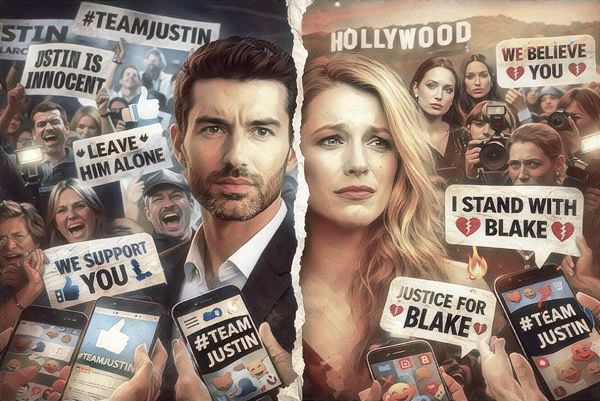
On one side, what could be described as a “Team Blake” perspective is grounded in the idea that Justin Baldoni, a director still consolidating his position, anticipated the conflict by hiring a crisis management team to deal with criticism and possible accusations that could emerge from the filming process itself. In this interpretation, that decision does not appear as a reaction, but as an indication that a public confrontation was expected, which in turn supports the hypothesis that what followed was not entirely spontaneous.
On the other side, the reading associated with what has been framed as “Team Baldoni” organizes the same set of facts differently. Blake Lively is seen as someone who sought to expand her control over the project, pushing for creative recognition and mobilizing her symbolic capital, including her proximity to Ryan Reynolds and Taylor Swift, referenced in messages as “dragons.” In this interpretation, the breakdown of the relationship does not stem from a single incident, but from an accumulation of tensions that led to distancing, restrictions and eventually to Baldoni’s exclusion from key moments of the film’s release.
The most delicate point is that these two readings do not cancel each other out easily. Hiring a PR team can be interpreted both as a defensive measure and as preparation for a broader confrontation. Messages suggesting the possibility of “burying” someone online may indicate active intent, but they also exist within a context in which the digital environment was already primed to absorb and amplify negative narratives.

This is precisely where the issue becomes harder to resolve. It is not only a matter of establishing what was done, but of understanding to what extent the fallout results from deliberate action or from an environment already predisposed to amplify certain framings.
The difficulty of proving that boundary, between strategic intervention and the activation of a flow that already existed, may be the most revealing aspect of the case, because it shifts the discussion away from a simple cause-and-effect logic into a field where intention, perception and context become deeply entangled.
Other cases, same pattern
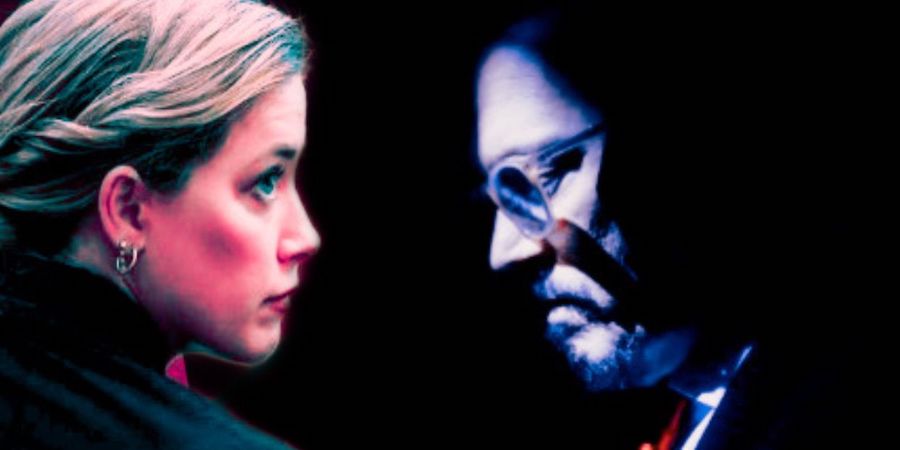
What is happening here is not isolated. It resonates directly with the public confrontation between Johnny Depp and Amber Heard, where legal proceedings were accompanied by a large-scale narrative battle.
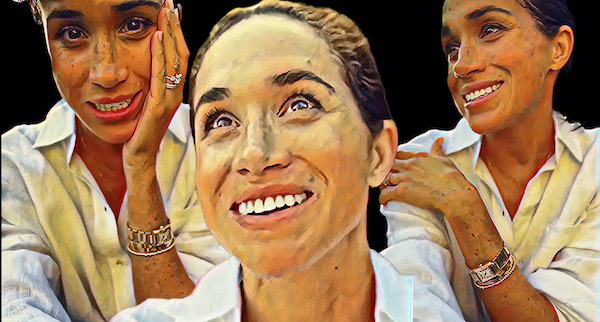
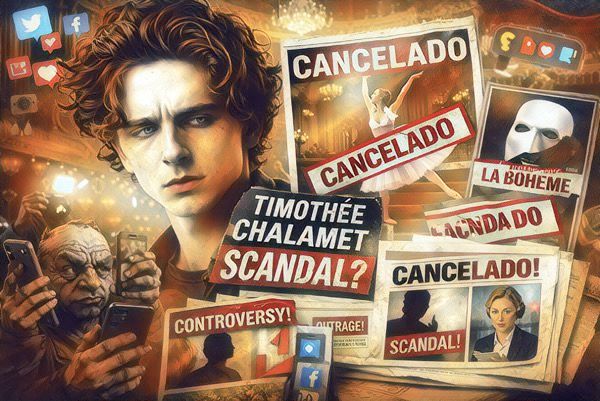
The same logic appears in readings of Meghan Markle, where criticism, bias and image disputes overlap, and in reactions to figures such as Timothée Chalamet and Karla Sofía Gascón, where public judgment reveals as much about the environment as it does about the individuals themselves.

The logic behind narrative construction
In this context, the film Our Brand Is Crisis functions less as an exception and more as a key for interpretation. Produced by George Clooney and starring Sandra Bullock, it was not a major box office or critical success, but it is based on the 2005 documentary of the same name and presents a fictionalized account of the involvement of the political consulting firm Greenberg Carville Shrum (GCS) in the 2002 Bolivian presidential election.
It operates almost as a case study of what is being discussed here, following a communications team tasked with reshaping a candidate’s image, relying not only on policy proposals but on the construction of an emotional frame capable of guiding public perception.
What is at stake is not simply persuasion, but defining how reality itself will be interpreted. By turning the opponent into a negative symbol and repeating that framing until it becomes familiar, the campaign shows that controlling narrative is often more decisive than presenting isolated facts.
That logic, which appears deliberately constructed in the film, now operates in a more diffuse way within the digital environment, where different actors participate, consciously or not, in the dispute over meaning.
The limits of containment
Once a narrative is established, attempts to reorganize perception face clear limits. Corrections do not circulate with the same intensity as accusations, court decisions do not compete with viral content, and the dispute unfolds in a space where speed outweighs consistency.
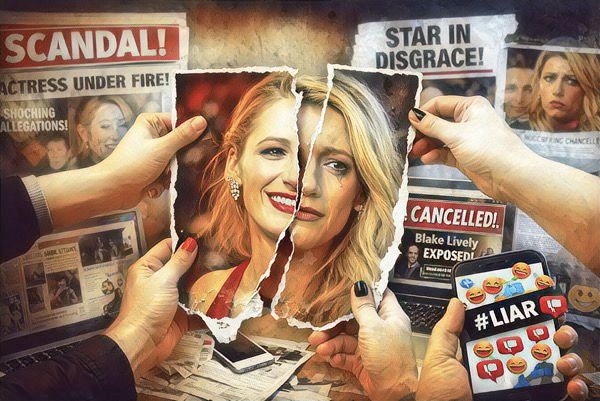
What remains possible is to dispute framing, to register more consistent versions and to try to prevent distortion from becoming total, even knowing that it will rarely be fully reversed.
How to read all this without falling into automatic thinking
Returning to the initial question requires accepting a level of discomfort that the digital dynamic itself tends to reject. Defamation remains an important category, but not sufficient to explain what happens online. Smear campaigns exist, but not every attack is coordinated. Denial is a possible mechanism, but it cannot be assumed.
Different layers can coexist within the same case without eliminating each other, and recognizing this does not resolve the conflict, but it prevents it from being reduced to a single narrative that, once accepted, begins to determine everything that can or cannot be seen.
After an unsuccessful attempt at settlement, the trial between Blake Lively and Justin Baldoni is scheduled to begin on May 18, 2026, in New York. What has not yet been fully organized into narrative may begin to take a different shape once public testimony is finally exposed.
Descubra mais sobre
Assine para receber nossas notícias mais recentes por e-mail.

