
In 1983, during the filming of the Say Say Say music video, Michael Jackson visited a property in California where Paul McCartney was staying. The place was not yet called Neverland, nor did it carry any symbolic weight. It was simply an isolated ranch, with vast landscapes, silence, and an architecture that suggested refuge, but something about that space seems to have marked the singer.
Five years later, already at the absolute peak of his career, Michael returned. In March 1988, he purchased the property for an estimated amount between 19.5 and 30 million dollars and changed its name: for Michael, that place was Neverland.
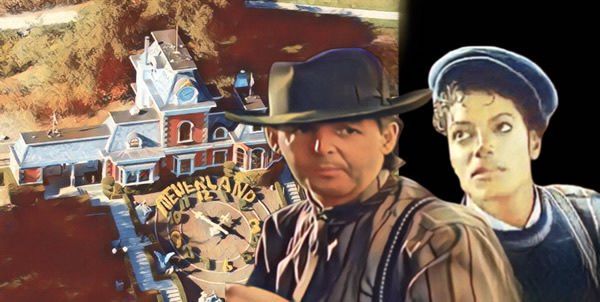
The choice was not symbolic in an abstract sense. It was literal. Obsessed with Peter Pan, Neverland ceased to be a reference and became a territory, and the most emblematic property of Michael Jackson, located in Santa Barbara County, California, near the regions of Los Olivos and Santa Ynez, on the edge of the Los Padres National Forest.
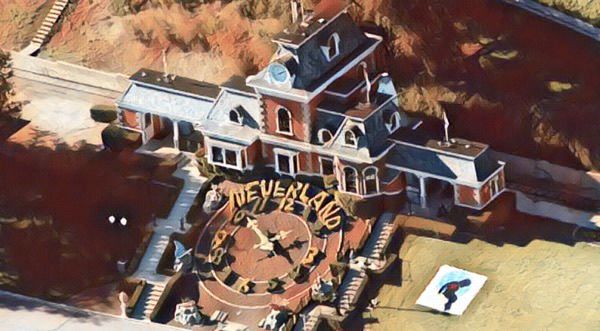
Originally called Zaca Laderas Ranch and later renamed Sycamore Valley Ranch in the early 1980s, the property already existed as an ambitious rural refuge before reaching Michael’s hands. The main house, completed in 1982, was conceived as an idealized country mansion, with formal gardens, a stone bridge, a four-acre lake with a waterfall, and an architecture that already sought a kind of aesthetic perfection isolated from the surrounding world.
The childhood that never existed as childhood
To understand Neverland, it is necessary to return to what Michael Jackson never stopped repeating: the feeling of having lost his childhood.
Born in 1958 in Gary, Indiana, he grew up in a small house with nine siblings, under strict discipline imposed by his father. From the age of five, he was already participating in Jackson 5 rehearsals, inserted into a routine that mixed work, pressure, and constant exposure. Childhood, as a space of spontaneity, practically did not exist, as the film Michael manages to show.
With the group’s success, the family moved to California in the early 1970s and began living in Encino, in the house known as Hayvenhurst. The move represented social ascension, but it did not alter the central dynamic. The environment remained collective, structured around the career, with little room for individuality, as shown in the film.
It was in this address that Michael went through adolescence, already a star, but still without full autonomy. The break began to consolidate in the 1980s, especially after Off the Wall and, above all, Thriller. He gradually distanced himself from the family home and sought a space no longer tied to that dynamic.
Before Neverland, he lived for a period in a luxury apartment in Century City. The space was sophisticated, but it did not respond to what he seemed to be looking for. The purchase of the ranch emerged as a response to this search because it was not just a change of address.
It was the creation of a territory of his own.
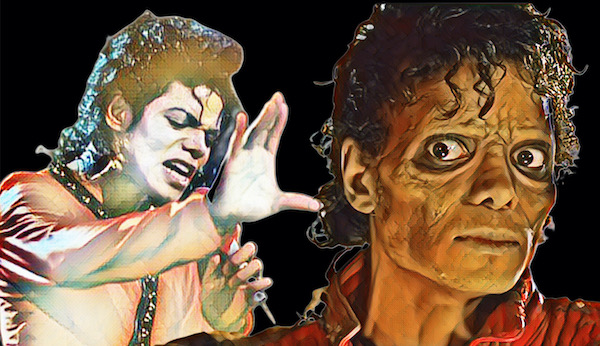
The creation of Neverland: when fantasy takes concrete form
Upon taking over the ranch, Michael began a transformation that went far beyond architecture.
He built a full amusement park within the property. A Ferris wheel, carousel, roller coaster, bumper cars, arcades, a cinema, a zoo, and train tracks became part of the space.
The internal railway system is particularly revealing of this logic. There was more than one train line within the property, including the Neverland Valley Railroad, with a steam locomotive named Katherine, in honor of his mother, in addition to other trains and tracks that crossed the land as if it were a private theme park.
The main house also incorporated elements of security and control, including even a hidden safe, reinforcing that Neverland was not only a fantasy, but also a carefully managed environment.
Nothing there was casual.
Neverland was not conceived as a home, but as a continuous setting where childhood could be experienced permanently. The relationship with Peter Pan, a character with whom Michael always identified, ceased to be a reference and began to structure the space.
The idea was not to remember childhood, but to keep it in operation.
Who lived in Neverland, and why it was never simple
Although it was his residence, Neverland never functioned as a conventional home. Michael lived there surrounded by an extensive team of employees responsible for maintenance, security, operation of the attractions, and care of the animals. The scale of the ranch required a permanent structure.
At the same time, Neverland was constantly occupied by guests, especially children. Michael hosted groups from hospitals, charities, and invited families, often staying for days.
This flow was not incidental, but part of the logic of the place.
Neverland also functioned as a stage for public and media events. Elizabeth Taylor’s wedding took place there in 1991. In 1993, it was the setting for the interview given to Oprah Winfrey, one of the most-watched of his career. In 1995, it hosted an international children’s congress, bringing together participants from different countries.
His children frequented the ranch at different moments, although he became progressively more private regarding their exposure.
Celebrities and friends visited the space, but Neverland never operated as a typical social hub. It was a controlled environment, where the presence of others was part of a dynamic that went beyond the idea of domestic life.
The scandals and the irreversible shift in meaning
From 1993 onward, this construction began to be crossed by another type of reading. The allegations of child sexual abuse placed Neverland at the center of a controversy that completely altered its public perception. The space that symbolized the attempt to reconstruct childhood began to be associated with suspicion.
In the 2000s, especially after the documentary Living with Michael Jackson and the process that culminated in the 2005 trial, this association intensified. The ranch became the target of search warrants and a central element of the accusations. Although Michael was acquitted criminally, the impact was irreversible. Neverland ceased to function as a refuge and began to be seen as evidence.
The departure: when the refuge ceases to exist
In 2005, shortly after his acquittal, Michael Jackson left Neverland and stated that he no longer considered the place his home. He never returned to the property.
His departure was not only physical, but emotional. After leaving, he was never the same, as the space had been built as an extension of his identity.
In the following years, the property faced financial difficulties, the risk of auction, and restructuring of ownership. In 2008, the ranch nearly went to auction due to millions in debt, later saved through agreements with investors.
In the concrete process of emptying Neverland, the rides were removed and sold, the zoo was dismantled, the animals left the property, and the space gradually returned to a configuration closer to that of a high-end rural estate.
What Neverland is today
After Michael Jackson died in 2009, the ranch spent years on the market, with its value progressively declining due to the difficulty of separating the place from its history.
In 2020, it was sold to businessman Ron Burkle for around 22 million dollars, a value significantly lower than what it once represented. Today, the property exists as Sycamore Valley Ranch. No park, no circulation, no narrative.

Neverland as an attempt and as a limit
The importance of Neverland in any narrative about Michael’s life — especially in light of the continuation studios’ claim to be developing — is undeniable. More than a physical space, it functioned as the concrete extension of the life he tried to build for himself, like a modern Peter Pan.
But Neverland also carries the contradiction that defines that attempt. It was, at once, a territory of happiness and, possibly, of pain, built upon an idea that could never sustain itself over time.
Today, it is increasingly erased from official narratives. And yet, it remains alive where it perhaps always belonged: in memory.
Descubra mais sobre
Assine para receber nossas notícias mais recentes por e-mail.


1 comentário Adicione o seu