
If Freud taught the twentieth century to distrust its own certainties, cinema has never managed to treat him as a fully stable figure. Somewhere between the doctor who inaugurates a new field of thought and the man who also runs up against his own limits, each portrayal seems less interested in fixing him than in testing him. Perhaps that is why he appears less often as a protagonist than one might expect, and, when he does, almost always at moments of transition: when the theory does not yet exist, when it begins to fracture, when it has already become a legacy — or when it no longer explains everything.
The ranking below organizes these appearances through that movement. It is not just a list of films about Freud, but a trajectory that follows how cinema itself has adjusted its relationship to him.
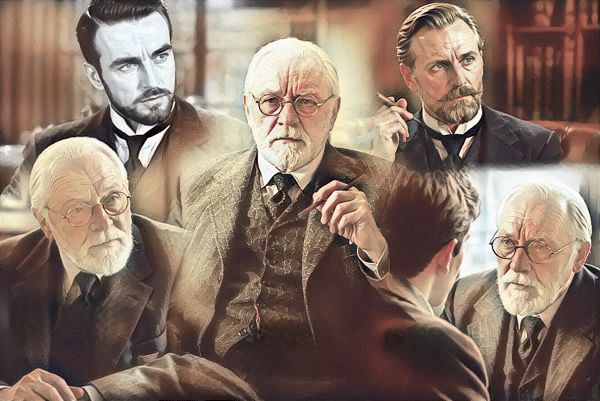
1. Freud (1962) — Montgomery Clift
Directed by John Huston, the film follows Freud’s formative years, when he is not yet the figure we recognize, but a physician in conflict with the limits of his time. There is an almost clinical interest here in process rather than myth: the study of hysteria, the use of hypnosis, the break with mentors and peers. Montgomery Clift portrays Freud as someone consumed by his own search, which inevitably gains another layer when one considers the actor’s personal fragility at that moment. The result is a less assured Freud than popular imagination tends to suggest, closer to someone feeling his way in the dark while building a theory he is not yet certain will endure.
2. A Dangerous Method (2011) — Viggo Mortensen
David Cronenberg shifts the focus from biography to the relationship between Freud, Jung, and Sabina Spielrein, turning the birth of psychoanalysis into a field of forces where desire, power, and rivalry intersect. Viggo Mortensen constructs a restrained, ironic Freud, fully aware of the weight of his ideas and the need to control them. Alongside Michael Fassbender and Keira Knightley, the film reveals something often lost in more didactic readings: psychoanalysis is born not only from theory, but from personal tensions, unstable bonds, and clashing worldviews that cannot fully coexist.
3. Freud’s Last Session (2023) — Anthony Hopkins
Here, Freud is no longer beginning, but approaching the end. The film imagines a meeting with C. S. Lewis and uses that encounter to explore religion, suffering, war, and mortality. Anthony Hopkins portrays a tired, sharp, yet still intellectually incisive Freud, someone who no longer needs to prove anything but continues thinking until the very end. The presence of Anna Freud introduces an intimate dimension rarely seen in other portrayals, shifting the character from a purely theoretical figure into a more domestic and therefore more vulnerable space.
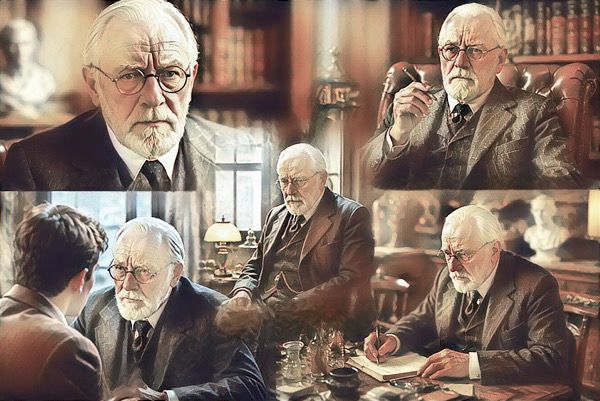
4. Young Freud (1976) — David Suchet
Less widely known, this television film returns to the period before recognition, emphasizing Freud as an outsider still trying to assert himself in an environment that does not yet welcome him. Long before Poirot, David Suchet builds the character through observation, almost as someone who records the world before he can explain it. While the film does not have the same reach as the others, it offers an important angle: Freud does not emerge as a ready-made authority, but as someone who constructs his position from a certain displacement in relation to what already exists.
5. The Tobacconist (2018) — Bruno Ganz
In Nikolaus Leytner’s film, Freud appears at the end of his life, in a Vienna on the verge of being overtaken by Nazism. Played by Bruno Ganz, he becomes a kind of interlocutor for a young man trying to understand love, desire, and his own emotional confusion. What the film does, with rare subtlety, is shift Freud from the position of one who explains to one who recognizes the limits of explanation. There is a quiet irony in this reversal: when faced with the most intimate questions — precisely the territory psychoanalysis helped to name — Freud does not offer definitive answers. He hesitates, deflects, admits not knowing. And perhaps this is the most contemporary portrayal of all, because it refuses the idea of total knowledge and places Freud back where he may always have been: not as someone who resolves, but as someone who opens questions.
Taken together, these portrayals do not form a fixed image, but a continuous displacement. Freud on screen begins as discovery, moves through conflict, becomes legacy, and ends — at least for now — as limit. And perhaps that is precisely where he remains most relevant.
Descubra mais sobre
Assine para receber nossas notícias mais recentes por e-mail.

