
With a premiere set for June 21, the third season of House of the Dragon begins to take shape even before a single scene airs. There are Easter eggs — or rather, spoilers — for those already familiar with what this stage of the story holds. If you think you’ve seen drama, there is more to come.
The new poster does not arrange its characters to sell confrontation, but to expose a consequence. By fragmenting the Iron Throne into blades that press against everyone, the image abandons the idea of power as conquest and instead frames it as a space of erosion. There are no potential winners here, only figures distributed around a center that no longer guarantees control.
Rhaenyra occupies the throne, but does not command it. Alicent and Helaena recoil, compressed by a structure they helped sustain. Daemon reaches upward without grasping. Corlys watches, but without the promise of victory. And the younger generation reacts, without real choice. More than anticipating war, the poster suggests a season in which conflict has moved beyond any possibility of mediation and begins to operate as fate. As the tagline states: win or die. There will be losers on both sides.
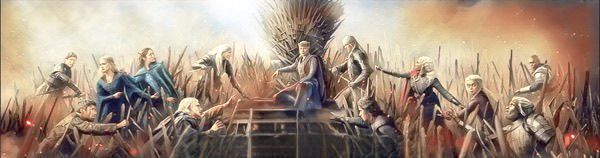
The throne as epicenter, not solution
In the full composition, the Iron Throne does more than centralize the image; it radiates conflict. The swords no longer form a recognizable, almost architectural structure, as they once did in Game of Thrones. They multiply, invade the characters’ space, and create a constant sense of instability. Everyone is under the violence of the blade.
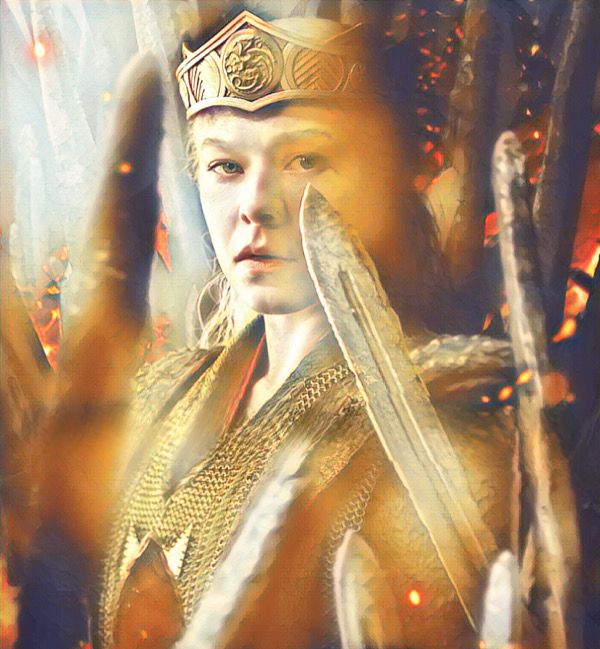
Rhaenyra is positioned at the highest point, yet the composition does not protect her. Her body leans, her gaze avoids direct confrontation, and her posture suggests vigilance rather than command. The throne, here, does not organize power. It fractures it. And no one truly sits in control of it.
The staircase: everyone ascends, no one arrives
A detail that gains strength in the full, diagonal composition is the staircase. It structures the characters’ movement, but offers no resolution. Everyone is in motion, yet no gesture is completed. On one side, the blacks; on the other, the greens.
Daemon defends his wife, while Aemond, holding the Targaryen dagger, is fixed on his uncle. This is clearly a teaser for the confrontation fans have long anticipated, though one that will likely only fully unfold in the final season.
There is something deeply tragic in seeing Jacaerys reaching toward his mother, yet doing so alone. We will have little time with the prince, and his absence will likely be felt.
With the series removing Nettles and redistributing narrative weight to Daemon’s daughters, Rhaena and Baela gain greater presence. Rhaena appears distracted in her struggle to protect her sister, her gaze directed toward something beyond the frame. Below them stands their grandfather, Corlys Velaryon, aligned with Rhaenyra yet not fully taking a side, watching everything with a sense of horror. This visual also aligns closely with events in the book.
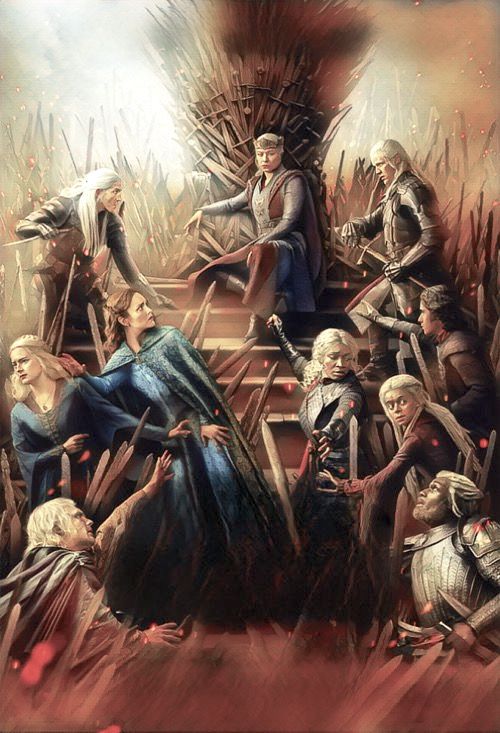
On the greens’ side, the dynamic shifts.
Aemond remains fixed on Daemon, but Alicent and Helaena move laterally, in retreat. The young queen does not even look back; she shows no impulse toward the Iron Throne, while Alicent looks toward Rhaenyra in visible fear. Below them, Aegon is the only one who actively throws himself toward the position he now, more than ever, claims as his.
In this way, the staircase, which in other narratives would function as a path to ascension, becomes here a space of impasse. To rise does not mean to arrive. To remain does not mean to control.
Alicent is at the center of a chaos she no longer controls
When isolated in earlier crops, Alicent already appeared pressured. In the full poster, this intensifies. She occupies a central position at the base of the throne, almost as a point of articulation between the two sides, yet her body turns outward, reacting rather than commanding.
The green of her costume, once a clear political marker, now dissolves into the surrounding environment. She no longer leads a faction. She attempts to orient herself within a structure that no longer responds to the logic she helped construct.
In the horizontal version, we also glimpse her cousin Ormund Hightower — who enters this season — moving to assist her. Amid the blades, wounded, stands Ser Criston Cole, ignoring his former lover and directing his weapon toward Rhaenyra.
The slogan as a sentence
In Cersei Lannister’s voice, early in Game of Thrones, the phrase that encapsulates survival in Westeros echoes around the Iron Throne: in war, you either win or you die. That is why “win or die” stretches across the top of the image as a definitive statement. And yet, the poster itself seems to question it, because no one appears to be in a position to win.
What the image constructs is not a battle between two sides, but a system in collapse, where victory may no longer hold meaning. The throne remains as an object, but loses its function as a promise.
What the poster anticipates about the season
By integrating all these elements, the poster moves beyond promotion and becomes a narrative synthesis. The season premiering on June 21 is not presented as a continuation of a dispute, but as the deepening of an exhaustion.
If earlier seasons still allowed space for negotiation, strategy, and the construction of power, everything here points toward a war that has moved past that stage. Conflict no longer organizes the characters. It passes through them.
And perhaps this is the most radical shift the series proposes now: not asking who will win, but what remains once winning is no longer a real possibility.
Descubra mais sobre
Assine para receber nossas notícias mais recentes por e-mail.


2 comentários Adicione o seu