
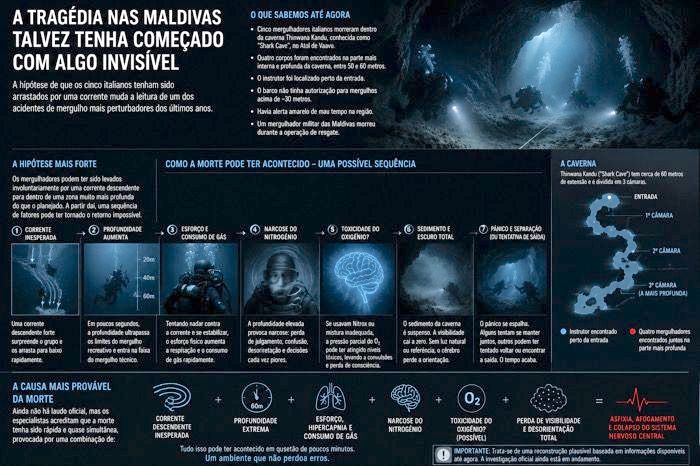
As more information emerges about the deaths of the five Italian divers in the Maldives, it becomes harder to treat the tragedy simply as a case of extreme recklessness. Among diving specialists and investigators, a more complex — and perhaps more frightening — hypothesis is beginning to gain traction: that the group may have been carried involuntarily into depths far beyond what had originally been planned.
There is still no official conclusion about what happened inside the so-called “Shark Cave” in Vaavu Atoll. But several details already help explain why the case has shocked even experienced divers.
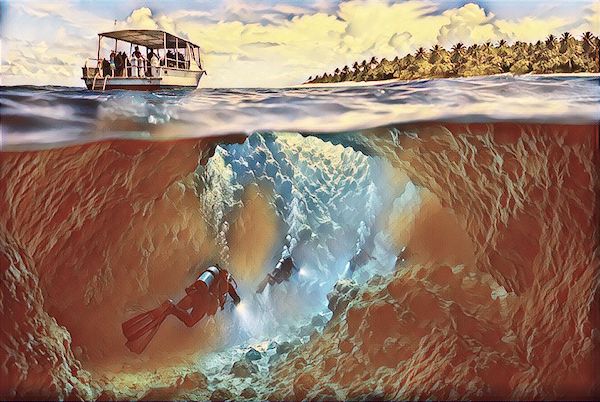
The bodies were found in the third and deepest section of the cave, between 50 and 60 meters underwater. That detail stands out because the boat used by the group reportedly did not have authorization for dives deeper than roughly 30 meters. There had also been a yellow weather warning in the region shortly before the accident.
None of this proves that the divers were dragged downward by a descending current. But it does reinforce the possibility that something moved dramatically outside the limits of the original dive plan.
The Vaavu region is known precisely for its violent and unpredictable underwater currents. In certain areas, the water can suddenly change direction, creating downdrafts capable of displacing even highly experienced divers. Around walls and cave systems, depth perception can also become distorted, especially under physical stress and low visibility.
If that hypothesis is correct, the group may have entered a rapidly escalating chain of problems. The deeper a diver descends, the greater the pressure on the body and the smaller the margin for error. Fighting against a current increases gas consumption, accelerates breathing, and makes spatial orientation even more difficult.
And then there is the cave itself.
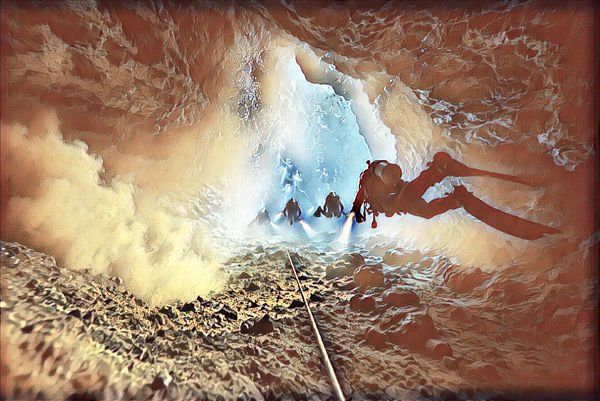
Cave diving is considered one of the most dangerous forms of technical diving because it removes the one thing that usually saves a diver in an emergency: the ability to ascend directly to the surface. When sediment is disturbed, visibility can disappear completely within seconds. Without natural light or spatial reference points, even trained professionals can lose all sense of direction.
There is another factor that investigators and diving specialists also consider plausible, although it has not been officially confirmed: hyperoxia, also known as oxygen toxicity.
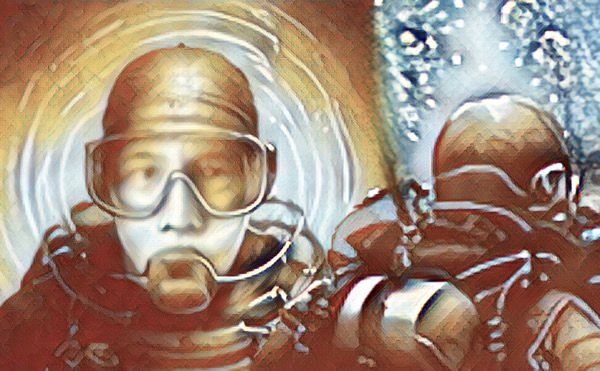
In deep dives, pressure completely changes the way gases behave inside the human body. Oxygen-enriched mixtures such as Nitrox can be extremely useful at shallower depths, but they become dangerous when used too deep underwater. Beyond certain limits, oxygen stops functioning merely as a vital element and begins acting as a toxin to the central nervous system.
If the group rapidly reached depths of 50 or 60 meters while using a gas mixture unsuitable for that depth, the risk of sudden convulsions, loss of consciousness, and drowning would have increased dramatically. Specialists believe that, in situations like these, death does not occur exactly “from hyperoxia” itself, but from the physical collapse and drowning that follow seconds after the diver loses consciousness.
The problem is that, inside a cave, an individual emergency can become a collective tragedy almost instantly.
If one diver starts experiencing distress, the others instinctively try to help. Physical exertion intensifies. Breathing accelerates. Carbon dioxide builds rapidly inside the body. Sediment spreads through the cave. The water turns into a wall of darkness. And without any visual reference, the brain completely loses its orientation.
That is why some specialists are considering the possibility of a domino effect: a rapid succession of disorientation, extreme exertion, possible gas toxicity, and cascading loss of consciousness.
The fact that four bodies were found together in the deepest section of the cave suggests the group likely tried to remain united. Meanwhile, the instructor found closer to the entrance may indicate an attempt to return or relocate the exit, though that too remains under investigation.
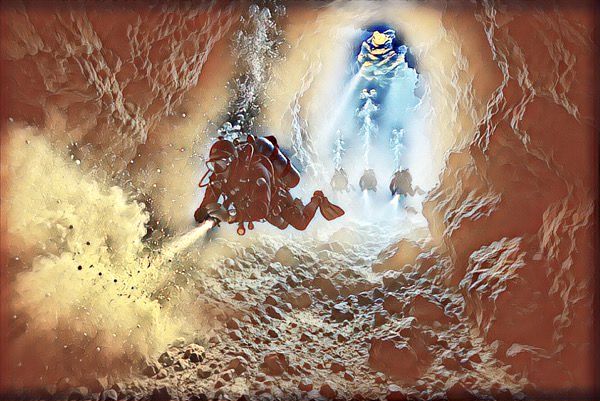
Ironically, the sharks themselves appear to have been the least dangerous part of the environment. The name “Shark Cave” helped turn the case into a global headline, but the real danger may have come from something far less visible: currents, pressure, depth, and disorientation.
And perhaps that is what makes the story so unsettling. There are no clear signs of a single cinematic mistake or an obviously suicidal decision. The picture beginning to emerge is one of a situation that may have changed far too quickly, even for people deeply familiar with the sea.
Because if they really were carried into depths beyond the original plan, there may have been a moment when the dive stopped being scientific exploration and became simply a desperate attempt to find a way back.
Descubra mais sobre
Assine para receber nossas notícias mais recentes por e-mail.

