
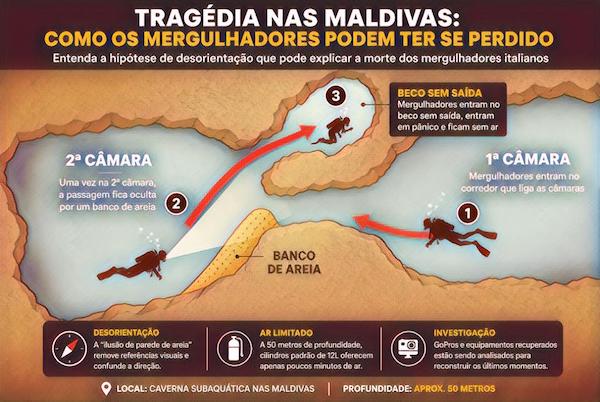
As new details emerge about the deaths of the five Italian divers in the Maldives, the tragedy becomes even more unsettling because it challenges the simplistic idea of recklessness or an obvious technical mistake. According to reports from the Italian press, investigators are now working with the hypothesis that the experienced group may have unknowingly entered the wrong tunnel during their ascent after being disoriented by what divers describe as a kind of “sand wall illusion” inside the submerged cave.
The bodies were found in a dead-end corridor about 50 meters below the surface.
It is a technically plausible and emotionally devastating theory. In cave diving, especially at significant depths, a single wrong movement can stir up sediment from the bottom and transform the water into a completely opaque mass. Visibility disappears almost instantly. Ceiling, floor, exit, and direction stop functioning as clear references. What remains is a claustrophobic labyrinth made even worse by the fact that the human body was simply not designed to rationally process darkness, pressure, and disorientation all at once.
And perhaps that is exactly what makes this story so disturbing: the realization that experience alone does not necessarily protect someone from a few fatal seconds of confusion.
At around 50 meters deep, air consumption increases dramatically because of pressure. Specialists interviewed by the Italian media estimate that, with standard 12-liter tanks, the group would have had only a few minutes of usable air left at that depth. Under normal circumstances, that already demands absolute control. Under stress, however, the body begins to operate differently. Breathing accelerates, carbon dioxide builds up, reasoning starts to fail, and panic stops being merely emotional and becomes physiological.
Many deep-diving deaths happen exactly this way: not through one sudden cinematic catastrophe, but through a sequence of minutes in which the brain gradually loses the ability to correctly interpret the environment around it.
The recovered GoPros may help investigators reconstruct those final moments. The central question now is whether the group lost the cave’s guideline, mistakenly entered the wrong corridor believing it led to the exit, or whether the so-called “sand wall” made it impossible to distinguish any direction at all.
There is something particularly cruel in the possibility that, for at least some time, they believed they were still moving toward safety.
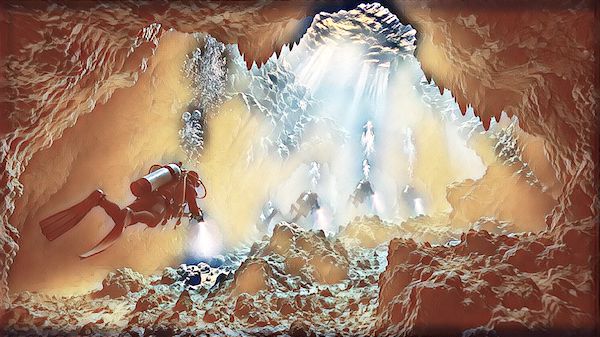
Cave diving has always been considered one of the most dangerous forms of diving, precisely because it leaves no room for error. Unlike open water, where reaching the surface remains a relatively intuitive escape route, submerged caves turn depth into confinement. It is not enough to swim upward. You must find the exact path back.
And in environments like these, a few minutes of confusion can be enough to turn experience into helplessness.
Descubra mais sobre
Assine para receber nossas notícias mais recentes por e-mail.

