
The first images of Laura Dern filming the new season of The White Lotus started circulating online this week, and while they still reveal very little about the plot itself, they already seem to confirm an unavoidable feeling: something has changed profoundly in Mike White’s series.
The photos show Dern looking stunning in a sequence set on the Cannes red carpet, surrounded by other characters and the kind of artificial glamour the French festival has turned into its own language. Officially, her character is described as a fading actress, but nothing in the images suggests someone diminished or invisible. Quite the opposite. Laura appears magnetic, sophisticated, perfectly integrated into that ecosystem of international celebrity figures trying to preserve relevance while continuing to perform youth, importance, and desirability.
And maybe that is precisely the point.
Because “decline” in Hollywood rarely means visually disappearing. More often, it means remaining beautiful while the industry slowly starts treating you like the past. It is a very specific kind of contemporary tragedy: the moment someone still possesses charisma, wealth, fame, and beauty, yet realizes they no longer control the narrative surrounding themselves.
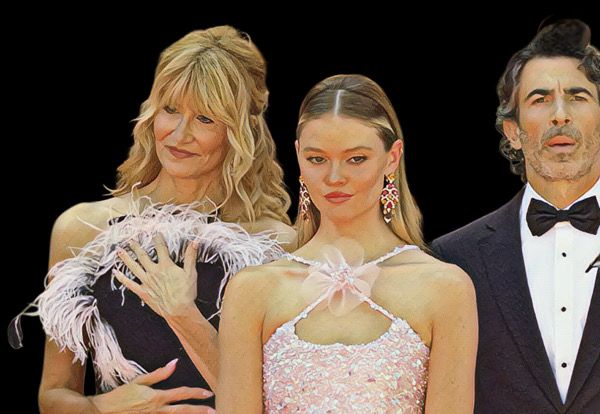
Laura Dern feels perfect for that. Helena Bonham Carter perhaps would have taken the role toward something more eccentric, tragicomic, or deliberately chaotic. Dern, on the other hand, conveys something more polished and painful: intelligent women trying to survive inside a machine that turns female aging into a silent threat.
And the images inevitably raise a bigger question: did the character fundamentally change after Helena Bonham Carter’s departure, or was this simply a rare case of complete miscasting in The White Lotus?
Because looking at the visual tone of the Cannes shoot now, Laura makes immediate sense. More than that: Cannes itself makes sense, perhaps for the first time since the series premiered.
Until now, The White Lotus has always operated around a very specific structure. The resort was less a vacation setting and more a luxurious emotional prison. Even in Sicily, when characters traveled through boats, villas, and Italian streets, everything still orbited the hotel as the narrative’s gravitational center. Thailand expanded the show’s spiritual and existential dimensions, but again within the claustrophobic logic of the resort.
Now, apparently, not anymore.
Information surrounding the new season points to two different hotels, constant movement throughout Cannes, scenes at the Palais, and filming spread across multiple festival-related locations. That fundamentally alters the series’s dynamic.
The Cannes Film Festival may be the most performative environment on the planet. Nobody is simply existing there. Everyone is acting all the time. Actors trying to appear relevant. Directors trying to appear brilliant. Influencers are trying to appear sophisticated. Executives are trying to appear artistic. Artists are trying to appear accessible. Everyone is performing some idealized version of themselves while negotiating status, attention, and desirability.
In a way, Cannes already naturally functions as a White Lotus, but there is also a massive risk in that.
What made the series work so brilliantly was its ability to transform luxury into psychological confinement. The characters were trapped with each other. Trapped inside their own neuroses. Trapped inside the hotel. Trapped inside the impossibility of escaping themselves. Once the narrative starts expanding too visually, there is the danger that The White Lotus simply becomes a “bigger” show filled with glamorous locations and international movement, but without the suffocating tension that made every dinner feel uncomfortable and every conversation potentially explosive. At the same time, repeating the same structure for a fourth season may have been an even bigger risk.

Season three already carried something close to thematic closure. Hawaii explored colonialism and inequality. Italy immersed itself in sex, fantasy, and desire. Thailand seemed obsessed with existential emptiness, spirituality, and symbolic ego death. There was something more melancholic about that season, almost as if Mike White was slowly dismantling his own characters in front of the impossibility of transcendence.
Cannes feels like something else entirely: less spiritual retreat and more celebrity-manufacturing machine, also less contemplative silence and more permanent spectacle. Maybe that is exactly why the Laura Dern images create so much curiosity — and a little fear at the same time. They do not simply feel like the reveal of a new character. They feel like the reveal of an entirely new phase for The White Lotus. Perhaps even a rebirth.
The irony is that Cannes may actually be the perfect setting for this evolution precisely because nobody there can separate identity from performance anymore. The entire festival operates like one massive stage where beautiful, wealthy, and influential people attempt to convince each other — and themselves — that they still matter.
Deep down, Mike White may have finally found a place even more toxic than any resort the series has ever featured.
Descubra mais sobre
Assine para receber nossas notícias mais recentes por e-mail.

