
Sam Neill, one of the most beloved and quietly elegant faces in cinema over the past five decades, died on Monday, July 13, 2026, at the age of 78. He died in Sydney, and his family described his death as “sudden and unexpected.” The cause has not been disclosed. In a statement published on the actor’s social media accounts, his family emphasized that he remained cancer-free after the illness he had faced in recent years.
For millions of viewers, Sam Neill will always be Dr. Alan Grant, the paleontologist who sees a living dinosaur for the first time in Jurassic Park and, for a few moments, looks every bit as stunned as the audience watching him. It is one of the great character introductions in popular cinema: long before Grant has to face velociraptors, the restrained wonder on Neill’s face has already convinced us that the impossible is happening.
Neill returned to the role in Jurassic Park III, released in 2001, and again in Jurassic World Dominion in 2022, reuniting with Laura Dern and Jeff Goldblum. Alan Grant became one of those characters who never needed grand speeches to remain in the public imagination. He was a reluctant hero: intelligent, impatient and profoundly human. Much of that was in the script, but a decisive part came from Neill himself — from the almost invisible irony, the quiet authority and that rare ability to convey emotion without ever seeming to perform it.
It would be unfair, however, to reduce Sam Neill to dinosaurs. His career included more than 120 roles in film and television, moving between independent productions, Hollywood blockbusters, historical dramas, horror films, adventures and some of the most unsettling works in modern cinema.
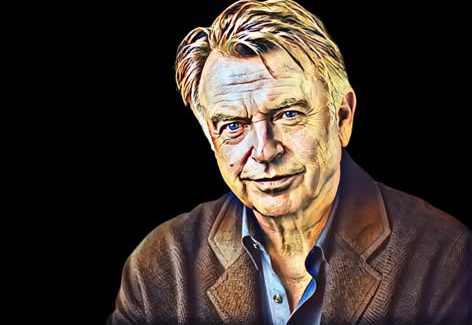
Long before the dinosaurs
Born Nigel John Dermot Neill on September 14, 1947, in Northern Ireland, he moved to New Zealand with his family as a child, remaining deeply connected to the country throughout his life. He adopted the name Sam during childhood and began his professional career behind the camera, directing and editing documentaries for New Zealand’s National Film Unit.
His breakthrough as an actor came with Sleeping Dogs in 1977, widely regarded as a landmark in New Zealand cinema. Soon afterward, his performance in My Brilliant Career, directed by Gillian Armstrong and starring Judy Davis, attracted international attention. From that point on, Neill began building a career that would never depend on a single kind of character.
He could play the Antichrist in Omen III: The Final Conflict and then, in his next film, plunge into one of the most extreme performances of his career in Andrzej Żuławski’s Possession. Opposite Isabelle Adjani, he took part in a story of separation, paranoia and body horror that was initially received with discomfort but would later be recognized as a cult classic.
In Dead Calm, released in 1989, he shared the screen with Nicole Kidman in a claustrophobic thriller directed by Phillip Noyce. The following year, he played Russian officer Vasily Borodin in The Hunt for Red October, alongside Sean Connery. He also appeared in Wim Wenders’ Until the End of the World and starred in John Carpenter’s In the Mouth of Madness, becoming part of yet another horror classic that would acquire cult status.
The extraordinary year of 1993
In 1993, Sam Neill appeared in two completely different films that would help define his career. One was Steven Spielberg’s Jurassic Park, a worldwide phenomenon that transformed Alan Grant into one of cinema’s most recognizable characters. The other was Jane Campion’s The Piano, winner of the Palme d’Or at Cannes and three Academy Awards.
In The Piano, Neill played Alisdair Stewart, the man who receives the silent Ada, played by Holly Hunter, in an isolated part of New Zealand. He was a rigid, possessive character, incapable of understanding the woman he had married. In the same year that he had to convince audiences that dinosaurs once again walked the Earth, Neill also took part in an intimate drama about desire, repression and power.
That coexistence between spectacle and arthouse cinema followed him throughout his career. Sam Neill never seemed out of place in a major studio production, but he also never abandoned strange, risky or deeply local projects. He could bring weight to an adventure while also introducing an unexpected note of humor into characters who might otherwise have become overly solemn.
In the years that followed, he appeared in films such as Bicentennial Man, The Horse Whisperer, Wimbledon, Escape Plan and Thor: Ragnarok. In 1997’s Event Horizon, he played the disturbed Dr. William Weir, helping turn an initial box-office disappointment into another film cherished by later generations.
On television, he played Cardinal Thomas Wolsey in The Tudors and the ruthless Inspector Chester Campbell in the early seasons of Peaky Blinders. More recently, he appeared in productions such as Apples Never Fall and the Australian legal drama The Twelve, a role for which he had received another Silver Logie nomination only weeks before his death.
The man behind the star
Perhaps one of the reasons Sam Neill was so widely loved was the contrast between his importance in cinema and the complete lack of pretension with which he treated his own fame. Away from the screen, he produced wine at Two Paddocks, his estate in New Zealand’s Central Otago region. Founded in 1993, the winery grew alongside the most famous phase of his acting career. While the world was discovering Alan Grant, Neill was planting the first vines of a project that would become an essential part of his life.
On social media, he appeared surrounded by animals, plants, bottles of wine and his wonderfully dry sense of humor. His public persona could not have been further removed from the inaccessible image of a Hollywood star. Sam Neill seemed far more interested in a good story, good company and a good vintage than in preserving any aura of celebrity.
In 2023, he revealed that he had been diagnosed with stage-three angioimmunoblastic T-cell lymphoma, a rare form of blood cancer. The diagnosis came while he was promoting Jurassic World Dominion. After chemotherapy stopped working, Neill underwent another treatment and entered remission.
It was during treatment that he began writing his memoir, published under the title Did I Ever Tell You This?. The book was not conceived as a planned farewell, but as a way to occupy his time, organize his memories and leave his stories for his children and grandchildren. Even while writing under the shadow of death, Neill avoided self-pity. He spoke frankly about cancer but insisted that his life was far greater than the illness.
In April 2026, the actor announced that he was cancer-free after years of treatment. For that reason, his family made a point of clarifying that his death was unexpected and occurred while he remained free of the disease. So far, there is no public information connecting his death to the cancer.
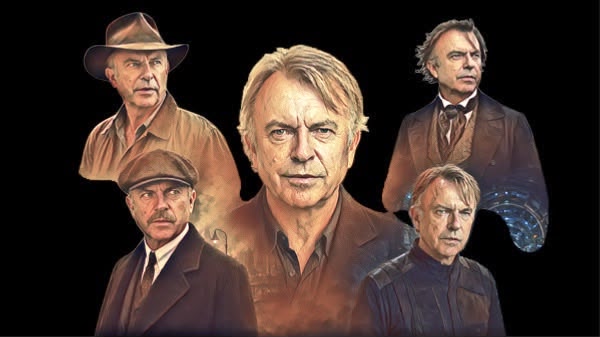
The elegance of never needing to exaggerate
Sam Neill was not the kind of actor who entered a scene demanding that everyone look at him. He was the actor who had often taken control of the scene before we even realized it. He worked through pauses, glances, small shifts in his voice and an irony that seemed to emerge naturally from his characters.
That quality made him a dependable leading man, a disturbing antagonist and a supporting actor capable of completely reorganizing the energy of a story. In good films or bad, large productions or small ones, Neill always brought intelligence. There was always something happening behind his eyes: a doubt, a threat or a joke the character had not yet decided to share.
In recognition of his contribution to acting, he received honors from New Zealand and, in 2022, his distinction was elevated to Knight Companion of the New Zealand Order of Merit. Officially, he became Sir Nigel John Dermot Neill. To audiences, however, he remained simply Sam: the man in the hat standing before the dinosaurs, the cruel husband in The Piano, the scientist consumed by hell in Event Horizon and the New Zealand actor who seemed to carry a measure of mystery, humor and humanity into every role.
Sam Neill moved between popular cinema and arthouse filmmaking without ever treating one as lesser than the other. He worked with Steven Spielberg, Jane Campion, Andrzej Żuławski, John Carpenter, Wim Wenders and Taika Waititi. He faced dinosaurs, demons, murderers, kings, gangsters and the depths of space. In every one of those worlds, he remained recognizable not because he always played the same man, but because he brought the same generous intelligence to every character.
His death leaves cinema a little less elegant, less ironic and certainly less human.
Descubra mais sobre
Assine para receber nossas notícias mais recentes por e-mail.

