
As published on Caderno B+
There is something almost reckless about Christopher Nolan’s decision to film The Odyssey. Not because the director lacks experience with large-scale productions, but because some stories are so important that they seem to resist the very idea of adaptation. The poem attributed to Homer has survived for nearly three thousand years, helping to establish archetypes, narrative structures, and characters that continue to reappear in virtually everything we tell. In some way, it already belongs to the culture even of those who have never read a single page of the original text.
The hero’s journey is there, along with war and its consequences. So are the desire to return home, the seduction of power, guilt, grief, identity, loyalty, waiting, fear of the unknown, and the realization that no one returns from a devastating experience exactly as they left. Adapting The Odyssey, therefore, does not simply mean filming monsters, gods, and adventures. It means trying to find a contemporary form for a story that lies at the origin of much of the way we still organize our own narratives. Christopher Nolan succeeds.

But here comes my reservation: his film is not perfect, and I do not consider The Odyssey the finest work of his career, nor necessarily the best film of this year. There is something admirable about the scale of the challenge he accepts and, above all, about the clarity with which he presents this universe to an audience that does not need to know Homer to follow it. That may be one of the adaptation’s greatest triumphs.
The Odyssey remains The Odyssey. The monsters are there, along with the trials, the dangers, and the fantastic dimension of the voyage, yet audiences do not need a classical education to understand what is happening. Nolan transforms one of the foundational works of Western culture into a major popular spectacle without treating it like a museum piece.
And at the center of everything is Matt Damon. It is difficult to imagine the film working without him.
Damon must make Odysseus both a great leader and a deeply fallible man. He must convey the confidence required to persuade other men to follow him while carrying in his body the weight of the deaths that occur throughout the journey. The character is a hero, but Nolan seems especially interested in asking what that word truly means when one man’s decisions have consequences for everyone around him. Matt Damon understands that ambiguity and sustains the film with one of the strongest performances of his career.
There is authority in his Odysseus, but also exhaustion, intelligence, and arrogance. There is courage, but also guilt. He is the man who helped win a war and destroy a city, only to discover that victory does not bring an end to what the war has caused. That may be the most interesting aspect of the film.
The journey home is also a long confrontation with the consequences of his decisions. What could have been merely the story of a man battling monsters becomes the story of someone trying to survive what he has done, what he has lost, and what he has become. Although war may end on the battlefield, its effects remain inside those who return.
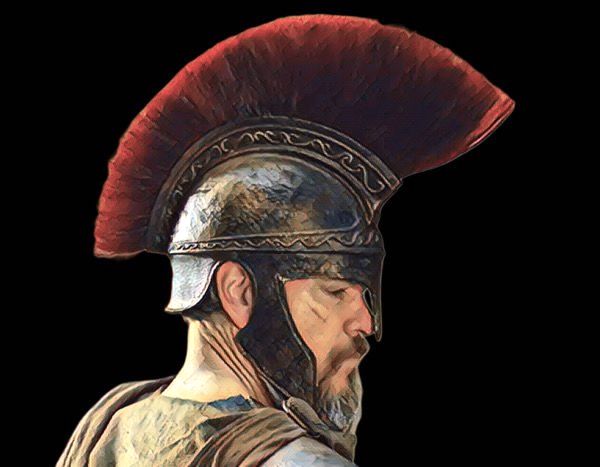
Perhaps that is why some of the best moments in The Odyssey come so close to horror. Nolan understands that the fantastic does not need to be treated as light fantasy. There are moments when the beauty of the images almost intensifies the vulnerability of those men, because it makes clear how small they are before the world they are crossing.
Hoyte van Hoytema’s cinematography is extraordinary. Filmed in locations including Greece, Morocco, Italy, Iceland, and Scotland, the film uses real geography to construct a voyage that must feel long, difficult, and unpredictable. Nolan does not use the landscapes merely as decoration. Each place seems to introduce a new threat, a new promise, or a new stage in Odysseus’ transformation.
Ludwig Göransson’s score is equally important. The composer, who has already won three Academy Awards, creates music that moves through the film without simply announcing to the audience what they are supposed to feel. The score expands with the spectacle, but it also knows how to express unease and anticipation. After Black Panther, Oppenheimer, and Sinners, Göransson will certainly return to the awards-season conversation.
Not everything, however, works with the same force.
Curiously, in a film featuring one of the most impressive casts assembled in recent years, it is the ensemble itself that produces some of my greatest reservations. As I have said, Matt Damon is the clear standout, and Himesh Patel finds a very convincing register beside him. Samantha Morton, as always, needs very little screen time to establish a commanding presence. But some of the film’s most famous stars do not achieve the same result.
Anne Hathaway strikes me as uneven. There are moments when her Penelope approaches a theatrical register, others when the actress searches for an almost excessively calculated delicacy, and still others when she attempts a more intimate performance. Those different choices do not always seem to belong to the same character.
Tom Holland also fell short of what I expected, as he himself has already acknowledged. This reservation comes precisely from my admiration for an actor who has already demonstrated that he is capable of work far more complex than his fame as Spider-Man might suggest. His Telemachus, however, never entirely disappears into that world. At times, I had the uncomfortable sensation of watching Spider-Man transported into a Greek epic.
Robert Pattinson is good as the villain, a role he performs with well-established skill and considerable frequency, but there is a curious phenomenon taking place in his career. After spending years trying to prove that he was much more than the heartthrob from Twilight, Pattinson built a succession of deliberately strange, disturbing, and eccentric characters. The hair, voice, posture, and stare may change, but the strangeness itself is beginning to become a signature. What once felt surprising now risks becoming a new form of repetition.
Yes, Pattinson works in the film, but I did not find him exceptional when compared with the many other variations of this same register that he has already presented.
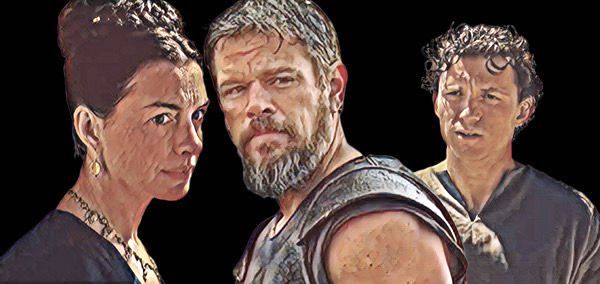
The parade of stars also produces a curious effect. Zendaya, Charlize Theron, Elliot Page, Travis Scott, and other familiar names appear throughout the film, and often the recognition of the performer arrives before the perception of the character. These appearances do not necessarily harm the narrative, but neither do they always carry the weight one might expect given the stature of the talent involved.
That said, these reservations do not diminish the scale of Christopher Nolan’s achievement. The Odyssey is cinema on a monumental scale and, at the same time, a demonstration of why certain texts survive for thousands of years.
We can replace the ships, the wars, the kings, and the gods. We can substitute mythological monsters with contemporary fears, but we continue trying to return home after experiences that have transformed us. We continue making well-intentioned decisions that hurt other people. We continue trying to determine whether we are responsible only for what we intended to do, or also for the consequences of what we actually did.
The film’s greatest merit does not lie solely in having adapted a work considered “essential.” It lies in making a story told nearly three thousand years ago accessible today to someone who has never read Homer, while still making it feel immediately recognizable. After all, The Odyssey has not survived all this time simply because it is a classic, but because, in one way or another, we are all still trying to find our way home.
Descubra mais sobre
Assine para receber nossas notícias mais recentes por e-mail.

