
On May 19, 1996, Jessica Fletcher solved her final weekly murder. The episode was called Death by Demographics, and it brought to an end 12 seasons, 264 televised cases, and one of the greatest ratings phenomena in CBS history. Thirty years later, Hollywood has decided to reopen the mystery: Murder, She Wrote is becoming a feature film starring Jamie Lee Curtis in the role made immortal by Angela Lansbury.
The title of that final episode could hardly have been more ironic. Death by Demographics followed a murder at a radio station that abandoned its traditional programming in an attempt to attract a younger audience. It was a barely disguised act of revenge by the writers against CBS, which had decided to end one of its most popular series because it considered its audience too old for the advertisers the network wanted to attract.
Three decades later, it is precisely the mature audience, the nostalgia, and the commercial strength of an older female protagonist that are supporting the revival. Jessica Fletcher is not returning despite her age. She is returning, in large part, because of it.
The new version will not initially be a television series, but a film produced by Universal, directed by Jason Moore, of Pitch Perfect, and written by Lauren Schuker Blum and Rebecca Angelo, of Dumb Money. Jamie Lee Curtis will take over the role of Jessica, and the release is scheduled for February 4, 2028.
Moore has already made it clear that he does not intend to turn Murder, She Wrote into a dark, violent, and hard-edged crime drama. Agatha Christie remains the reference point: an investigation filled with suspects, twists, and false clues, in which the audience believes it is following the detective’s reasoning but still cannot anticipate the identity of the murderer. There will be humor, especially because Jamie Lee Curtis knows how to move between comedy and tension, but the director insists that the film will be a proper mystery, not a nostalgic parody.
He has also promised to bring back the original theme music in an unexpected way, include a tribute to Angela Lansbury, and scatter references throughout the film for the most devoted fans. Even Jessica’s typewriter will become part of the investigation. Since the film takes place in the present day, the clash between the typewriter and the computer will be incorporated into the mystery itself.
It is a clever choice because modernizing Jessica does not require eliminating everything that appears old-fashioned. On the contrary, there is something especially interesting about placing a woman whose greatest tool has always been observation in a world that believes every answer can be found on a screen.

Who Was Jessica Fletcher?
Created by Peter S. Fischer, Richard Levinson, and William Link, Murder, She Wrote premiered on CBS on September 30, 1984. Jessica Fletcher was a retired, widowed English teacher who lived in Cabot Cove, a fictional small town in Maine.
After a nephew secretly sent one of her manuscripts to a publisher, Jessica became an enormously successful mystery novelist. Her literary fame gave her access to publishing houses, parties, hotels, theaters, wealthy families, universities, and social circles in which, by a statistically alarming coincidence, someone almost always ended up murdered.
Jessica was not a police officer, a private detective, or a government agent. She did not carry a gun, possess special training, or rely on a permanent male partner to justify her presence in an investigation. Her authority came from her intelligence, her experience, and her ability to understand how people constructed their stories.
The combination was directly inspired by the world of Agatha Christie. Jessica had something of Miss Marple, the seemingly harmless older woman who understood human nature better than the official investigators, but she also carried something of Christie herself: she was a famous writer who recognized the structure of a crime because she spent her life imagining murders.
The difference was that Jessica emerged on American television in the 1980s as a more modern figure than her conservative appearance suggested. She was an independent, professionally fulfilled, and financially autonomous woman who could travel the world alone. She did not need to find a new husband, become anyone’s love interest, or ask permission to enter spaces dominated by men.
Angela Lansbury was nearly 60 when she began playing the character. In an industry that frequently reduces the opportunities available to women as they age, she became the absolute center of one of the most-watched programs in the United States.

The Numbers Behind the Phenomenon
Murder, She Wrote remained on the air from 1984 to 1996, completing 12 seasons and 264 episodes. After the weekly series ended, Angela Lansbury returned as Jessica in four television movies broadcast between 1997 and 2003.
For almost its entire run, the series remained among the most-watched programs in the United States. It ranked among the top ten shows for eight seasons and entered its eleventh year still occupying eighth place in the national ratings. At its peak, it attracted approximately 25 million viewers each week.
In 1994, when it had already been on the air for ten years and had accumulated more than 200 corpses, Murder, She Wrote finished the season as the highest-rated drama in American primetime. It surpassed younger, more expensive, and ostensibly more modern productions, including Lois & Clark, seaQuest DSV, produced by Steven Spielberg, and Martin.
Angela Lansbury received an Emmy nomination for Outstanding Lead Actress in a Drama Series in each of the show’s 12 seasons. She never won the role, although the series accumulated 41 Emmy nominations. At the Golden Globes, she won four times as Best Actress in a Television Drama for Jessica Fletcher.
The success was even more remarkable because it depended almost entirely on a single protagonist. Characters such as physician Seth Hazlitt, Sheriff Amos Tupper, his successor Mort Metzger, and Jessica’s nephew Grady appeared frequently, but Jessica was the only indispensable presence. When Angela Lansbury reduced her participation in several sixth-season episodes, the ratings fell. When she regained creative control and returned to appearing regularly, the series recovered its strength.
The mystery mattered, but the phenomenon was her.
The Formula Audiences Never Tired of Watching
Murder, She Wrote followed an extremely recognizable structure, but audiences did not watch despite the repetition. They also watched because of it.
Jessica would arrive somewhere to visit a friend, promote a book, attend a ceremony, help a relative, or simply take a holiday. Around her, there would be a small community: a wealthy family, a theater company, a publishing house, a hospital, a radio station, a hotel, a ship, or some apparently respectable institution.
Before the murder, the episode established the conflicts. Someone was hiding a debt. Someone else feared losing an inheritance. A marriage was falling apart. A company was facing an internal dispute. An old secret threatened to resurface. When the victim was finally discovered, almost everyone present had a plausible reason to want that person dead.
The police usually chose the most obvious suspect, who was frequently a friend or relative of Jessica’s. She would then begin asking questions that seemed casual. There were no lengthy forensic analyses, graphic scenes, or major chases. The solution usually lay in a sentence, an impossible timeline, an object out of place, or a piece of information the culprit should not have possessed.

Jessica did not merely understand what people said. She noticed how they constructed their versions of events. The murderer’s mistake was almost always narrative: a detail introduced too soon, an explanation that was too perfect, or a reaction that only made sense for someone who already knew about the crime.
Then came the traditional confrontation scene, in which Jessica reconstructed the murder in front of the culprit and the audience. The revelation restored order, cleared the person who had been wrongly accused, and allowed the episode to end with a dinner, a farewell, or some comment about her next book. The producers called this moment the “gotcha,” the scene in which Jessica demonstrated how she had connected all the clues.
Each episode also needed a human drama capable of concealing the mystery. A love story, a family conflict, a professional rivalry, or an old wound provided both the emotion and the false leads. The formula remained while the settings and relationships changed.
In a single season, Jessica could investigate murders connected to classical music, theater, horse racing, restaurants, art galleries, cooking programs, video games, mining, psychiatry, and space exploration. She also travelled constantly, turning every city into a temporary extension of Cabot Cove.
Why Was a Series About Murder So Comforting?
The paradox of Murder, She Wrote is that few productions accumulated so many corpses while creating such a powerful sense of safety.
The violence was rarely explicit. The murderer existed to create the puzzle, not to exploit the victim’s suffering. The audience knew that the world would be temporarily disrupted, but also knew that Jessica would uncover the truth before the closing credits.
Today, that formula is usually described as the cozy mystery: stories that contain crimes but treat them as social and intellectual puzzles. The interest lies not in brutality, but in secrets, relationships, and the small contradictions that reveal who is lying.
Angela Lansbury’s presence was essential in balancing this world. Jessica was warm without being naïve, polite without being passive, and morally firm without seeming self-righteous. She could confront a millionaire, correct a sheriff, or provoke a murderer while remaining someone the audience would happily sit down with for tea.

Her greatest advantage was also the prejudice of the other characters. Because she appeared to be merely a curious older woman, Jessica was constantly underestimated. People said more than they should in front of her, revealed resentments, and offered information they would never have given to a police officer.
Jason Moore appears to have identified exactly this quality in Jamie Lee Curtis. For him, Jessica works because she is the kind of person others trust and end up telling their secrets to. Curtis possesses that mixture of curiosity, humor, warmth, and affectionate interference. She can speak both to the person at the center of the room and to the person who remains invisible while serving everyone else.
That may be the most important quality for her to inherit from Angela Lansbury. Jessica did not solve crimes because she was the most powerful person in the room. She solved them because she was the only one paying attention to everyone.
Sunday Night and Everyone’s Grandmother
For 11 years, Murder, She Wrote aired on Sundays after 60 Minutes. The scheduling turned the series into a family ritual and gave CBS one of the most stable programming blocks on television.
Angela Lansbury herself acknowledged that repetition was part of the appeal. The audience heard the theme music, saw Jessica at her typewriter, and knew it was time to sit down. The series was not merely watched; it became part of the organization of the week.
Jason Moore understands that this memory has outlived the individual cases. According to him, many people may not know Murder, She Wrote in depth, but they remember watching it with their grandmother. That emotional memory explains why the original theme music, the typewriter, and the references to Angela Lansbury cannot be treated merely as decorative objects.
They represent a way of watching television that has almost disappeared: millions of people gathered around the same program at the same time, trusting that the story would be resolved before Sunday was over.
The challenge for the film will be to recover that feeling without turning Jessica into a museum piece.

The Series That Hid the Murderer Among the Stars
The weekly structure also made it possible to renew almost the entire cast in every episode. The producers quickly realized they could turn that necessity into an additional attraction.
Peter S. Fischer explained that, in other crime series, hiring only one famous actor made the solution obvious: the best-known guest star was probably the murderer. On Murder, She Wrote, the strategy was to hire several recognizable names and hide the culprit among them.
By 1989, when the series was still in its fifth season, around 500 guest actors had already appeared in just over 100 episodes. Veterans enjoyed the job because they could reunite with friends, appear in a hit production, and avoid carrying the responsibility of sustaining the entire program.
The list of guest appearances became a kind of parallel history of Hollywood. Janet Leigh, Tippi Hedren, Jean Simmons, Mickey Rooney, Van Johnson, June Allyson, Leslie Nielsen, Roddy McDowall, Peter Graves, Shirley Jones, Eli Wallach, Florence Henderson, Jerry Orbach, and Martin Landau all passed through the series.
At the same time, actors who were still building their careers appeared before becoming stars, including George Clooney, Bryan Cranston, Courteney Cox, Linda Hamilton, Neil Patrick Harris, and Joaquin Phoenix, then credited as Leaf Phoenix.
Tom Selleck appeared as Thomas Magnum in a crossover with Magnum, P.I., in which Jessica had to prove that the detective had been wrongly accused of murder. Jerry Orbach played Harry McGraw, an investigator who appeared in several episodes and received the spin-off series The Law & Harry McGraw before the actor became Lennie Briscoe on Law & Order.
Each week, therefore, became a meeting between different generations of performers. Stars from classical Hollywood could share the screen with young actors whom the audience would only recognize many years later.
The Episodes That Defined Murder, She Wrote
The pilot, The Murder of Sherlock Holmes, immediately established the formula. Jessica had just become a published writer when a man dressed as Sherlock Holmes was murdered during a party, and her nephew Grady emerged as a suspect. The episode introduced her intelligence, her connection to detective fiction, and her refusal to accept a convenient answer simply because the police wanted to close the case.
Murder Takes the Bus, still in the first season, is one of the clearest examples of Agatha Christie’s influence. A storm forces the passengers of a bus to take shelter in an isolated restaurant. When one of them is murdered, everyone is trapped in the same place with the culprit. It is the series reduced to its purest form: a closed setting, several suspects, incompatible stories, and Jessica observing everything.
In Death Takes a Curtain Call, a murder during a ballet performance leads Jessica into a story involving Soviet artists and Cold War tensions. The episode demonstrates how any cultural world could be transformed into a small society with hierarchies, rivalries, and secrets.
Magnum on Ice concluded the crossover that began on Magnum, P.I. and united two of the most popular crime-solving figures on 1980s television. Jessica travelled to Hawaii and had to discover who had framed Thomas Magnum.
Mirror, Mirror, on the Wall, the two-part fifth-season finale, introduced Jean Simmons as Eudora McVeigh, a mystery novelist whose career was in decline and who felt threatened by Jessica’s success. The plot turned the protagonist’s own profession into a territory of vanity, jealousy, and crime.
The Sins of Castle Cove played with the effect of an apparently fictional book that exposed the secrets of Cabot Cove’s residents. When someone was murdered, everyone began searching the novel for the identity of the killer. It was a story about the power of narrative to reveal truths a community would rather conceal.
Who Killed J.B. Fletcher? pushed Jessica’s fame into absurd territory by introducing a member of her fan club who assumed her identity to investigate a case. When the false Jessica was found dead, the real one had to discover who had murdered her impersonator.
Finally, Death by Demographics ended the series with that radio station under pressure to abandon its identity and pursue younger consumers. After 12 years of proving that a mature woman could sustain a major popular success, Jessica Fletcher said goodbye while investigating a crime caused by the obsession with replacing an older audience with one considered theoretically more valuable.

How CBS Killed Its Greatest Mystery
Murder, She Wrote did not go off the air because it had stopped being popular. At the end of its eleventh season, it remained among the ten most-watched programs in the United States and was still one of CBS’s strongest productions.
The problem was the age of its audience. The network wanted to attract younger viewers, who were considered more desirable to certain advertisers, and decided to move the series to a different night.
After 11 years on Sundays, Murder, She Wrote was moved in 1995 to Thursday nights, directly opposite Friends and NBC’s powerful Must See TV lineup. It was an almost impossible competition, and the ratings predictably fell.
When some episodes were exceptionally returned to Sundays, the numbers rose again. The final installments broadcast in the traditional time slot attracted more viewers, and the series finale once again reached the upper positions of the weekly ratings. CBS, however, had already made its decision.
Angela Lansbury was also tired after 12 years of a demanding production schedule and acknowledged that the ending might have been natural. What upset her was the way the network deliberately weakened a still-successful program to justify a decision based on demographics.
The series that had survived hundreds of murders was ultimately defeated not by another program, but by the idea that its audience had grown too old.
Why Does Jessica Fletcher Need to Return Now?
Thirty years later, the landscape is curiously different. Popular culture has rediscovered exactly the kind of mystery Murder, She Wrote mastered: elegant investigations, star-filled casts, humor, eccentric suspects, and crimes presented as puzzles rather than merely as spectacles of violence.
Knives Out turned Benoit Blanc into a franchise. Only Murders in the Building combined crime, comedy, and protagonists from different generations. The Thursday Murder Club placed Helen Mirren, Pierce Brosnan, Ben Kingsley, and Celia Imrie in the roles of retirees investigating murders and attracted 69 million views on Netflix in the second half of 2025.


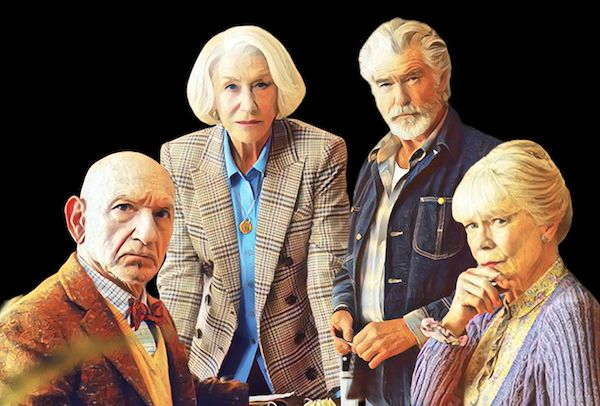
The audience CBS considered too old in 1996 has become valuable to platforms and studios that have discovered the strength of stories led by mature characters. At the same time, younger viewers have begun seeking a form of crime fiction less oppressive than narratives about serial killers, extreme violence, and investigations defined by trauma.
Jessica Fletcher belongs perfectly in this moment. She was never an action heroine, but she was never fragile either. Her strength lay in experience, in her ability to recognize patterns, and in her willingness to listen to people everyone else ignored.
Jamie Lee Curtis comes to the role in her 60s, after winning an Oscar and entering one of the most interesting phases of her career. Like Angela Lansbury before her, she does not need to be made younger to justify her presence. Age is precisely part of the character’s authority.
The typewriter may represent the entire film. In a world of computers, databases, cameras, and artificial intelligence, Jessica will continue looking for what no technology can identify on its own: hesitation, vanity, resentment, guilt, and the small contradiction that exposes a lie.
The new Murder, She Wrote will work if it understands that Jessica Fletcher was not special because she lived in Cabot Cove, wore discreet clothes, or wrote on a typewriter. She was special because she entered a room without appearing threatening, listened to what everyone said, and noticed what everyone else had missed.

The series is returning 30 years later because Hollywood has finally recognized that what seemed outdated in 1996 has become modern again. Jessica was a mature, independent, professionally fulfilled, and respected woman whose intelligence did not diminish with age, but deepened through experience.
She did not need to run, seduce suspects, or carry a gun. She only needed to ask a question and wait for someone, convinced they were speaking merely to a polite older woman, to reveal far more than they should.
Descubra mais sobre
Assine para receber nossas notícias mais recentes por e-mail.

