
In November 2026, Rocky turns 50 and returns to American theaters in a restored 4K version. But Hollywood has found a particularly clever way to celebrate the anniversary. Before screenings of the classic, audiences will get a preview of I Play Rocky, the film about how Sylvester Stallone managed to get Rocky made. The character who became synonymous with the underdog will, half a century later, introduce the real story of the man who had to behave very much like him just to make it onto the screen.
It is difficult today to grasp just how unlikely it all was. Rocky was not born as a franchise, a brand, or a carefully designed star-making vehicle. Sylvester Stallone was a virtually unknown actor when he wrote the story of Rocky Balboa, a second-rate Philadelphia boxer who is given the absurd opportunity to face heavyweight champion Apollo Creed. Stallone managed to interest producers in the script, but he did not simply want to sell it. He wanted to play Rocky. And that is exactly where the behind-the-scenes story began to look strangely like the movie itself.
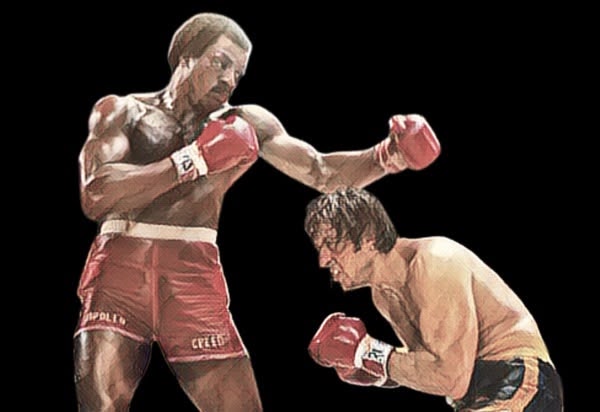
Today, after decades of sequels, training montages, triumphant music and pop-culture iconography, it is easy to forget another essential detail: in the first Rocky, Rocky Balboa does not win the fight. Apollo Creed wins by split decision. For Rocky, however, surviving all 15 rounds already means proving that he is not just another disposable guy. His goal that night is not to become champion. It is to find out whether he can stay on his feet.
That is precisely why the film remains moving 50 years later. Rocky looks like a boxing story, but it is essentially a story about dignity. About someone who knows exactly how the world sees him and decides, for once, to test whether that definition has to be permanent.
Stallone did something similar. When producers showed interest in the screenplay, there was one condition he refused to negotiate: he would also play the lead. By Hollywood standards, it was a difficult commercial gamble to justify. Stallone was not a star, and there were much bigger names who could have made the project safer. But he insisted. The film was eventually made for around $1 million, shot quickly, and went on to receive ten Academy Award nominations. It won three, including Best Picture and Best Director for John G. Avildsen. Suddenly, the unknown actor who had refused to hand his character over to someone else was standing at Hollywood’s biggest awards ceremony.
The unknown had gone the distance.

That is the story I Play Rocky is now going to dramatize. Directed by Peter Farrelly, who won an Oscar for Green Book, the film stars Anthony Ippolito as the young Sylvester Stallone. Anyone who watched The Offer already knows the actor’s curious specialty: in that series, he played a young Al Pacino during the making of The Godfather. Now he takes on another dangerous assignment, reproducing not only Stallone’s appearance but his voice, gestures and a persona that has been part of the popular imagination for half a century.
The cast also reconstructs the world behind the original film. Stephan James plays Carl Weathers, AnnaSophia Robb is Sasha Czack, Stallone’s first wife, Matt Dillon appears as Frank Stallone Sr., Jay Duplass plays John G. Avildsen, and P.J. Byrne and Toby Kebbell portray producers Irwin Winkler and Robert Chartoff. The idea is not to recreate the story of Rocky Balboa, but the moment when nobody yet knew that Rocky Balboa would become Rocky Balboa.
The first trailer makes its thesis very clear. I Play Rocky wants to present Stallone as the real Rocky before Rocky existed: a man with no power in the industry, hearing one “no” after another and convinced that giving up the role would mean giving up his own story.
It is a great narrative. Perhaps even a little too perfect.
Biopics about Hollywood always require a degree of caution because Hollywood loves turning its own past into a screenplay. The story of how Rocky was created has been told so many times over five decades that fact and mythology have inevitably begun to blur, and Stallone himself has helped build the narrative of the man who bet everything on himself.

Perhaps that is exactly what makes I Play Rocky especially interesting. The question is not only how Rocky was made, but how the story of its creation became part of the legacy of Rocky itself. Because what followed was enormous. The small film turned Stallone into a star, created a franchise that crossed generations, and eventually found a second life through Creed. Rocky Balboa stopped belonging only to the plot of a 1976 movie and became a kind of cultural archetype. When someone runs up a flight of steps to triumphant music, the reference no longer needs to be explained.
There is another perfect irony in the story. At the Academy Awards, Rocky defeated films such as Taxi Driver, All the President’s Men and Network. Seen 50 years later, it almost feels like a natural extension of the movie’s own metaphor: the small production starring an unknown actor stepped into the ring with the giants and walked away with the night’s biggest prize.
That does not necessarily mean it was “better” than all of them. It means that, at that particular moment, Rocky represented something larger than cinema itself. Audiences were watching a man nobody took very seriously get the opportunity of a lifetime, while the man playing him was undergoing almost exactly the same transformation in front of Hollywood.
The anniversary re-release of Rocky takes place in the United States in November and will include material from I Play Rocky, which also reaches theaters during the 50th-anniversary window. It is an efficient release strategy, naturally, but it also creates a beautiful image. In 1976, we watched Rocky Balboa running through the streets of Philadelphia trying to find out whether he could stay on his feet against Apollo Creed. In 2026, we will watch a young Sylvester Stallone trying to stay on his feet against Hollywood.
We know how both stories end. We know Rocky goes the distance, and we know Stallone gets the movie made. There is no suspense in either outcome. And perhaps there does not need to be. Because Rocky was never really about finding out who wins. It was about finding out who keeps fighting when almost nobody believes he belongs in the ring. Fifty years later, I Play Rocky simply reveals that the story began before the cameras ever started rolling.

Descubra mais sobre
Assine para receber nossas notícias mais recentes por e-mail.

