
Spoilers for the third and final season follow.
Romy Schneider’s Sissi captivated generations with a promise of romance that Elisabeth of Austria’s life came nowhere near fulfilling. The young woman who won the emperor’s heart also had to find a place in a court that watched her, corrected her, and expected her to ensure the dynasty’s survival. The third and final season of The Empress returns to that conflict, but its attempt to move beyond the fairy tale runs into a contradiction: giving suffering more room and presenting a less idealized marriage does not necessarily make the story more historically accurate.
The problem becomes particularly apparent in Elisabeth’s relationship with the Hungarian count Gyula Andrássy. The series establishes their affair within its fictional narrative and steers its conclusion toward a suggestion about Marie Valerie’s paternity. These are dramatic choices that need to be acknowledged as such. An old rumor does not become a discovery simply because it has been given actors, costumes, and a convincing scene.

A marriage that can no longer sustain the fantasy
Franz Joseph’s return from war confronts the season with the consequences of defeat. Philip Froissant’s emperor carries the guilt of battlefield deaths, while Elisabeth, played by Devrim Lingnau, tries to reach an increasingly distant husband. His infidelity deepens the rupture. The marriage that should have offered protection begins to reproduce the isolation of court life.
Elisabeth’s declining health creates an opportunity to leave Vienna. Her journey to recover also allows the narrative to explore an existence outside her imperial role. It is along this path that Andrássy, played by Dejan Bućin, emerges as an emotional and intellectual alternative. Their attraction is part of Netflix’s own stated premise.
This construction serves a clear purpose: making Elisabeth’s desire to remain away understandable. Andrássy offers attention, conversation, and the possibility of being recognized beyond her usefulness as a wife. The risk lies in turning everything that draws her toward Hungary into a consequence of this encounter. Her dissatisfaction with Vienna and her interest in a different political arrangement deserve to exist without needing a romance to validate them.
When jealousy begins to govern
The Hungarian question brings the marital crisis into the heart of government. Following the defeat by Prussia, Elisabeth advocates concessions, while Sophie resists. The discovery of her meetings with Andrássy turns the negotiations into a personal dispute: Franz restricts his wife’s freedom and separates her from their children. The possibility of an agreement becomes entangled with the husband’s humiliation.
The emperor begins to exploit precisely what he knows about Elisabeth’s vulnerabilities. A palace can be a prison without ceasing to look like a palace, and access to the children becomes a means of control. Here, the narrative finds a more interesting discussion than a simple competition between two men: how much of a woman’s private life can be managed as the institution’s property?
At the same time, this device compresses a complex political transformation into a domestic crisis. Viewers are invited to follow the empire’s fate through the couple’s emotional state. It provides an entry point into the drama, but there is a cost when jealousy seems to explain more than the structures of power the series intends to examine.
Maximilian and the promise of another crown
Maximilian’s fate expands the season’s theme: the distance between wanting a crown and understanding the power that sustains it. Franz’s brother sees the Mexican proposal as a chance to escape his secondary position. His ambition, however, depends on foreign intervention and support he cannot control.
The loss of French backing makes the project untenable. His execution brings this promise of autonomy to a violent end. While one brother tries to preserve the monarchy through concessions, the other discovers that a crown offered by a European power does not confer legitimacy to govern another country.
The connection between their trajectories works best when it exposes this fragility, rather than reducing Maximilian to a man who wanted to prove his worth to his family. Mexico cannot exist merely as the setting for a Habsburg tragedy. There is a conflict over sovereignty that extends beyond the character’s suffering.
The agreement and the final insinuation
The conclusion moves toward the political reorganization of the dual monarchy and the coronation in Hungary. Elisabeth stays with Franz, but continuing their marriage requires room for her freedom. The proposed reconciliation does not restore the innocence of the beginning; it attempts to establish a way of living together after the rupture.
It is within this ending that the pregnancy takes on another meaning. The glance toward Andrássy and the hand placed over her abdomen invite viewers to associate the baby with the affair. The epilogue, set in 1916, introduces an adult Marie Valerie whose appearance reinforces that interpretation for some viewers. The series encourages suspicion, although it does not provide an unequivocal confirmation of paternity.
That distinction needs to be maintained. The affair is depicted within the fiction; the paternity is strongly implied. Neither constitutes evidence about the historical Elisabeth.
Less romantic, but more truthful?
Between 1955 and 1957, Ernst Marischka and Romy Schneider created a Sissi who became an emotional and visual touchstone. The marriage, the conflicts with her mother-in-law, and her ability to win people over sustained a fantasy of reconciliation. The films’ beauty helped make the world that constrained their heroine appear desirable.
The Empress changes the vocabulary of that fantasy. Marriage is no longer enough; freedom, desire, and resistance to control move to the foreground. Yet the need to translate a nineteenth-century woman into a heroine recognizable to contemporary audiences continues to shape the reconstruction.
There is a particularly uncomfortable contradiction in the choice of Andrássy. In trying to give Elisabeth autonomy, the series risks making her political involvement dependent on a love affair. The woman who needs to be recognized as a subject in her own right ends up being explained, once again, through the man she desires.
There is no need to demand that a historical series provide an impossible reconstruction of every private conversation. It is necessary, however, to recognize when invention changes the meaning of a life. Linking a daughter to a lover is more than filling in a missing exchange. It incorporates an unsupported suspicion about her legitimacy into a dramatized biography.
Romy Schneider’s Sissi promised that love could accommodate rebellion within the monarchy. The Empress invests in the desire to escape it. Between those two images, the historical woman continues to demand more than another version of the romance.

Sissi e Andrássy: o romance existiu fora da série?
Amizade, política e maternidade alimentaram uma suspeita sem comprovação.
A proximidade entre Elisabeth e Gyula Andrássy tem base histórica. O salto está em tratá-la como comprovação de um caso sexual. O projeto histórico The World of the Habsburgs, ligado ao patrimônio imperial austríaco, descreve uma amizade íntima e considera altamente improvável sua interpretação como relacionamento amoroso. A ligação política de Elisabeth com a Hungria também está documentada. Isso permite discutir afinidade, admiração e influência, mas não afirmar um caso sexual.
Marie Valerie nasceu em 1868 e era a quarta criança de Elisabeth e Franz Joseph. O nascimento em Buda e a educação em húngaro reforçaram sua identificação como a “criança húngara”. Esse contexto ajuda a compreender a fofoca; não demonstra a paternidade de Andrássy. A filiação histórica é a de filha do casal imperial. Elisabeth pôde participar diretamente de sua criação, diferentemente do que ocorrera com os primeiros filhos, criados sob a autoridade da arquiduquesa Sophie.
Convém também separar as filhas. Sophie era a primogênita, que morreu ainda criança, em 1857. Gisela chegou à vida adulta. Marie Valerie era a caçula associada ao rumor. Não se trata da mesma experiência de maternidade repetida três vezes, mas de momentos distintos da relação de Elisabeth com a família e com o poder que limitava sua participação na criação dos filhos.
Rudolf e a passagem do drama histórico ao balé
Rudolf, o único filho homem e herdeiro, oferece outra discussão. Sua educação militar excessivamente rígida é documentada, assim como a intervenção de Elisabeth, que apresentou um ultimato ao marido em 1865 para assumir o controle da educação dos filhos. Há aqui uma questão concreta sobre a violência de preparar uma criança para representar uma instituição. Isso não permite, porém, explicar toda a vida adulta dele por uma causa única.
Em 30 de janeiro de 1889, Rudolf e Mary Vetsera morreram em Mayerling. Ele tinha 30 anos; ela, 17. A reconstrução histórica predominante é que ele a matou e depois se matou. A expressão “pacto de amor” exige cuidado, sobretudo quando transforma a morte de uma adolescente em desfecho romântico.
É a história que já abordei no MiscelAna ao escrever sobre Mayerling, de Kenneth MacMillan. Estreado pelo Royal Ballet em 1978, o balé usa música de Liszt, arranjada por John Lanchbery, para explorar a violência, a sexualidade e o isolamento do herdeiro. A dança permite desenvolver as relações de Rudolf com as mulheres de sua vida, mas também a distância entre o papel público do príncipe e sua intimidade.
No cinema, a versão de 1968, dirigida por Terence Young, reuniu Omar Sharif e Catherine Deneuve como Rudolf e Mary, com Ava Gardner como Elisabeth e James Mason como Franz Joseph. Também ali, a representação artística precisa ser distinguida da reconstituição histórica: a força de uma tragédia na tela não resolve as perguntas sobre a vida de quem a inspirou.
A terceira temporada de The Empress não acompanha Rudolf até essa tragédia. Esse é um desdobramento que merece espaço próprio: a mulher tantas vezes reconstruída como heroína de romance também pertence à história de uma família cuja intimidade foi atravessada pela obrigação de preservar o poder.
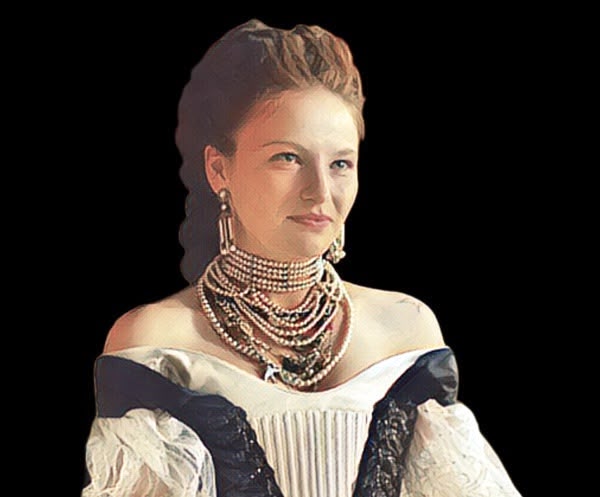
Sissi and Andrássy: Did the Romance Exist Beyond the Series?
Friendship, politics, and motherhood fueled an unproven suspicion.
The closeness between Elisabeth and Gyula Andrássy has a historical basis. The leap lies in treating it as proof of a sexual affair. The historical project The World of the Habsburgs, associated with Austria’s imperial heritage, describes an intimate friendship and considers a romantic interpretation highly unlikely. Elisabeth’s political attachment to Hungary is also documented. This allows for a discussion of affinity, admiration, and influence, but not an assertion that they had a sexual relationship.
Marie Valerie was born in 1868 and was Elisabeth and Franz Joseph’s fourth child. Her birth in Buda and her upbringing in Hungarian reinforced her identification as the “Hungarian child.” That context helps explain the gossip; it does not establish Andrássy’s paternity. Historically, she is recognized as the imperial couple’s daughter. Elisabeth was able to take a direct role in raising her, unlike her older children, whose upbringing had been overseen by Archduchess Sophie.
The daughters also need to be distinguished from one another. Sophie was the firstborn, who died in early childhood in 1857. Gisela survived into adulthood. Marie Valerie was the youngest, associated with the rumor. These were not three repetitions of the same experience of motherhood, but different stages in Elisabeth’s relationship with her family and with the power that restricted her involvement in raising her children.
Rudolf and the passage from historical drama to ballet
Rudolf, the only son and heir, opens up another discussion. His excessively harsh military education is documented, as is Elisabeth’s intervention: in 1865, she gave her husband an ultimatum to take control of their children’s upbringing. There is a concrete issue here about the violence of preparing a child to represent an institution. It does not, however, allow his entire adult life to be explained through a single cause.
On January 30, 1889, Rudolf and Mary Vetsera died at Mayerling. He was 30; she was 17. The prevailing historical reconstruction is that he killed her and then himself. The expression “love pact” requires care, particularly when it turns a teenage girl’s death into a romantic conclusion.
This is the story I previously explored on MiscelAna when writing about Kenneth MacMillan’s Mayerling. First performed by the Royal Ballet in 1978, the ballet uses music by Liszt, arranged by John Lanchbery, to explore the heir’s violence, sexuality, and isolation. Dance allows Rudolf’s relationships with the women in his life to unfold, while also exposing the distance between the prince’s public role and his private world.
On screen, the 1968 version directed by Terence Young starred Omar Sharif and Catherine Deneuve as Rudolf and Mary, with Ava Gardner as Elisabeth and James Mason as Franz Joseph. There, too, artistic representation needs to be distinguished from historical reconstruction: the power of a tragedy on screen does not settle the questions surrounding the lives that inspired it.
The third season of The Empress does not follow Rudolf as far as that tragedy. That development deserves a separate discussion: the woman so often reconstructed as a romantic heroine also belongs to the history of a family whose private life was shaped by the obligation to preserve power.
Descubra mais sobre
Assine para receber nossas notícias mais recentes por e-mail.

