
They say the eyes are the windows to the soul. It is an expression repeated so often that we rarely question its meaning. We search other people’s eyes for signs of love, fear, desire, sincerity, and remorse. We believe we can recognize sadness in someone’s gaze, just as we often become suspicious of those who avoid looking us in the eye. But do our eyes really reveal as much as we imagine, or are we simply finding what we already expect to see?
Two women, under entirely different circumstances, help us explore this question: Suzane von Richthofen and Elizabeth Holmes. Both were convicted of crimes, had their stories turned into documentaries, and became subjects of almost obsessive scrutiny. Not only because of what they did or said, but because of the way they look into the camera.
Suzane provokes comments about the apparent coldness of her expressions and the authenticity of her tears. Holmes, the founder of Theranos, became known for an intense, almost unblinking stare that for years helped establish her image as a visionary entrepreneur. After her conviction for fraud, that same behavior began to be interpreted as a sign of manipulation.
What changed? Their eyes, or what we know about the people we are watching?

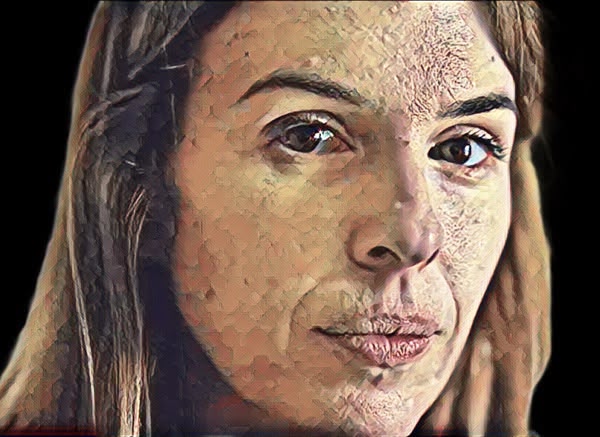
Elizabeth Holmes: The Gaze That Inspired Trust
During the rise of Theranos, Elizabeth Holmes cultivated a carefully recognizable image. Black clothing, a deep voice, speeches about a technological revolution, and an extraordinarily fixed gaze became defining elements of her public persona.
Journalist John Carreyrou, who exposed the company’s fraud, described in Bad Blood the intensity with which Holmes stared at her interlocutors, making them feel as though they had her undivided attention. Her gaze seemed almost hypnotic.
That manner of maintaining eye contact could be interpreted as confidence, determination, and conviction. After all, someone who looks us directly in the eye while promising to change the world appears to believe deeply in what they are saying.
When the fraud was exposed, the interpretation changed. The gaze that once inspired credibility began to provoke discomfort.
In recent discussions about Holmes, the intensity of her expressions and the frequency with which she blinked once again attracted attention. Viewers began searching for signs of deception in behavior that had previously been interpreted as confidence.
Yet we know that her company deceived investors because investigations, documents, and testimony established the fraud. No one needed to decipher her eyes to demonstrate her responsibility.
The question is why we continue searching for an explanation there.

Suzane and the Search for Remorse
With Suzane von Richthofen, the process is similar, although the nature of the crime and her personal history are entirely different.
Convicted for her involvement in the murder of her parents in Brazil, Suzane inspires curiosity that extends far beyond the established facts. The public searches her expressions for remorse, guilt, or suffering. Her tears are analyzed, the direction of her gaze is questioned, and even the way she responds to questions becomes evidence, in the eyes of viewers, of her personality.
There is a precedent that makes this suspicion understandable: an old recording in which her lawyer instructed her to cry during an interview. The performance on that occasion profoundly damaged the credibility of her later emotional displays.
But recognizing a previous attempt at manipulation does not mean we can determine, through observation alone, what someone feels at every subsequent moment.
We can question a narrative, identify contradictions, and compare statements with facts. The problem begins when we believe that a facial expression, by itself, constitutes a diagnosis or definitive proof of sincerity.
There is an important difference between recognizing a lie established through evidence and believing we can identify deception through someone’s eyes.

The Other’s Gaze and the Construction of the Self
In psychoanalysis, the gaze occupies a place that goes far beyond the simple ability to see.
Donald Winnicott attributed great importance to the mother’s face in emotional development. The infant looks at the face of the person caring for them and seeks a response to their own existence. Through this experience of recognition, the child gradually begins to organize a perception of the self and the surrounding world.
Before we learn to interpret another person’s gaze, we need to be seen.
Jacques Lacan introduces another dimension by distinguishing the eye, as the organ of vision, from the gaze as an experience connected to desire and the position we occupy in relation to others.
It is not simply about seeing. It is also about the experience of being seen, desired, judged, or misunderstood.
A gaze can awaken shame, fascination, insecurity, or pleasure, but these experiences do not depend exclusively on the person looking at us. They are shaped by the subjective history of the person receiving that gaze.
This is precisely where we begin to understand why two people can observe the same expression and reach entirely different conclusions.

Bette Davis Eyes: The Gaze That Seduces and Threatens
Literature, cinema, and music have always explored the power of the eyes in seduction. An exchange of glances can initiate a romance, suggest a promise, or awaken a passion that has not yet found words. But it can also intimidate, provoke jealousy, or make us believe in feelings that may not even exist.
One of the most memorable expressions of this fascination is Bette Davis Eyes, the song made famous by Kim Carnes in 1981.
The song describes a woman whose gaze becomes an instrument of seduction, mystery, and power. Yet it is hardly an innocent celebration of feminine beauty. The woman is portrayed as someone who understands the effect she has on others, knows how to exploit their desire, and exercises control over those who fall under her spell.
The reference to Bette Davis is particularly interesting. The actress possessed an extraordinary ability to express vulnerability, defiance, cruelty, and desire, sometimes within the same scene. Her eyes became a defining feature of her screen persona, but also an acting instrument that invited audiences to imagine hidden intentions behind her expressions.
The woman described in the song does not necessarily need to lie to conquer someone. Her power lies precisely in what others believe they can find in her gaze.
And this raises an important question: how much of seduction belongs to the person doing the seducing, and how much belongs to the fantasy of the person being seduced?

In psychoanalysis, the concept of projection helps us understand part of this process. Feelings, desires, and aspects of ourselves may be attributed to another person, influencing how we interpret their actions.
When we are in love, we may discover signs of reciprocation where none exist. When we distrust someone, even an ordinary gesture may seem suspicious.
The gaze may remain exactly the same. What changes is our disposition to interpret it.
Can We Detect a Lie Through Someone’s Eyes?
There is a widespread belief that people who lie avoid eye contact. Other theories suggest that someone who stares excessively at another person is deliberately trying to convince them of something.
Neither of these assumptions provides a reliable method for detecting deception.
Eye direction, blinking frequency, and other forms of nonverbal behavior are influenced by numerous factors, including anxiety, individual habits, cultural context, and emotional states.
The same applies to tears. Crying does not prove remorse, just as the absence of tears does not demonstrate an absence of suffering.
Human behavior does not operate according to a universal code in which every expression corresponds to a specific emotion.
This does not mean ignoring what we observe. Facial expressions and gestures are part of communication, but they need to be understood within a broader context.
Perhaps the greatest mistake is imagining that there is a direct correspondence between appearance and character. After all, if Elizabeth Holmes’s intense gaze was once interpreted as proof of credibility and later as evidence of manipulation, what are we really evaluating?

Why Do We Need to Find the Truth in Other People’s Faces?
Perhaps there is a particularly human explanation for our fascination with the eyes of people involved in crimes and scandals.
We want to believe that we can recognize someone who represents a threat. If dishonesty, cruelty, or manipulation are written across a person’s face, we might be able to identify them before being deceived.
This belief offers a sense of security. The problem is that it can also create false confidence in our ability to interpret others.
In Holmes’s case, many people believed in her sincerity before learning about the fraud. Afterward, they began finding signs in her expressions that suddenly seemed obvious.
With Suzane, prior knowledge of the crime profoundly influences the way the public observes her behavior.
And in fiction, as in Bette Davis Eyes, we encounter another possibility: desiring someone precisely because we believe something is hidden behind their gaze.
The same fascination that draws us toward another person can also feed our distrust of them.
In all these examples, our perception is shaped by what we know, desire, fear, or imagine.
Psychoanalysis does not attempt to read minds through the eyes. Its fundamental instrument is listening, developed over time through words, silences, contradictions, repetitions, and the relationship between analyst and analysand.
Even within this process, understanding another person requires recognizing that we will never have complete access to their subjectivity.
Perhaps it is precisely this uncertainty that makes us so uncomfortable.
We want to find a definitive truth in someone’s eyes because accepting that we can never entirely know another person can be deeply unsettling.
Yet before deciding what someone reveals through their gaze, it might be worth asking what we ourselves bring to that encounter.
Because we do not always see in another person’s eyes who they really are. Often, we find what we were already expecting to see.
Descubra mais sobre
Assine para receber nossas notícias mais recentes por e-mail.

