
When Ridley Scott released Blade Runner in 1982, the year 2019 still belonged to a future distant enough for us to imagine flying cars, space colonies, and artificial beings virtually indistinguishable from humans. Well, 2019 has come and gone, and while we still don’t have flying cars at our disposal, we are discussing the limits of artificial intelligence, the authenticity of images, the ownership of our memories, and even the possibility of developing emotional attachments to machines on a daily basis.
In a way, the future arrived along different paths from those Scott imagined, but the questions that made his film a classic have never been more relevant.
With all eight episodes of Blade Runner 2099 available on Prime Video since November 25, we return to a cinematic universe that, interestingly enough, has never needed a constant stream of productions to remain relevant. There were 35 years between the original film and Denis Villeneuve’s 2017 sequel, and another nine before the franchise’s first live-action television series.
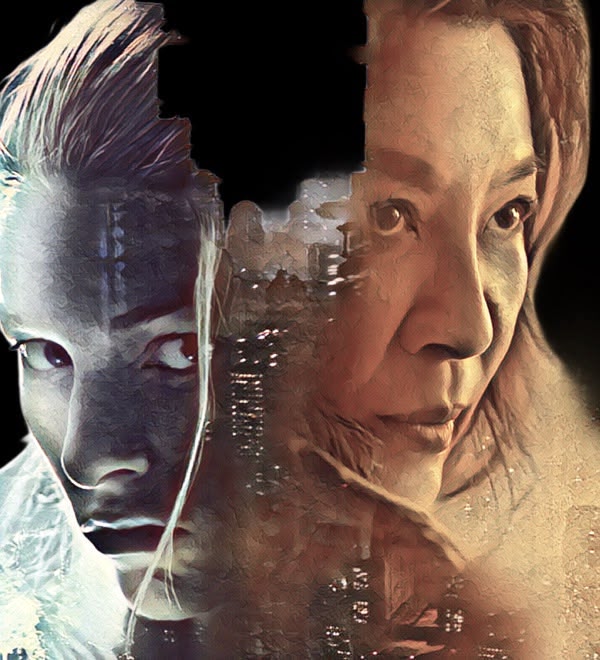
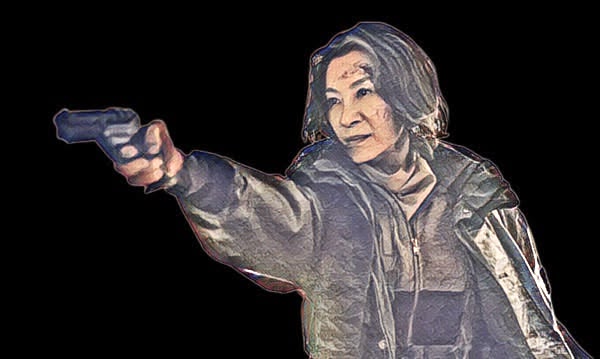
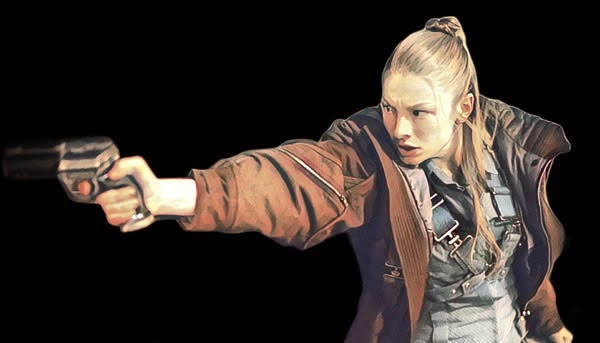
Ridley Scott returns as executive producer, but this time, creative leadership falls to Silka Luisa, the creator of the intriguing Shining Girls. Michelle Yeoh and Hunter Schafer lead the story, which takes place 50 years after Villeneuve’s film. And there is a fundamental shift in the power dynamics of this universe.
But let’s go in chronological order.
Before Blade Runner, There Was Philip K. Dick
Published in 1968, Philip K. Dick’s novel Do Androids Dream of Electric Sheep? inspired Ridley Scott’s film, although there are considerable differences between the two works.
In the novel, Earth has been devastated by nuclear war, real animals are rare, and owning one is also a symbol of social status. Rick Deckard makes a living hunting androids and dreams of earning enough money to replace his artificial sheep with a real animal.
What supposedly distinguishes humans from androids is their capacity for empathy. But Dick, as Scott would later do, challenges that premise by presenting humans who are indifferent to the suffering of others and artificial beings whose struggle for survival awakens our compassion.
It is a reversal that sustains the entire franchise. If an artificial being demonstrates more humanity than the one who created it, what exactly are we defending when we claim our superiority?
2019: Blade Runner (1982)
It is almost impossible to measure the visual influence of Blade Runner on contemporary cinema. From architecture and advertising to fashion and video games, the perpetually rain-soaked Los Angeles imagined by Ridley Scott became something of a universal reference for the dystopian future.
With the invaluable contributions of designer Syd Mead, cinematographer Jordan Cronenweth, and composer Vangelis, Scott blended science fiction and film noir in a movie that, ironically, was not a major commercial success upon its release.
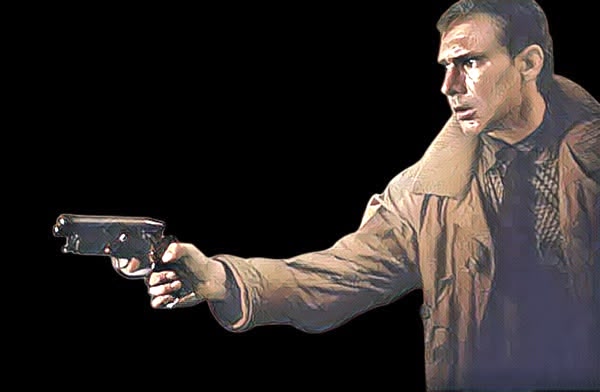
Harrison Ford plays Rick Deckard, a former police officer called back into service to locate and eliminate replicants who have illegally returned to Earth. Replicants are bioengineered beings created to perform dangerous tasks in extraterrestrial colonies. They are not simply metallic robots: they have organic bodies, intelligence, emotions, and, depending on the model, physical abilities superior to those of humans.
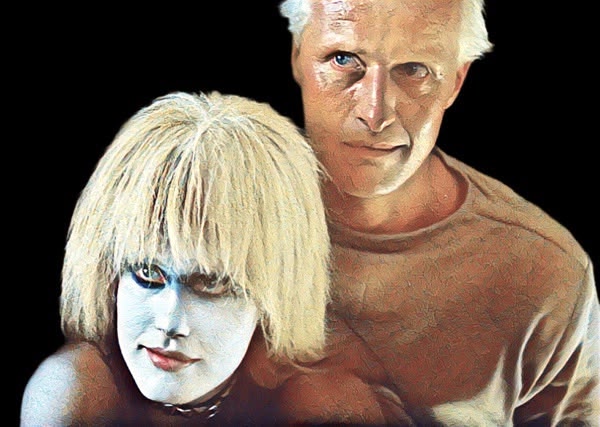
The Nexus-6 replicants pursued by Deckard have a lifespan of just four years. Roy Batty (Rutger Hauer), the group’s leader, seeks out his creator, Eldon Tyrell, hoping to extend his existence.
Here lies the great irony of Blade Runner: the character initially presented as the antagonist is demanding something we consider a fundamental right—the right to live. His anguish in the face of death is perhaps the most human expression in the entire film.
Meanwhile, Deckard meets Rachael (Sean Young), a replicant who believes she is human because she has been given implanted memories. Discovering the true nature of those memories undermines everything she believed she knew about herself.
And, of course, there is the endless debate surrounding Deckard’s own identity. Ridley Scott and Harrison Ford held different interpretations of the character for years, and the various versions of the film have only fueled the discussion.
For those planning to revisit the original, I recommend The Final Cut, released in 2007, the version over which Scott had complete artistic control.
2022: Blade Runner – Black Out 2022 (2017)
When Denis Villeneuve took on the responsibility of continuing the classic, there were three decades of events to account for. Three short films were produced to fill part of that gap.
The first in chronological order is Black Out 2022, an animated short directed by Shinichirō Watanabe, best known for Cowboy Bebop.
Growing hostility toward replicants leads to an operation that causes a massive blackout and destroys digital records, compromising the ability to identify artificial beings.
The event has economic, social, and political consequences. Replicant production is eventually banned, and the Tyrell Corporation falls into decline.
It is interesting to consider that, in this universe, the loss of digital information also represents a potential path to freedom. Without records documenting their origins, replicants can escape the system that identifies and controls them.
It is a question that takes on new dimensions in a society like ours, where we are increasingly dependent on digital records to prove our own identity.
2032: Blade Runner – Black Lotus (2021)
Before Blade Runner 2099, the franchise had already made its way to television, albeit in animated form.
Across 13 episodes, Blade Runner: Black Lotus follows Elle, a young replicant who awakens with no memory and attempts to understand her origins, her abilities, and the events that brought her there.
The series explores the period following the Great Blackout and expands our understanding of the struggle for control over replicant technology.
Once again, memory lies at the heart of the narrative. It is interesting how Blade Runner is less concerned with how machines work than with how identity is formed. If our memories can be manipulated, to what extent can we trust the story we tell ourselves about who we are?
2036: Nexus Dawn (2017)
Directed by Luke Scott, Ridley Scott’s son, the second short introduces Niander Wallace, played by Jared Leto.
Wallace has acquired the assets of the Tyrell Corporation and developed a new generation of replicants, the Nexus-9, designed to obey humans. His objective is to persuade the authorities to authorize their production once again.
Wallace promises safer, more controllable technology. Yet it is disturbing that the guarantee of such safety lies precisely in eliminating the autonomy of the beings he creates.
What has changed, therefore, is not necessarily the relationship between creator and creation, but the efficiency of the mechanism of subjugation.
2048: Nowhere to Run (2017)
Also directed by Luke Scott, the third short follows Sapper Morton, played by Dave Bautista, a replicant attempting to live discreetly among humans.
When he intervenes to protect two people, Sapper inadvertently exposes his true nature.
The short serves as a direct introduction to the events of Blade Runner 2049 and reinforces one of the franchise’s most interesting contradictions: an act of solidarity can threaten the survival of someone supposedly created without the same humanity as those he protects.

2049: Blade Runner 2049 (2017)
I confess that when Hollywood announced a sequel to Blade Runner, there were plenty of reasons to be skeptical. Some films owe their fascination precisely to the questions they leave unanswered. Explaining them is not always a good idea.
But Denis Villeneuve was probably one of the few directors capable of revisiting that universe without simply replicating it.
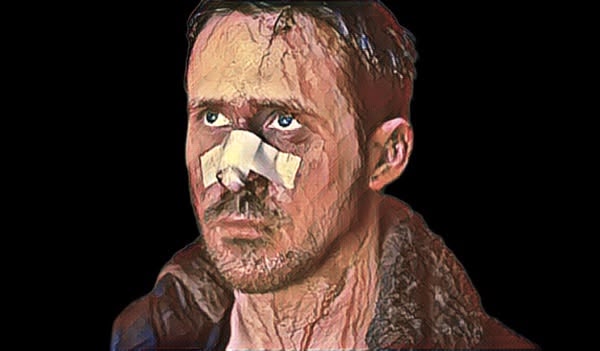
Ryan Gosling plays K, a Nexus-9 replicant who works for the Los Angeles Police Department, eliminating other replicants. During an investigation, he discovers evidence that a female replicant was able to become pregnant and give birth.
The possibility of natural reproduction threatens the entire social structure. After all, how can the status of beings as property be justified when they are capable of creating new life independently of their manufacturers?
The investigation leads K to Rick Deckard, once again played by Harrison Ford, but it is also a journey in search of his own identity.
K wants to believe that his memories are real, that his existence is unique, and that there is something special about his origins. His relationship with Joi (Ana de Armas), an artificial intelligence marketed as a romantic companion, adds another layer to the discussion.
If an artificial intelligence has been programmed to love us, does that necessarily invalidate the feelings we experience in our relationship with it?
In 2017, the question still seemed predominantly philosophical. In 2026, with the widespread adoption of chatbots and virtual companions, it has become an entirely contemporary discussion.
With Roger Deakins’ extraordinary cinematography, which finally earned him an Academy Award, Villeneuve managed to preserve the contemplative atmosphere of the original. And, just as with Scott’s film, its commercial performance fell short of its artistic significance.
2099: The Reversal of Roles
Eighty years after the events of the original film, Los Angeles is once again a transformed city. This time, however, it has been rebuilt by replicants.
Against this backdrop, we meet Cora (Hunter Schafer), a fugitive accustomed to assuming different identities who sees the possibility of becoming a Blade Runner as a way to finally stop running.
She must work alongside Olwen (Michelle Yeoh), a replicant approaching the final days of her existence. Their investigation involves a conspiracy whose origins stretch deep into the city’s past.
The casting of Michelle Yeoh is particularly interesting because, like Roy Batty in 1982, her character is confronting the prospect of death. Hunter Schafer, who rose to international fame through Euphoria, plays someone whose survival depends precisely on her ability to reinvent her identity.
Joining them in the cast are Dimitri Abold, Lewis Gribben, Sheila Atim, Tom Burke, Johnny Harris, and Matthew Needham, better known as Larys Strong in House of the Dragon. Jonathan van Tulleken, whose credits include Shōgun, directs the first two episodes.
The reversal of the hierarchy between humans and replicants is perhaps the most intriguing premise of the new series. Once in power, how do those who were created to serve relate to their former oppressors? Do they reproduce the system that enslaved them, or are they capable of building a different society?
What to Watch Before Blade Runner 2099
For those wishing to explore the franchise’s screen history in chronological order, the sequence is:
- 2019: Blade Runner (1982).
- 2022: Blade Runner: Black Out 2022 (2017).
- 2032: Blade Runner: Black Lotus (2021).
- 2036: 2036: Nexus Dawn (2017).
- 2048: 2048: Nowhere to Run (2017).
- 2049: Blade Runner 2049 (2017).
- 2099: Blade Runner 2099 (2026).
Watching the short films and the animated series is not essential to following the new production, but the two feature films are fundamental to understanding the philosophical dimensions of the story.
There are also comic books and video games that expand this universe, although they are not necessary to follow the series.
The Future That Finally Caught Up With Blade Runner
What is most fascinating about revisiting Blade Runner nearly 45 years after its release is realizing that while its imagined technology has aged in some respects, its existential questions have become even more relevant.
We live in an age when a voice can be artificially reproduced, an image can depict an event that never happened, and a machine can simulate interest, affection, and concern. We are learning to distrust even what our own eyes and ears recognize as familiar.
But it is important to remember that the replicants in Blade Runner are not equivalent to the artificial intelligence we use today. They are artificial biological beings conceived within a fictional universe that grants them consciousness and subjective experience. The comparison is philosophical, not technological.
And perhaps that is precisely why the franchise remains so fascinating. It was never fundamentally about machines wanting to become human, but about humans having to define what makes them human.
Roy Batty wanted to live. Rachael wanted to understand who she was. K wanted to believe that his existence had a special meaning. And all of them, in one way or another, were searching for something we ourselves spend our lives trying to find.
After all, isn’t it the awareness that we will die that makes the need to find meaning in our existence so urgent?
In 1982, Blade Runner seemed to anticipate our future. In 2026, perhaps it is the present that finally allows us to understand Blade Runner a little better.
Descubra mais sobre
Assine para receber nossas notícias mais recentes por e-mail.

