
Anyone who followed American television in the 1990s certainly remembers Peter Berg as Dr. Billy Kronk in Chicago Hope, one of the medical dramas competing with ER for audiences. Berg was a decent actor, but nothing in his career in front of the camera necessarily anticipated the one he would build behind it. Today, at 64, he is one of the American directors most closely associated with stories of sports, survival, heroism, and sacrifice. And he returns to Netflix with a narrative that brings together virtually all these elements: The Mosquito Bowl.
Available on the platform since November 25, the film brings together Nicholas Galitzine, Bill Skarsgård, Tom Francis, and Ray Nicholson (yes, Jack Nicholson’s son) to tell a true story from World War II that remains relatively unknown outside the United States. And although American football is at the heart of the narrative, you don’t need to understand anything about the sport to appreciate the magnitude of these young men’s tragedy.
The film also reunites Peter Berg with Pulitzer Prize-winning journalist Buzz Bissinger, the author of Friday Night Lights, which the filmmaker adapted for the big screen in 2004 before turning the story into one of the most acclaimed American television series of the 2000s.
Two decades later, the two return to American football to talk about something far greater than the sport itself.

The True Story of the Mosquito Bowl
On Christmas Eve 1944, on the island of Guadalcanal in the South Pacific, a group of American Marines organized a football game. They were hardly amateurs. Among them were some of the most talented college football players in the United States, young men who, under different circumstances, would likely have pursued professional careers in the sport.
The Japanese attack on Pearl Harbor on December 7, 1941, had radically altered their plans for the future. America’s entry into World War II mobilized an entire generation, including athletes who already enjoyed considerable public recognition.
On Guadalcanal, members of the 4th and 29th Regiments of the 6th Marine Division decided to settle a sporting rivalry on the field. The game earned the nickname Mosquito Bowl because of the insects that infested the area, a humorous reference to America’s traditional college football bowl games.
For a few hours, those men could return to being who they had been before the war. They were not fighting over territories or following military orders. They were simply playing football.
The historical significance of that encounter, however, would only become apparent months later.
Of the 65 men who played in the game, 15 died in the Battle of Okinawa in the spring of 1945. Many others were wounded. For some of those young men, Christmas Eve 1944 represented their final opportunity to play the sport to which they had devoted much of their lives.
The Four Young Men Who Inspired the Film
Published in 2022, The Mosquito Bowl: A Game of Life and Death in World War II required Buzz Bissinger to conduct extensive research into military archives, family documents, personal correspondence, and university records.
The author’s connection to the story was also personal. His father had served in one of the regiments involved in the episode and fought in the Battle of Okinawa.
Among the dozens of real-life individuals identified during his research, four became central figures in the film adaptation.
John McLaughry, played by Nicholas Galitzine, had played football at Brown University and was the son of a respected coach. His story represents the interruption of a future that seemed relatively secure thanks to his athletic talent.
Bob Bauman, played by Bill Skarsgård, was a University of Wisconsin football player. Bissinger’s research benefited from the cooperation of his family, who helped reconstruct aspects of his personality and personal history.
Tony Butkovich, portrayed by Ray Nicholson, had distinguished himself at the University of Illinois and Purdue University. Of Croatian immigrant descent, he was one of the promising names in American college football.
Dave Schreiner, played by Tom Francis, was also a University of Wisconsin star. Some of his personal correspondence was preserved by the Wisconsin Historical Society, allowing Bissinger to reconstruct aspects of his private life, his relationships, and his plans for the future.
McLaughry and Bauman survived the war. Butkovich and Schreiner died on Okinawa.
It is precisely the opportunity to get to know these men before learning their fates that makes the story so compelling. They were not merely names in military records, but young men with families, romances, ambitions, insecurities, and expectations.
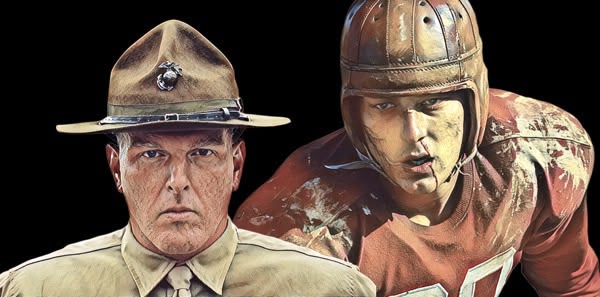
A Cast of Young Stars and the Sons of Stars
Peter Berg has brought together four actors at particularly interesting points in their respective careers.
Nicholas Galitzine achieved enormous popularity with Red, White & Royal Blue and The Idea of You, opposite Anne Hathaway. The British actor has sought to diversify his roles, moving between romantic films, period productions, and major franchises.
Bill Skarsgård, meanwhile, has already demonstrated that his dramatic abilities extend well beyond the physical transformations that made him famous. Pennywise in It and Count Orlok in Nosferatu, he is also the son of actor Stellan Skarsgård and the brother of Alexander Skarsgård. He belongs to a family that has managed to turn the inevitable comparisons between its members into remarkably distinct careers.
But another famous surname draws particular attention in The Mosquito Bowl.
Ray Nicholson, the son of Jack Nicholson and actress Rebecca Broussard, was born in 1992 and has been quietly building his career. His credits include Paul Thomas Anderson’s Licorice Pizza, the television series Panic, Smile 2, and Novocaine.
It is almost impossible to look at Ray without recognizing something of his father, especially when he smiles. In Smile 2, the resemblance was particularly striking for those of us who grew up watching Jack Nicholson in The Shining.
But carrying one of the most important surnames in American cinema is an advantage that comes with considerable responsibility. How do you establish your own artistic identity when audiences search every facial expression for a reminder of another actor?
Rounding out the quartet is Tom Francis, a British actor who rose to prominence in musical theater with the production of Sunset Boulevard starring Nicole Scherzinger. His performance as Joe Gillis earned him an Olivier Award and a Tony nomination. He also appeared in the final season of Netflix’s You.
It is a cast that combines popularity, theatrical prestige, cinematic experience, and the inevitable curiosity surrounding Hollywood’s heirs.
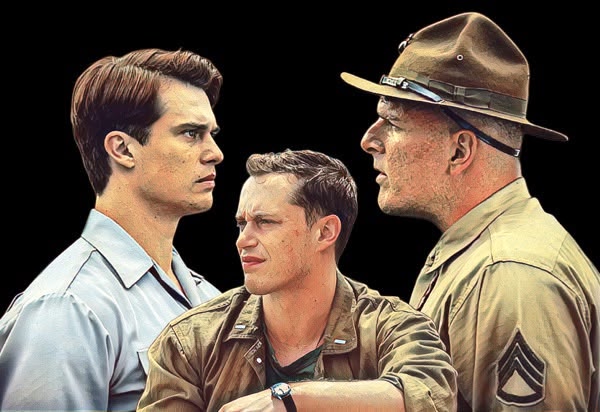
Peter Berg: A More Interesting Director Than Actor
I confess that, in the 1990s, Peter Berg was not an actor who particularly caught my attention. He appeared in productions such as The Last Seduction, Fire in the Sky, and, of course, Chicago Hope. He was competent, but he did not necessarily possess the magnetism of other actors of his generation.
It was as a director that Berg found his true artistic identity.
His feature directorial debut, Very Bad Things, in 1998, was a decidedly dark comedy starring Christian Slater and Cameron Diaz. Then came The Rundown, with Dwayne Johnson, and Friday Night Lights, in 2004, a film that is fundamental to understanding the career he would go on to build.
Berg recognized something in American football that extended beyond athletic competition. In the story of a small Texas town obsessed with the performance of its high school football team, he found a way to explore masculinity, family expectations, social pressure, frustration, and belonging.
The television series Friday Night Lights, which premiered in 2006, expanded on those questions and became one of the most respected television productions of its time.
Berg subsequently directed Hancock, Battleship, Lone Survivor, Deepwater Horizon, and Patriots Day. The last three, all starring Mark Wahlberg, cemented his association with true stories about ordinary men facing extraordinary circumstances.
Not all of his films are equally successful artistically, but Berg has a particular talent for constructing visceral narratives in which audiences understand the magnitude of an experience through the physical exhaustion, fear, and vulnerability of his characters.
More recently, his partnership with Netflix resulted in Painkiller and American Primeval, two very different productions that demonstrate his ability to tell American stories without necessarily idealizing the country.
The Mosquito Bowl, therefore, represents something of a return to Berg’s own creative roots. It brings together the sports of Friday Night Lights, the military world of Lone Survivor, and the interest in real-life events that has shaped much of his career.
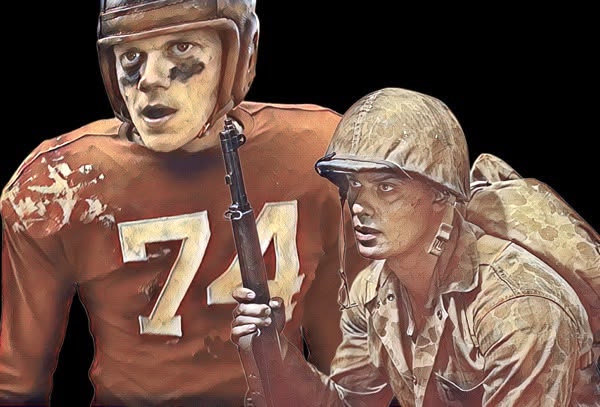
Sports, War, and the Making of the American Hero
There is a particularly strong association between sports and war in American culture. Sporting vocabulary is often militarized, stadiums are spaces for patriotic displays, and athletes are celebrated for qualities equally valued by the armed forces: discipline, physical endurance, teamwork, and a willingness to sacrifice.
This association is not exclusive to the United States, of course, but American football occupies a particularly distinctive place within that cultural construction.
The story of the Mosquito Bowl, however, also exposes the limitations of that comparison.
In sports, there are rules, referees, identifiable opponents, and, above all, the possibility of another game. In war, there is no guarantee that courage, physical preparation, or talent will be enough to ensure survival.
Those young men had spent years learning how to win. The war placed them in circumstances where winning and surviving were not necessarily the same thing.
And perhaps that is the most painful dimension of the story Peter Berg has brought back to life. What happened on Guadalcanal was not particularly significant to the outcome of World War II. The game did not alter American military strategy, determine the outcome of a battle, or hasten the end of the conflict.
Its significance lies precisely in how ordinary it was.
For a few hours, those men could set aside their identities as soldiers and reclaim something the war had taken from them. They became athletes, friends, rivals, and young men who still had a future ahead of them.
We know what happened next. On that December afternoon in 1944, they did not.
And it is the distance between what we know and what those young men still hoped for in life that makes the true story of The Mosquito Bowl so moving.
Descubra mais sobre
Assine para receber nossas notícias mais recentes por e-mail.

