
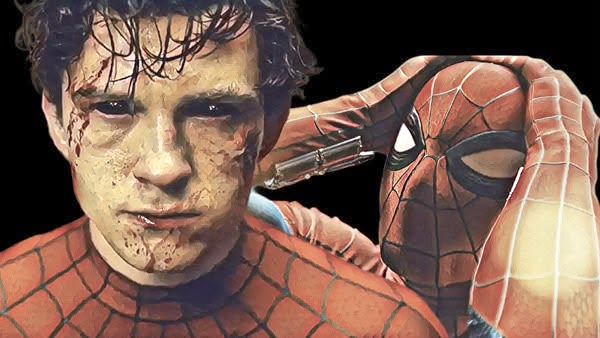
Just weeks before the release of Avengers: Doomsday, Spider-Man: Brand New Day arrives on HBO Max. One of the biggest box office successes of 2026, the film is also, alongside VisionQuest, one of the most immediate connections to the highly anticipated return of the Avengers. There is plenty for Marvel fans to identify, decipher, and speculate about, but I confess that, amid so many Easter eggs and action sequences, what interested me most was precisely what the film could have explored further: Peter Parker’s profound sadness.
Curiously, a film titled Brand New Day should be so dark, dense, and melancholic. Spider-Man, historically one of Marvel’s most entertaining heroes, the one who never misses an opportunity to crack a joke while fighting his enemies, has grown up. And so has Tom Holland, an exceptional actor who, at this point, deserves Marvel’s confidence in his ability to carry a film through drama without necessarily resorting to seemingly endless action sequences.
Because beneath the adventure lies a devastating story.
The Consequences of Being a Hero
If there is one element that connects much of Marvel’s output in recent years, it is its concern with the consequences of heroism. Ever since Avengers: Infinity War and Endgame, the Marvel Cinematic Universe has been trying to process its characters’ trauma. The Blip, the disappearance of half the population, the five years of absence, and the return of those who vanished could not simply be erased from the narrative. Saving the world did not necessarily mean restoring normality, let alone recovering happiness.
That was, in fact, one of the most interesting aspects of WandaVision, The Falcon and the Winter Soldier, Hawkeye, and, more recently, Thunderbolts and VisionQuest. Marvel began asking what happens to its heroes when they are not saving the world. Who are these people when they take off their costumes? How do they process their losses? And, above all, who takes care of those whose purpose is to take care of everyone else?
Peter Parker may be the most painful embodiment of that question.
In Spider-Man: No Way Home, he made a decision that saved countless lives but virtually erased his own. By asking Doctor Strange to make everyone forget who Peter Parker was, he gave up not only his relationship with MJ (Zendaya) and his friendship with Ned (Jacob Batalon), but also his own shared history with other people.
Four years later, while the two have moved on with their lives and their studies at MIT, Peter follows on social media what he should have been experiencing alongside them. He is a spectator of the life he could have had.
And there is something particularly cruel about his situation: he cannot even share his grief with those he has lost because, as far as they are concerned, there has been no loss at all.
When Heroism Becomes Self-Punishment
There is an interesting parallel between Peter Parker and Steve Rogers. Both are men displaced from their own lives, carrying such an absolute sense of moral responsibility that personal happiness seems almost like an unjustifiable indulgence. For Peter, loving someone also means making that person vulnerable. His solution is self-sacrifice.
But at what point does altruism cease to be a virtue and become a form of self-punishment?
Peter does not rest, does not establish new emotional connections, and barely exists outside his costume. Spider-Man is loved by New York, but Peter Parker has no one waiting for him at home. The irony is that while Captain America finally allowed himself to choose happiness at the end of Endgame, Peter seems to be moving in the opposite direction.
Even the physical transformations he undergoes in Brand New Day can be interpreted as manifestations of his emotional suffering. Stress compromises his control over his powers, and his body begins to change in frightening ways. It is as though, as Peter Parker emotionally disappears, the spider occupies an increasingly larger part of his identity.
It is no coincidence that Bruce Banner (Mark Ruffalo), another character whose existence is defined by the difficult relationship he has with his own nature, is the one who can help him understand what is happening.
And it is precisely this universe of questions that I would have plunged into headfirst. Especially with Tom Holland as the leading man.
Tom Holland Deserves More Room for Drama
It is remarkable to witness Holland’s evolution since his debut as Spider-Man a decade ago in Captain America: Civil War. That enthusiastic, talkative teenager, desperate for Tony Stark’s approval, has become a man whose loneliness is palpable even when surrounded by people.
Holland is particularly effective at conveying this sadness because he does not need to underline it. His Peter Parker still has a sense of humor, is still kind, and still cares about others, but there is a permanent sense of emotional exhaustion in his eyes. And in his scenes with Zendaya, the emotional imbalance between them is almost unbearable.
Peter knows everything about MJ. MJ knows virtually nothing about Peter. He recognizes the small gestures, expressions, and peculiarities of this woman, while she finds herself standing before a stranger. How can a relationship be rebuilt under such circumstances? And would it be fair to expect her to reciprocate a feeling whose very experience has been taken away from her?
The film has the maturity not to resolve this issue with a magic trick. When MJ learns through a letter what happened between them, she makes it clear that knowing their story does not mean loving Peter. It is a fundamental distinction. Knowing that we loved someone is not necessarily the same as feeling that love.
The possibility of recovering their memories is suggested when Ned instinctively reproduces their secret handshake. But for Peter and MJ, there is no immediate romantic reward.
There is, however, enough material in this story for an entire film. And Holland and Zendaya are more than capable of carrying it.
Somewhere Between Cinema and a Theme Park
This is where I notice what may be a generational difference between myself and much of Marvel’s audience. I found the action sequences in Brand New Day excessively long. I appreciate the technical sophistication, the creativity of the choreography, and the sheer number of comic book references, but at certain moments, I felt as though I were on one of those amusement park rides that throw us from side to side, without giving us time to breathe or even absorb what has just happened.
It is impossible not to recall the controversy sparked by Martin Scorsese in 2019, when he compared Marvel movies to theme parks. Interestingly, Brand New Day offers much of what Scorsese was questioning at the time: emotional complexity, vulnerability, human contradictions, and characters who must live with the consequences of their choices.
The problem, for me, is that the film does not seem to entirely trust the strength of that material.
Just as I become more invested in Peter’s anguish, I am transported into another lengthy action sequence. When I want to better understand his motivations, I must follow yet another connection to Marvel’s expanded universe. When I would like to spend a few more minutes with Holland and Zendaya, there is another character, another threat, or another reference to identify.
Perhaps younger viewers are better equipped to handle this constant alternation of stimuli. And certainly, for the most dedicated comic book fans, recognizing characters, references, and narrative possibilities is a fundamental part of the fun. I do not question the pleasure they derive from it. I simply wish Marvel would occasionally allow itself to do less in order to say more.
The Arrival of the Mutants and the Road to Doomsday
Warning: spoilers ahead.
Naturally, Spider-Man: Brand New Day does not exist in isolation. Destin Daniel Cretton’s direction and Chris McKenna and Erik Sommers’ screenplay must also accommodate several of Marvel’s broader narrative ambitions, particularly the integration of the X-Men into its cinematic universe.
The confirmation that Sadie Sink is playing Jean Grey is one of the film’s major revelations. And once again, what makes the character interesting is not simply the extent of her powers, but her pain. The loss of her sister, the experiments conducted by the Department of Damage Control, and her inability to fully control the consequences of her suffering establish a parallel with Peter.
It is significant that, during the decisive confrontation, Peter manages to connect with Jean by sharing an emotional memory of Aunt May. It is not physical superiority that allows him to reach her, but his ability to recognize in another person a pain he knows himself.
Spider-Man is at his best when he understands that saving someone does not necessarily mean defeating them.
The presence of the Punisher (Jon Bernthal), Bruce Banner, and Jean Grey expands the possibilities for connections with upcoming films. The post-credits scene, in which the Spider-Man tracking app indicates that he has traveled beyond Earth, fuels speculation about Peter’s involvement in the events of Doomsday or Secret Wars.
Unlike VisionQuest, which establishes an explicit connection to Doctor Doom and Wanda Maximoff, Brand New Day relies on suggestions. The extended version of the film, returning to theaters in December, will also include a deleted scene from Doomsday, reinforcing that connection. So far, however, Holland’s participation in the next Avengers film has not been officially confirmed.
There is also an emotional question that particularly interests me. When and if Peter Parker comes face to face with Robert Downey Jr.’s Doctor Doom, how will he react to seeing the face of the man who was his most important father figure and whose death affected him so profoundly?
Beyond the implications of the multiverse, there is extraordinary dramatic potential in that encounter.
The Right to Be Happy
International critics received Brand New Day predominantly positively, although there was no consensus regarding the balance between drama and spectacle. Some celebrated the maturity of its narrative, while others felt that the franchise’s obligations compromised its strongest moments. I find myself closer to the latter group, even though I recognize many of the film’s qualities.
I do not necessarily miss the teenage, reckless Spider-Man. I appreciate the character’s evolution and, above all, Tom Holland’s evolution as an actor. What bothers me is that Marvel has finally discovered such an interesting dramatic dimension to Peter Parker and still seems reluctant to explore it without constantly resorting to spectacle.
I am also beginning to wonder how much longer Marvel will so directly associate its heroes’ maturity with loss, loneliness, and suffering. Trauma was an interesting way to move the universe forward after Endgame, but it should not be the only one.
Peter Parker has demonstrated countless times that he is willing to die for those he loves. Perhaps the next step in his maturity is understanding that he also has the right to live for himself.
The maxim that has accompanied Spider-Man for decades tells us that with great power comes great responsibility. But responsibility should not necessarily be synonymous with renunciation.
After everything Peter Parker has lost, I would like his next great challenge to be learning how to be happy. And that would not require a single explosion.
Descubra mais sobre
Assine para receber nossas notícias mais recentes por e-mail.

