
A series about repression, sexuality, religious fanaticism, and collective hysteria ends up provoking a reaction outside the screen that directly echoes the themes it seeks to explore. The success of The Body, the Netflix production that premiered on November 11 and reached the top of the platform’s weekly ranking of English-language series, carries an irony that’s hard to ignore.
While thousands of people sign a petition demanding its cancellation because they consider it offensive to Christianity, the series created by Quinn Shephard, who was also behind Under the Bridge, continues to expand its audience. Between November 16 and 22, it recorded 9.5 million views, confirming its status as one of the streaming phenomena of the end of the year.
It would not be the first time an attempt to prevent a work of art from circulating has ultimately increased public curiosity about it.
But beyond the religious controversy, what exactly does The Body have to say?
The Horror of Being a Teenage Girl
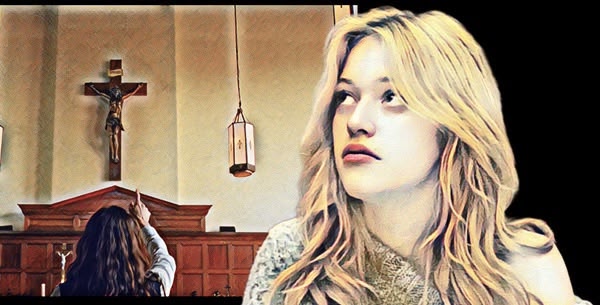
Set in 2004, The Body follows a group of teenage girls who belong to the dance team at St. Mark’s, a Catholic school. During a Halloween party, an initiation ritual ends tragically when one of the team members, Grace (Sofia Wylie), falls into a coma.
The incident triggers a succession of strange behaviors. The girls begin reporting visions of Grace, raising expectations within the community that they might be witnessing a divine manifestation. But what appears to be a miracle may also conceal a story of guilt, manipulation, and shared secrets.
At the center of the narrative are Anya (Kristina Bogic), the team captain, her best friend Elise (Sara Boustany), and Lisbeth (Geena Meszaros), a teenage girl who desperately wants to become part of the group.
The relationship between Anya and Elise goes beyond friendship, but acknowledging the nature of their feelings means confronting not only the expectations of their religious community but also the social conventions that structure adolescence itself.
Lisbeth, meanwhile, understands that knowing other people’s secrets can give her the power that her social position does not.
There are elements of Mean Girls, The Craft, Euphoria, Jennifer’s Body, and, particularly, Arthur Miller’s The Crucible. Shephard herself acknowledges the influence of teen movies from the turn of the millennium and narratives about collective paranoia.
But perhaps the most interesting element of this combination is precisely the choice of dance.

The Body as a Site of Conflict
The series’ title is particularly effective because it allows for different interpretations. There is the physical body, which these teenage girls are discovering, transforming, and learning to recognize. There is the body disciplined through dance, subjected to repetition, correction, evaluation, and the demands of a collective performance. There is also the religious body, associated with sin, purity, sacrifice, and transcendence.
And there is Grace’s body, which becomes the repository of an entire community’s expectations, fantasies, and emotional needs.
Adolescence is a period during which our relationship with our own bodies undergoes particularly intense transformations. What was once familiar begins to acquire new meanings. The body becomes something that is observed, desired, compared, judged, and frequently experienced as something we cannot entirely control.
Within a dance team, there is an additional contradiction: the need to stand out individually without ceasing to belong to the ensemble. You must be special enough to be recognized, but not so different that you compromise the unity of the group.
This tension permeates virtually every relationship in The Body.
Quinn Shephard and executive producer Gina Gammell drew on their own teenage experiences when developing the series. Gammell attended an all-girls Christian school without being Christian herself, while Shephard has acknowledged experiencing conflicts related to her sexuality and her need to belong.
The issue, therefore, is not exclusively religious. It is also about the difficulty of discovering who we are when our identity depends, to a considerable extent, on the approval of others.
Desire, Guilt, and the Need to Belong
One possible reading of The Body lies in the way the series establishes a relationship between desire and guilt.
Desire, particularly when it conflicts with what we have learned to consider acceptable, can generate anxiety. Not simply because of what we desire, but because of what we believe that desire reveals about us.
For Anya, acknowledging her feelings for Elise means risking the loss of an identity that provides her with security and recognition. She is popular, occupies a leadership position, and has a boyfriend. There is an established social narrative about who she is, and her desire threatens to disrupt that narrative.
Lisbeth, on the other hand, experiences exclusion. Her desire to belong is so intense that she begins manipulating the very relationships of which she would like to be a part.
There is an important distinction between being accepted and managing to make oneself indispensable. When we do not believe we can be loved spontaneously, we may try to control circumstances so that others do not have the option of abandoning us.
It is in this territory that The Body finds questions far more interesting than the mere possibility of demonic possession.
What Explains the Religious Controversy?
Even before its premiere, The Body had become the target of a campaign organized by the conservative platform CitizenGO. The petition accuses the production of using Catholic symbols disrespectfully and associating Christianity with occult practices and behavior its organizers consider offensive.
The number of signatures surpassed 150,000 in the week following the premiere, and the controversy attracted international attention.
It is perfectly legitimate for religious viewers to feel uncomfortable with the way their beliefs are represented in a work of fiction. It is also legitimate to question the use of symbols considered sacred as instruments of artistic provocation.
But there is an important difference between criticizing a representation and demanding that it not be allowed to exist.
Part of the campaign against The Body preceded the release of its eight episodes. This means that many of the initial expressions of outrage occurred before audiences had the opportunity to experience the narrative in its entirety.
And that is precisely where the reaction to the series becomes particularly interesting.
A work about the circulation of beliefs, the need to belong, and the way certain groups construct collective interpretations of reality ends up becoming the subject of a similar phenomenon.
This does not mean that everyone criticizing the series is behaving irrationally. But it invites us to consider how outrage can also function as a source of collective identification.
The Need to Believe
Warning: spoilers for the series’ ending follow.
What happened to Grace was not initially the result of supernatural intervention. The teenager had consumed drugs during the Halloween party, and the circumstances surrounding her collapse were concealed by people who feared the consequences of their own actions.
The alleged visions reported by the members of the dance team were not genuine either.
But by the time a rational explanation finally begins to emerge, the collective narrative has already acquired a dimension that goes beyond the girls’ original intentions.
Grace ceases to be simply a hospitalized teenager and becomes the embodiment of a possible miracle. People who need something to believe in invest expectations in her story that do not necessarily depend on what actually happened.

It is a particularly interesting mechanism because it demonstrates how a belief can acquire a life of its own, independent of the events that originally gave rise to it.
Arthur Miller explored something similar in The Crucible, using the seventeenth-century witch trials to reflect on the political persecutions of his own time. When fear becomes an instrument of social cohesion, questioning the dominant narrative can represent a greater risk than embracing it.
In The Body, the fear of exclusion, guilt, and the desire for recognition contribute to sustaining a story that progressively escapes the control of those who initiated it.
What Did Critics Think?
International critical reception was predominantly positive, although not unanimous. Its approval rating on Rotten Tomatoes exceeded 80%, while its Metacritic score reflected a favorable but somewhat less enthusiastic response.
The combination of genres was among the most praised aspects of the production. There were also reservations about the length of its eight episodes, its pacing, and its excessively dark cinematography — a problem that, incidentally, seems to plague much of contemporary streaming television.
RogerEbert.com identified similarities with Euphoria and Ken Russell’s The Devils, while an analysis published by The Atlantic this week highlighted the presence of Catholic guilt and references to The Crucible and The Craft.
Netflix has not yet officially announced a second season. The producers, however, have already discussed possibilities for continuing some of the relationships introduced in the first.
When Attempts at Censorship Become Publicity
There is a phenomenon known as the Streisand effect, an expression popularized after Barbra Streisand attempted to prevent the circulation of a photograph of her property. Her efforts ultimately attracted considerably more attention to the very image she had sought to remove from public view.
We cannot claim that the campaign against The Body is responsible for its success. Doing so would mean disregarding the series’ creative premise, its critical reception, Netflix’s promotional strategy, and audiences’ interest in teenage narratives.
But it is difficult to imagine that the publicity surrounding the petition has not sparked some curiosity.

In that sense, the performance of The Body in streaming rankings raises a question that goes beyond the series itself: in a culture where attention is one of the most fiercely contested resources, to what extent has public outrage become an involuntary marketing tool?
Quinn Shephard created a story about teenage girls who want to be seen, recognized, and accepted, but who discover the destructive potential of what happens when the collective gaze turns toward them.
Ironically, the series is experiencing something similar.
And perhaps that is the greatest provocation of The Body: not necessarily what we believe, but what we are willing to do to preserve our beliefs and continue belonging to those with whom we share them.
Descubra mais sobre
Assine para receber nossas notícias mais recentes por e-mail.

