
Some books have had such a significant impact that, a century later, it becomes difficult to appreciate just how revolutionary they were when first published. After all, we are already familiar with so many works that reproduce, adapt, or reinvent their ideas that we may even confuse the original with its countless derivatives. Such is the case with Agatha Christie’s The Murder of Roger Ackroyd, which celebrated its centenary in 2026.
In January, when we marked the 50th anniversary of the British author’s death, I revisited some of the reasons why she remains so popular. But the centenary of The Murder of Roger Ackroyd deserves particular attention because it was with this novel that Agatha Christie not only consolidated her reputation as a mystery writer but also challenged the very conventions of crime fiction.
And to think that, at the time, Hercule Poirot was appearing in only his third novel.
Initially serialized in the London Evening News in 1925 and published in book form in 1926, The Murder of Roger Ackroyd was Christie’s sixth novel and her first published by William Collins, with whom she would maintain a long association. The author was 35 years old and still far from imagining the extraordinary dimensions her career would eventually assume.
Her Belgian detective, introduced in The Mysterious Affair at Styles in 1920, was already familiar to readers but had yet to achieve his status as one of the most popular characters in world literature.
It was precisely with an apparently conventional story that Christie changed everything.
A Murder in the Tranquility of the English Countryside
The story takes place in the fictional village of King’s Abbot, one of those small English communities that Agatha Christie would turn into particularly fertile territory for murder. Everyone seems to know everyone else’s business, although, naturally, no one knows exactly what happens behind closed doors.
A widow, Mrs. Ferrars, dies after taking an excessive dose of medication. The local doctor, James Sheppard, is called, while his sister Caroline, always remarkably well-informed about their neighbors’ lives, speculates about the circumstances of her death.
Roger Ackroyd, a wealthy local businessman, had been romantically involved with the widow. Shortly before her death, she had revealed to him that she was being blackmailed over a secret concerning the death of her first husband. When Ackroyd is found murdered in his study, everyone who had access to his home becomes a potential suspect.
There are financial interests, family secrets, romantic relationships, and seemingly inexplicable behavior. Fortunately, a new resident of the village, an eccentric Belgian who intended to devote his retirement to growing vegetable marrows, turns out to be none other than Hercule Poirot.
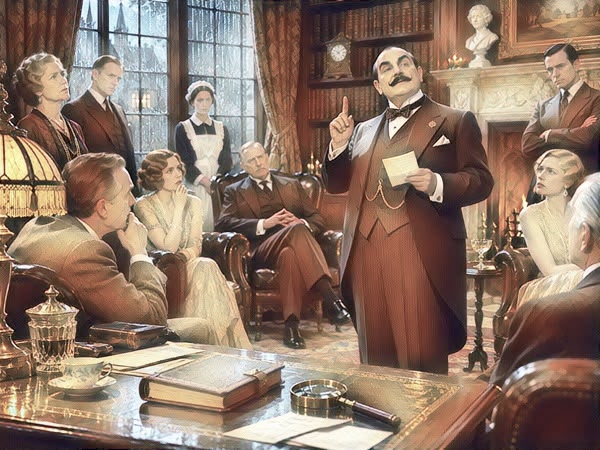
The detective takes on the investigation, accompanied by Dr. James Sheppard, who also happens to be the narrator of the story. So far, there is nothing particularly different from a Sherlock Holmes novel. We have a crime, a limited group of suspects, an exceptionally intelligent detective, and a doctor responsible for recording his discoveries.
And that is precisely where Agatha Christie’s genius lies.
When the Reader Is Also Deceived
Warning: spoilers for the novel’s ending follow.
One of the most interesting aspects of classic crime fiction is the pact established between writer and reader. We are invited to solve a crime, given information, encouraged to analyze behavior, and ultimately discover whether we were as clever as the detective.
For this game to work, we need to trust something. We may distrust the characters, the suspects, and their statements, but we tend to trust the person telling us the story.
Arthur Conan Doyle had contributed enormously to establishing this convention with Sherlock Holmes and Dr. Watson. The doctor does not possess Holmes’s deductive abilities, but his function is precisely to bring the reader closer to the detective. Watson is our intermediary and, therefore, our ally.
Agatha Christie understood this relationship of trust perfectly and decided to use it against us. James Sheppard occupies a position in The Murder of Roger Ackroyd similar to Watson’s. A respected doctor, apparently rational and sufficiently close to the events, he is the one who guides us through the investigation.
What we discover at the end is that Roger Ackroyd’s murderer is James Sheppard himself.
He was also the person blackmailing Mrs. Ferrars. When he realizes that Ackroyd is about to discover his identity, Sheppard murders him and manipulates the circumstances of the crime to divert suspicion. But the most interesting aspect is not simply the identity of the murderer. It is the way Christie constructs the narrative.
Sheppard carefully selects what he tells us. He relies on omissions, exploits ambiguities, and allows readers to draw erroneous conclusions from apparently objective information. Often, there is no need to lie when we can simply choose what not to disclose.
Upon finishing the book, the immediate temptation is to return to its opening pages to discover precisely when we were deceived. And it is during that second reading that we realize how much we contributed to our own deception.
We believed Sheppard not necessarily because he had demonstrated that he deserved our trust, but because he occupied a narrative position we associated with honesty. Agatha Christie understood not only literary conventions. She understood her audience.
Did Agatha Christie Cheat?
The solution generated controversy. For some readers and critics, Christie had broken an implicit agreement within crime fiction. After all, how can readers solve a crime when the person responsible for providing the information is precisely the one concealing his own responsibility?
The discussion was particularly relevant because crime fiction was experiencing what became known as its Golden Age. Writers such as Dorothy L. Sayers and, later, Ronald Knox and S. S. Van Dine contributed to establishing or formalizing the principles that should guide the genre.
The detective novel was also an intellectual exercise, and readers were expected to have a reasonable opportunity to arrive at the solution.
But had Christie really cheated?
I find this discussion fascinating because, when we reread the novel, we realize that she did not necessarily need to break the rules. She needed to understand our prejudices as readers.
We begin with the assumption that the doctor is trustworthy. We associate his profession with respectability, his proximity to Poirot with innocence, and his role as narrator with transparency. Christie exploits precisely those associations.
It is a lesson that extends far beyond crime fiction. How often do we confuse the authority of the person telling us a story with the truthfulness of what we are being told? How often does a narrative seem convincing simply because it corresponds to our expectations?
The unreliable narrator was not Agatha Christie’s invention. It had existed in literature long before 1926. But the way she incorporated it into the structure of a popular detective novel helped redefine the possibilities of the genre.
And, a century later, we remain fascinated by stories that force us to reconsider everything we believed.
The Extraordinary Modernity of Agatha Christie
From contemporary psychological thrillers to television series that present different versions of the same event, it is difficult not to recognize Christie’s legacy.
Books such as Gillian Flynn’s Gone Girl and Alex Michaelides’s The Silent Patient belong to a narrative tradition that questions the reliability of those guiding us through the story. They are not reproductions of The Murder of Roger Ackroyd, but they explore territory that Christie helped make familiar to mystery readers. Today, we are particularly accustomed to narratives that introduce apparently innocent characters, reveal contradictory versions of events, and invite us to reassess the information we have received.
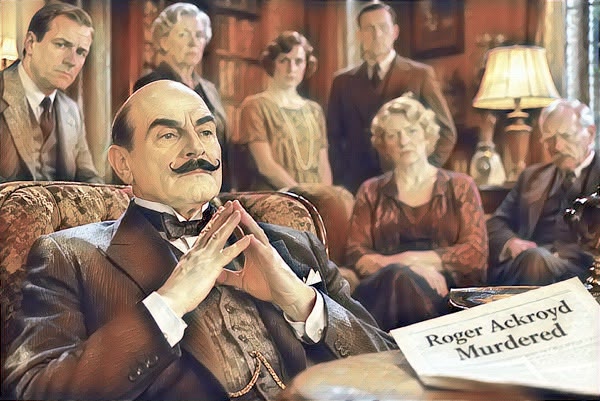
In 1926, Christie already understood that the mystery did not have to lie exclusively in the crime. It could lie in the very way the story was told. The novel’s success has endured across generations. In 1939, Orson Welles played both Poirot and Sheppard in a radio adaptation. In 2000, David Suchet returned as the detective in a television adaptation for Agatha Christie’s Poirot, although transferring the story to the screen required changes to its narrative structure.
After all, how does one visually reproduce a story whose principal mechanism of suspense lies precisely in the narrator’s choice of words? In 2013, the Crime Writers’ Association voted The Murder of Roger Ackroyd the greatest crime novel of all time in a poll of crime writers. The work that had divided opinion in 1926 had become an essential reference for those who followed in Christie’s footsteps.
The Year Fiction Met Reality
There is another extraordinary coincidence in the history of The Murder of Roger Ackroyd. The year that represented one of Agatha Christie’s greatest professional achievements was also one of the most painful of her personal life.
In 1926, she lost her mother, discovered that her husband was in love with another woman, and, in December, disappeared for 11 days, mobilizing authorities, journalists, and thousands of people.
When she was found in a hotel, she offered no explanation that satisfied the public’s curiosity. Interpretations of the episode multiplied, and, a hundred years later, we are still discussing what really happened. The woman who had demonstrated how readers could be led to erroneous conclusions through a carefully constructed narrative became the subject of other people’s narratives. But unlike the murder of Roger Ackroyd, her own mystery never received a definitive explanation.
Perhaps that is one of the most fascinating aspects of revisiting Agatha Christie in 2026. The author we associate with stories in which intelligence ultimately brings order to chaos and the truth emerges from contradictions also left us an enigma for which no final revelation has ever been sufficient. A hundred years later, Hercule Poirot may still have something to teach us: before asking who committed the crime, perhaps we should ask who is telling us the story.
Descubra mais sobre
Assine para receber nossas notícias mais recentes por e-mail.

