
The trailer for The Devil Wears Prada 2 isn’t designed to reassure fans — it’s pure provocation. It reenacts familiar images, but always with a slight shift, and that’s precisely where the knowing wink lies for those who’ve followed the story. Nothing is there merely to “remind” us of the 2006 film. Every choice seems to ask what has changed in fashion, in work, in power — and in us — over the past twenty years. Here are 10 Easter eggs, clues, and surprises that reveal how this return to Runway is anything but innocent.
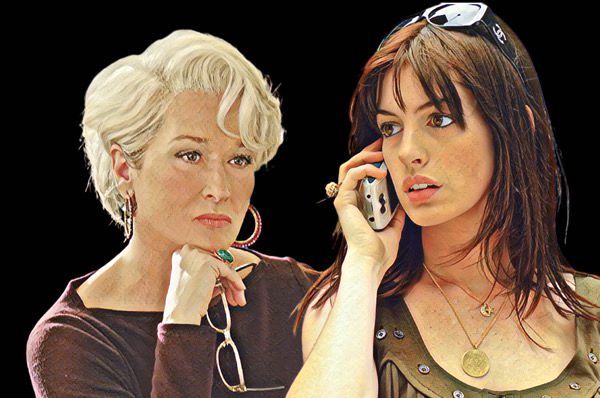
1. “Vogue,” by Madonna, as source code
As in the original, the song isn’t just a soundtrack — it’s a thesis. “Vogue” speaks of pose, image, performance, and survival through style, which is precisely Miranda Priestly’s language. As a fictional transposition of Anna Wintour at Vogue, the character turns the song into a coded citation: whoever controls the image continues to control the game. In 2026, that feels less glamorous and far more strategic.
2. Andrea’s arrival at Runway — now with awareness
The trailer replicates the classic framing of Andrea arriving at the Runway building. But the difference is decisive. Before, she arrived naïve and out of place. Now, she arrives more stylish — still outside the absolute standard, but fully aware of what she’s wearing and what it communicates. Nigel’s jab (“Look what T.J. Maxx dragged in,” as heard in the trailer) doesn’t diminish her the way it once did. Andy knows exactly where her clothes come from — and she chose them.
3. “Emily” as a generic name: Miranda’s false amnesia
The idea that Miranda wouldn’t remember Andrea sounds absurd — and the trailer knows it. The clue lies in the past: Miranda never cared to remember assistants’ names. They were all “Emily.” The supposed forgetfulness is less a memory lapse and more a power move. Remembering someone grants importance; pretending not to remember rearranges hierarchies.
4. The pole spin, repeated
In the first film, in Paris, Andrea spins around a pole before kissing Christian Thompson. In the sequel’s trailer, she repeats the gesture in New York, now with a new romantic interest. This isn’t cheap nostalgia. It’s a bodily signature. Andy remains someone in motion, someone who spins before choosing — even after everything she’s lived through.
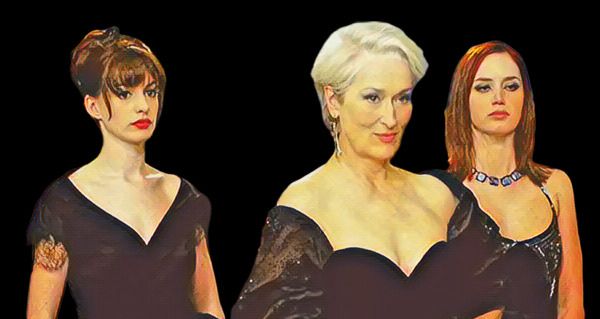
5. Emily’s return — now on the money side
Emily appears first as a specter: background, reflection, a limousine door. When she’s revealed, the impact is immediate. The trailer makes her new role clear: a powerful executive, tied to the capital that could ensure Runway’s survival. Her reunion with Andrea isn’t juvenile or competitive — it’s the collision of two women shaped by the same system, who survived by opposite paths.
6. The “Not-Met Gala” and the “Spring Florals” banners
Perhaps the sharpest joke in the trailer. An event that mimics the Met Gala without being the Met Gala, decorated with banners reading “Spring Florals.” It’s perfect irony. The film laughs at its own meme (“Florals? Groundbreaking.”), at an industry stuck in repetition, and at spectacle turned self-parody. Runway creates its own ritual because fashion’s symbolic center is no longer singular.
7. Andrea as editor of discourse, not trends
It almost slips by unnoticed, but it changes everything: Andy now holds an editorial role tied to content and curation. She doesn’t execute fashion — she organizes narrative. In 2006, she learned to obey. In 2026, she competes for the power to tell stories.
8. Nigel as emotional anchor
Nigel’s mere appearance brings immediate relief. That’s no accident. He functions as the story’s ethical bridge, reminding us that humanity still exists within that ecosystem. His presence ensures that, despite the sharper cynicism, the film’s emotional core remains intact.
9. The car window: who looks, and who is looked at
There’s a moment when a car window rolls down. This time, Emily is inside. It’s a direct citation of the final image from the first film: Miranda in the car, Andy outside, that ambiguous look that closed the story. By repeating the gesture and swapping who occupies the seat of power, the trailer suggests that faces change, but the ritual endures. The car remains Runway’s ultimate symbol of hierarchy: those inside observe; those outside must interpret the gesture.
10. Emily with two assistants: when the victim becomes the mold
A quick, almost peripheral detail says a lot: Emily now has two assistants, exactly like Miranda. This isn’t just a status symbol or an inside joke for attentive fans. It’s a structural commentary. Emily was shaped by a system that humiliated, exhausted, and disciplined her — and upon rising, she doesn’t dismantle it. She reproduces it. The symmetry is clear: same position, same machinery, new occupant. The repetition of the two assistants acts as a cruel mirror of corporate meritocracy: the system changes faces, but preserves its choreography.
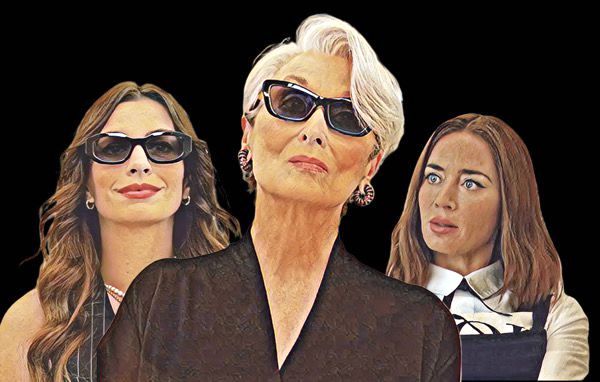
At its core, the trailer makes one thing very clear: it doesn’t just want to take us back to Runway. It wants to test how much we, as viewers, have changed — and how deeply we still respond to the same codes of glamour, memory, and power. And you know what? We want more. The Devil Wears Prada 2 hits theaters on April 30. We’re already counting the weeks.
Descubra mais sobre
Assine para receber nossas notícias mais recentes por e-mail.

