
For a long time, fashion and Lilibet were never the most obvious connection in the legacy of Queen Elizabeth II. That association seemed to belong to other women around her. Princess Margaret, with her appetite for excess. Princess Diana, who transformed every appearance into an emotional and media event. And more recently, Catherine, Princess of Wales, whose relationship with fashion has become part of the industry itself.
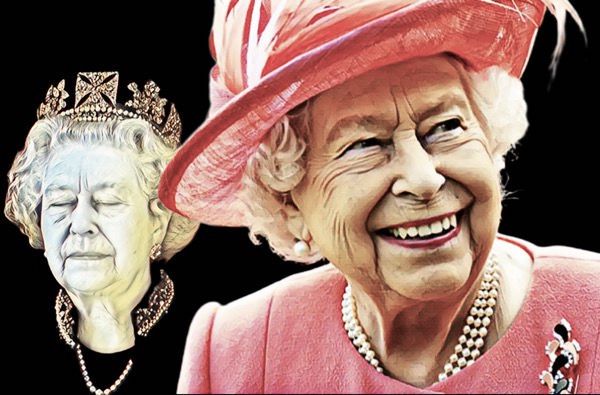
Elizabeth appeared to exist in a different space. Her choices were often described as safe, repetitive, and discreet to the point of disappearing. A perception that lasted for decades and was reinforced by The Crown, where clothing often reads less as expression and more as institutional uniform.
But perhaps the mistake was to confuse silence with absence.
That is what the exhibition Queen Elizabeth II: Her Life in Style, opening on April 11 at Buckingham Palace, begins to correct. Not through a dramatic revision, but by revealing a process that was always there, simply overlooked.
When style does not demand attention, but builds presence
It is no coincidence that the exhibition opens in April, the month in which Elizabeth would have turned 100. The centenary becomes both context and lens. This is not just a revisiting of a wardrobe, but an attempt to understand what that wardrobe constructed over seven decades of reign.
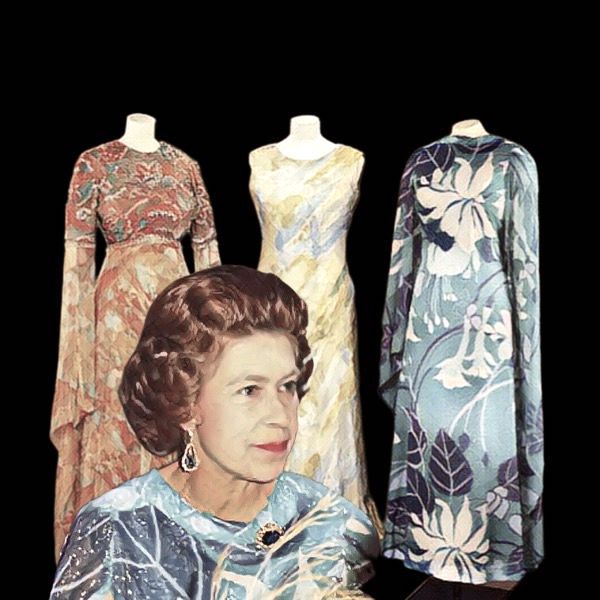
Bringing together around 200 pieces, many shown for the first time, the exhibition moves across all stages of her life, from childhood to her final years, revealing not just clothes, but a system of decisions.
There are dresses, jewellery, hats, shoes, and accessories, but also sketches, fabric samples, and correspondence that expose something long left out of the dominant narrative. Elizabeth did not simply wear clothes. She shaped them, guided them, and approved them. In her case, fashion was never superficial. It was a language, carefully built over time.
The curatorial approach avoids strict chronology in favour of ideas. Relationships with designers, the consolidation of British couture, the diplomatic use of clothing, and the influence of her visual identity all emerge as ways of understanding how this wardrobe functioned in the world.
The pieces that tell the story before the story
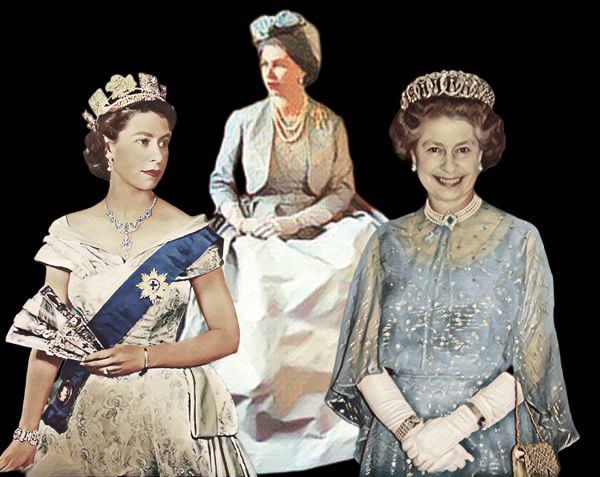
Among the items displayed for the first time, there is something almost intimate in the decision to begin with childhood. A bridesmaid’s dress designed by Edward Molyneux, worn by an eight-year-old Elizabeth in 1934 at the wedding of her uncle, Prince George, Duke of Kent, to Princess Marina of Greece and Denmark. Made of silver lamé and tulle, it is now considered the earliest surviving designer piece from her wardrobe.
It is revealing not because of its grandeur, but because of what it anticipates. Before she became Queen, Elizabeth was already being dressed for the public gaze. The idea that clothing would be part of her image was already in place.
From there, the exhibition moves into the pieces that would define her.
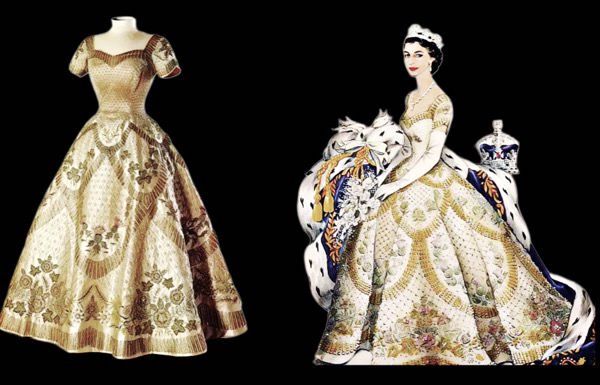
Her wedding dress, designed in 1947 by Sir Norman Hartnell (Marilyn Monroe‘s and Marlene Dietrich‘s favorite designer), carries the language of post-war renewal. Her Coronation dress, in 1953, expands that language into something far more symbolic. Made of white satin and embroidered in gold and silver with emblems of the United Kingdom and the Commonwealth, it turns the body of the Queen into a political surface.
Both dresses reveal something essential. Elizabeth was not a passive recipient. She chose the tone, a specific ice-white shade, requested a silhouette that echoed her wedding gown, and insisted on the inclusion of symbols representing the nations under the Crown. She also made a request that feels almost contradictory in retrospect, that the dress should not be showy.
Hartnell delivered with precision. Months of research, multiple sketches, a construction where nothing could fail. And yet, within that control, he left a hidden gesture. A four-leaf clover embroidered among the floral motifs was a quiet message of good luck to the young Queen.
Looking at it now, it is difficult not to think about what followed. Seventy years of reign, an image that remained intact even as everything around it changed.
Hartnell returned to the public conversation in 2020, when Elizabeth lent her own dress to her granddaughter, Princess Beatrice, for her wedding. The gesture carries a sense of continuity that the exhibition reinforces throughout. These are not just preserved objects, but a narrative that extends, repeats, and evolves without breaking.
And perhaps that is what gives this collection its emotional weight. These are not simply clothes. They are fragments of a life lived under constant observation, where every choice carries intention.
Somewhere between a child’s dress and a coronation gown, Lilibet’s style begins to emerge not as fashion, but as language.
Colour as strategy and the influence she never claimed
There is a moment in the exhibition where this idea becomes almost unmistakable. It appears in colour.
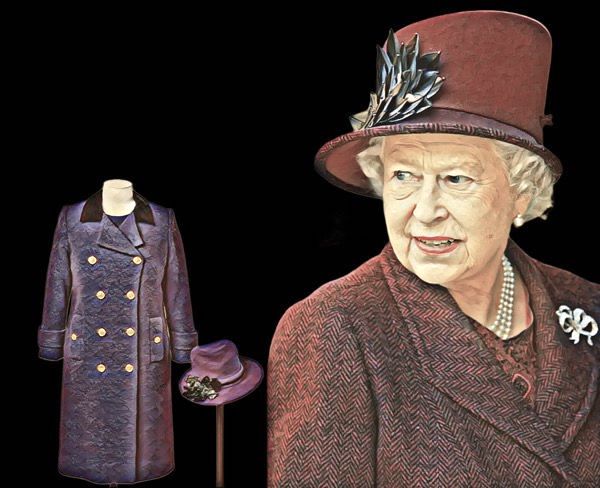
Elizabeth understood something early on that few public figures have applied with such consistency. Being present was not enough. She had to be seen. In official engagements, surrounded by crowds, her image needed to travel distance, weather, and confusion. Colour became a tool.
Daywear followed a precise logic. Strong, singular tones, always paired with hats designed not to obscure her face. Everything was constructed so she could be recognised instantly, even from afar.
What later became the “rainbow Queen” was never about playfulness alone. It was a practical solution that evolved into a signature.
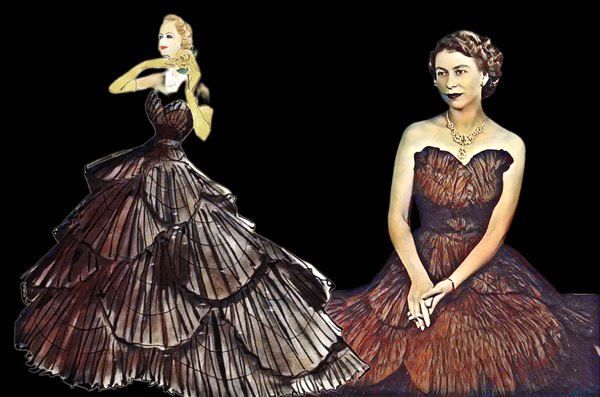
This approach has deeper roots. In the 1940s, as Princess Elizabeth stepped into public life, her wardrobe already reflected the influence of the New Look created by Christian Dior in 1947. Defined waists, controlled volume, and a post-war reconstruction of femininity.
London, at the time, was competing with Paris, and British couturiers such as Norman Hartnell were part of that movement. This was not simply about dressing a princess, but about establishing an industry.
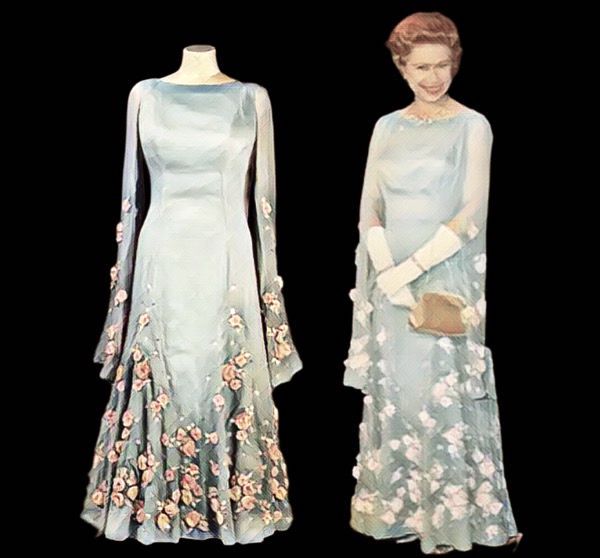
Hartnell runs through the exhibition like an emotional thread. The Queen’s favourite designer, responsible for her most iconic dresses, but also for some of her most understated ones. Pieces that may seem simple at first glance, but become something else entirely when seen up close, removed from the noise of official imagery.
There is something unexpectedly moving in that.
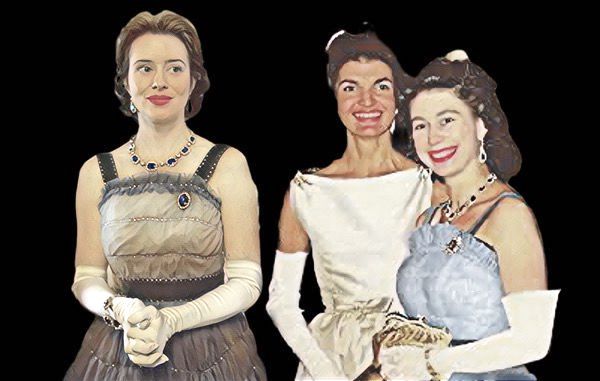
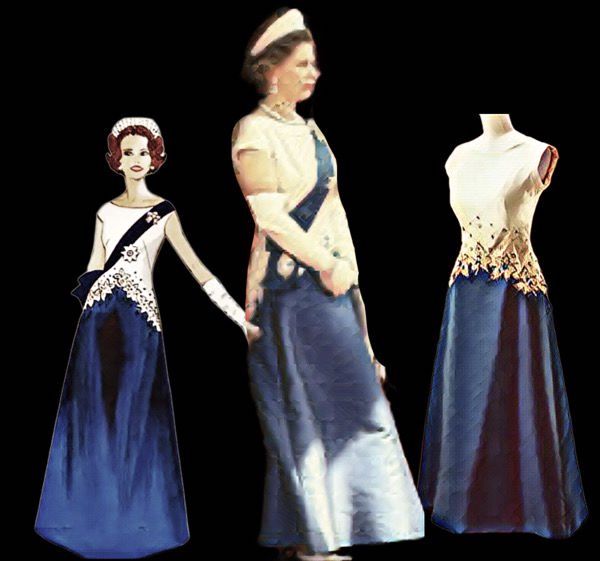
Among them is the gown worn during the 1957 state visit hosting John and Jacqueline Kennedy, a moment that has come to symbolise two distinct forms of public presence. It was revisited in The Crown, but seeing the dress itself shifts the focus away from narrative and back to material reality.
The style that influenced without seeking influence
Perhaps the most revealing aspect of the exhibition is this shift in perspective. Elizabeth was never framed as a central figure in contemporary fashion, and yet her influence is quietly everywhere.
It moves through generations of designers, from Miuccia Prada to Alessandro Michele, as well as names like Erdem Moralioglu and Richard Quinn, all of whom engage, in different ways, with the idea of a strong and consistent visual identity.
Her most tangible impact, however, may have been within British fashion itself. From supporting local designers in the 1940s and 50s to attending shows and legitimising the industry, she played a role in its consolidation. Decades later, this relationship became explicit with the creation of the Queen Elizabeth II Award for British Design, which she personally presented during London Fashion Week.
What is striking is that none of this appears driven by a desire to influence. At least not in the contemporary sense.
And yet, looking at the whole, it becomes clear that she did.
Because her style was never about novelty. It was about coherence. And coherence, sustained over time, becomes a form of power that fashion rarely achieves.
Service
Exhibition: Queen Elizabeth II: Her Life in Style
Location: The King’s Gallery
Opening: April 11, 2026
Context: centenary of Elizabeth II
Collection: around 200 items, including clothing, accessories, jewellery, sketches, and correspondence
Highlights: Coronation dress, wedding dress, childhood pieces, and historic looks
More information: https://www.rct.uk/collection/stories/queen-elizabeth-ii-her-fashion-story
Descubra mais sobre
Assine para receber nossas notícias mais recentes por e-mail.
 miscelana.com