
I was already preparing to write about Marlene Dietrich, simply because she is one of the greatest Divas in history, when a short scene from the series Becoming Karl Lagerfeld gave me the final justification.
In the series, the German couturier needs a celebrity to put him in the spotlight in Vogue, and when the legendary actress seeks him out, she finally sees the greatest opportunity at hand. At first, she says she sought him out because “she missed speaking German”, but ends up giving in and believes that Lagerfeld will help her stand out as a fashion reference. When Marlene sees the model created for her, she runs away, but before she does, she warns him that “the designer is just the mirror of the woman he is wearing”, she says, “You only exist if the reflection of what I see in the mirror pleases me”, she summarizes.
Whether this is true or not, the series leaves it unclear, but it is a scene that has the Diva’s face.
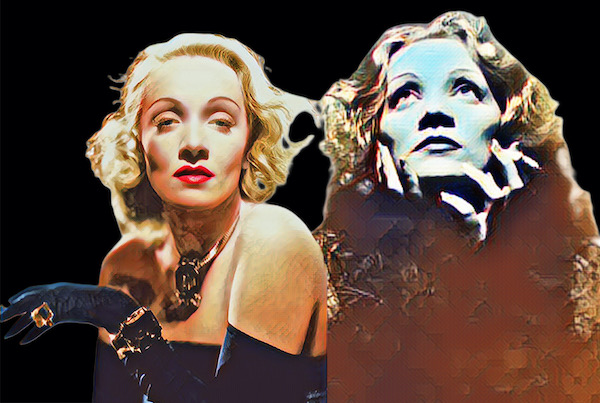
Marlene Dietrich, who died at the age of 90 in Paris in 1992, is still an international symbol of glamour and sex, with a controversial and complex life in equal measure. Singer, actress, model, spy, and celebrity, Marlene will always be on the short list of the greatest and one of the most influential personalities of the 20th century.
Born in Berlin in 1901 as Marie Magdalene Dietrich, she was the daughter of a police lieutenant and former cavalry major, who died when she was 9 years old, and the granddaughter of a wealthy watch merchant, growing up in the comfort of an upper-middle-class. A student at a private school, Marlene dreamed of being a violinist, but a hand injury changed her plans for the theater, where she adopted her stage name due to family disapproval. While still young, she appeared in plays, cabarets, and films, but without starring roles.
Her luck changed when she began working with Josef von Sternberg, who would not only make her an international star with The Blue Angel in 1930 but would remain her mentor forever. The film, based on Heinrich Mann’s novel “Professor Unrat,” was shot in both German and English, opening doors for the diminutive actress with an ego twice her size. The world was never the same after seeing her as Lola-Lola, the singer who destroys an elderly professor in love (Emil Jannings).
Her success also took her straight to Hollywood, where, 30 pounds lighter, she became one of the most talked-about names in entertainment, but always compared to Greta Garbo. By this time, Marlene had married and had a daughter, Maria (who would also become an actress), and her husband and child came with her to the United States, but the marriage quickly fell apart, although they never divorced. The truth is that even though she participated in major films and was a legend, Marlene always lived in the shadow of the decadent, sexually liberated, and ambiguous Lola-Lola.
Her roles were always that of the mysterious and exotic femme fatale, in large part, perhaps because of her strong accent, contributing to the persona with which she is associated to this day. “I played prostitutes,” she acknowledged years later, “I never played any recommendable character.”
Her personal life was the subject of curiosity, and, later cited as openly homosexual, she collected famous lovers from John Gilbert to Gary Cooper, Jimmy Stewart, and John Wayne. Her romance with the writer Erich Maria Remarque, author of All Quiet on the Western Front, was the inspiration for the character Joan Madou in the novel Arch of Triumph.
When World War II began to unfold, Marlene Dietrich was one of the most outspoken opponents of Nazism, helping Jews escape from Europe as much as she could. Even so, Hitler’s agents offered her a fortune to go to Germany and make local films. Her refusal led the dictator to decree that any film she made would be banned in Germany, and this only made the actress decide even more quickly to become an American citizen. As such, she participated in anti-Nazi broadcasts in Germany, in war bond campaigns, and visited Allied troops to encourage them.
In times of peace, with fewer offers in ageist Hollywood, she returned to performing in cabaret shows around the world, making a fortune. In the early 1970s, she moved to Paris and never returned to America. She became a recluse and lost patience with the press. She even wrote an autobiography, but she gradually isolated herself until she was virtually no longer seen in public. But just as significant as the Cinema was the recognition of Marlene Dietrich as a fashion symbol, having pioneered the use of men’s clothing in a feminine way, such as the tuxedo, which many claim inspired Yves Saint Laurent to create his signature piece decades later. The look became known as the “Dietrich silhouette,” highlighting her thinness and bisexual stance.
“I dress for the image. Not for myself, not for the public, not for fashion, not for men,” she once explained. “All my life I have represented glamour in a medium that was anything but glamorous. People don’t come to see me, but to look at me,” she explained.

In general, Marlene tried to make all her choices seem casual, but biographers refused to endorse this image. For them, the actress knew how to mix her political and personal stance in each role or outfit she wore, combining a fashion statement with an opinion. For example, her open and fierce refusal to wear any Chanel piece was due to what the seamstress did when she got involved with the Nazis during the invasion of Paris. Marlene never forgave her. Christian Dior pieces, on the other hand, were an integral part of her wardrobe.
Whether on or off stage, Marlene Dietrich only accepted perfection. “Glamour is a guarantee. It’s a kind of knowing that you are well in every way, mentally, physically, and in appearance, and that, whatever the occasion or situation, you are the same as her,” she taught. “And the image? A conglomeration of all the roles I have played on screen,” she continued.
Timeless, isn’t she? So much so that Dior was inspired by her for its 2024 collection. “She [Marlene] was hyper-glamorous,” said Maria Grazia Chiuri, the brand’s current creative director. “And one of the first actresses to understand the power of a look to define who she was.” A timeless and perfect definition of a genius. Of a Goddess.
Descubra mais sobre
Assine para receber nossas notícias mais recentes por e-mail.


2 comentários Adicione o seu