
Is anxiety a modern condition, a social byproduct, or something structural and unavoidable within us? Is there a way to control it, to cure it, or are we simply dealing with its effects without fully understanding its logic? And perhaps more importantly, do we actually know what we mean when we use the word “anxiety” so frequently today?
In 1926, when Sigmund Freud had already established the foundations of psychoanalysis and accumulated more than three decades of clinical practice and theoretical development, he paused his own trajectory to revise a central point of his work. The result was Inhibition, Symptom and Anxiety, a text that does not merely correct an earlier hypothesis but reorganizes how psychic suffering is understood, shifting anxiety from the position of consequence to that of signal.
Considered one of the most important works for psychoanalytic thought and clinical practice, this essay marks a turning point that extends far beyond its time. A century later, the question is not only what Freud discovered, but how these formulations can still be read and applied in a world that has radically transformed the ways we live, feel, and process discomfort.
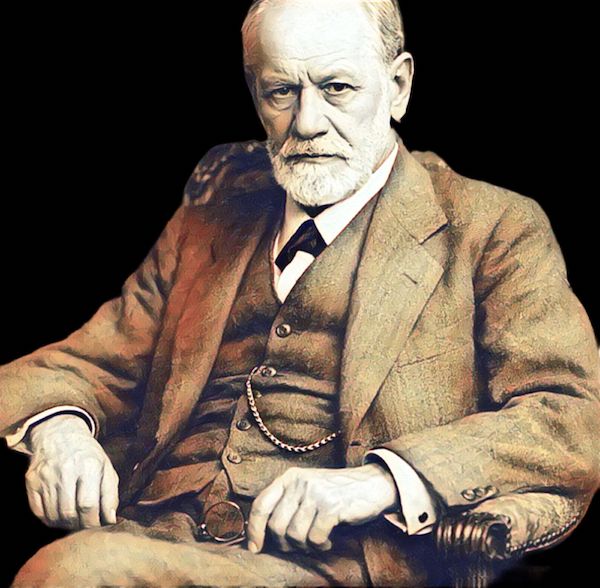
What anxiety is for Freud
Before any theoretical revision, it is necessary to define the concept. For Freud, anxiety is not simply fear. Fear has an object; it is directed toward something identifiable in the external world. Anxiety, on the other hand, is more diffuse, harder to locate, and therefore more unsettling. It emerges as a sense of threat without a clear name, an anticipation of danger that cannot be fully grasped.
In the 1926 formulation, anxiety is understood as a signal produced by the Ego in the face of a possible psychic breakdown. This breakdown may be linked to the emergence of an unacceptable desire, the repetition of a trauma, or the loss of an essential bond. In this sense, anxiety is not only suffering but also a form of internal communication, a warning that something exceeds the subject’s capacity to process at that moment.
Freud grounds this experience in a fundamental condition that runs through all psychic life: helplessness. The human being is born in a state of absolute dependence, and this initial experience leaves marks that are reorganized throughout life in different forms of anxiety, such as fear of loss, rejection, or disintegration. Anxiety does not arise from nothing; it is anchored in a structural memory that never completely disappears.
How Freud constructed this theory
The theory presented in Inhibition, Symptom, and Anxiety did not emerge in isolation. It is the result of decades of clinical listening and successive attempts to explain psychic functioning. In the early stages of psychoanalysis, Freud understood anxiety as a product of repression, that is, as a transformation of libidinal energy that failed to find discharge.
This hypothesis made sense within a model centered on the dynamics between drive and repression, but over time, it began to show its limits. Freud realized that in many cases anxiety appeared before any identifiable repression, as if the psychic apparatus were reacting in advance.
This observation led to the development of what became known as the signal theory of anxiety. The Ego came to be understood as an instance capable of detecting risks and producing a preventive response. Anxiety ceased to be a passive effect and became an active function of the psyche.
At the same time, Freud articulated this new conception with his already established second topography, which distinguishes Id, Ego, and Superego. Conflict was no longer seen only as a tension between desire and external prohibition, but as a dynamic among internal instances operating under different logics. Anxiety emerges precisely at this point of tension.
Why did Freud revise his theory in 1926
The revision of 1926 is not merely theoretical; it responds to a clinical and historical impasse. The post–World War I period introduced a new dimension of trauma, particularly in the so-called war neuroses, which did not fit easily into earlier explanations. There was something in the traumatic experience that escaped the logic of simple repression.
In addition, Freud had been encountering, in his practice, cases in which the symptom did not seem to derive directly from a repressed desire but from an attempt to avoid something even more threatening. The previous model could not adequately account for these situations.
Revising the theory of anxiety was therefore a way of aligning psychoanalysis with what the clinic was already indicating. Freud did not abandon his earlier work but reorganized it, shifting the role of anxiety within the psychic apparatus. This movement reveals a central feature of his thinking, which is its capacity to change in response to experience.
Inhibition, symptom, and defense: how the subject responds to danger
By redefining anxiety as a signal, Freud also clarifies what follows from it. The subject does not remain passive in the face of the alert; there is always a response.
Inhibition appears as a limitation of the Ego’s functioning, a way of avoiding situations that could trigger greater anxiety. It is not incapacity but protection.
The symptom emerges as a more complex solution. It allows a partial and indirect satisfaction of desire while keeping the conflict under control. The symptom is not simply an error but an attempt at balance.
Defense mechanisms enter as specific strategies for dealing with perceived danger. Among them, isolation of affect stands out for its contemporary relevance. In this process, the subject separates the experience from its emotional charge, narrating intense events without feeling their corresponding impact. This operation allows functioning to continue, but at the cost of impoverishing experience and hindering elaboration.
What remains valid in 2026
A century later, the notion of anxiety as a signal remains one of psychoanalysis’s most solid contributions. The idea that psychic suffering is not arbitrary but follows a logic continues to be fundamental for any approach that seeks to understand the subject.
In practice, this means recognizing that anxiety, panic, or unease are not merely symptoms to be eliminated, but manifestations that indicate the presence of a conflict or a subjective risk. Anxiety still functions as an indicator that something cannot be integrated at that moment.
The link to helplessness also remains relevant. In a world marked by instability, fragile bonds, and a pervasive sense of insecurity, the structural vulnerability described by Freud finds new forms of expression.
What has changed: from repression to saturation
If the structure remains, the context has profoundly transformed. Freud was describing a subject shaped by repression, rigid norms, and clear boundaries between what is allowed and what is forbidden. The central conflict revolved around containing desire.
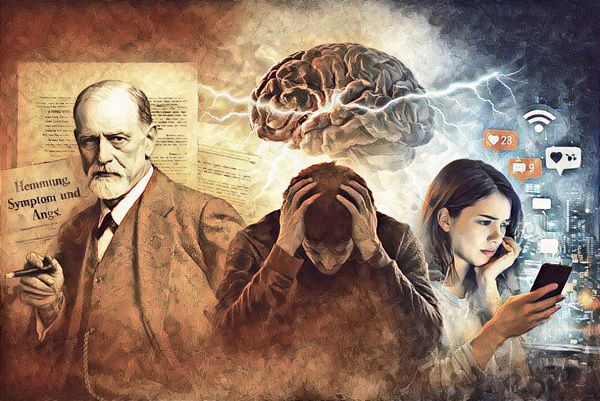
In the twenty-first century, the scenario is different. The contemporary subject is confronted with an excess of stimuli, possibilities, and demands. Anxiety no longer stems only from prohibition but also from the difficulty of sustaining choices, identities, and performances in an environment of constant exposure.
In this context, anxiety tends to lose clear contours and become diffuse. Instead of signaling a specific danger, it may appear as a continuous state, a persistent background of unease. This does not invalidate Freud’s theory but requires a more flexible reading of its concepts.
How to apply Freud in the digital age
To think about the 1926 theory today is to displace it without losing its structure. Anxiety remains a signal, but the dangers it points to have changed form.
In the digital environment, the risk lies not only in the repression of desire but in constant exposure, permanent comparison, and the fragility of boundaries between public and private. The Ego, which in Freud attempted to contain internal impulses, must now also deal with an external overload that invades psychic space.
The isolation of affect described by Freud gains an expanded dimension in this scenario. Hyper-intellectualization, the need to explain everything, and emotional distance become ways of surviving in an environment that demands speed, control, and continuous response. The subject understands, names, and analyzes, but often cannot feel.
Applying Freud today does not mean rigidly repeating his categories, but using them as tools for interpretation. The central question remains the same: what is anxiety signaling? The difference is that this question must now take into account a subject who lives simultaneously in an inner world and in a continuous network of external stimuli.

One hundred years later: listening to what still insists
Inhibition, Symptom, and Anxiety remains relevant not because it explains everything, but because it provides a structure for thinking about what escapes. By transforming anxiety into a signal, Freud shifts the focus from the symptom to the process that precedes it, allowing for a more precise listening to suffering.
A century later, the challenge may not be only to understand what has been repressed, but to recognize what has been separated from experience and is no longer felt. In a time that privileges explanation and performance, Freud’s 1926 theory still points to something more basic and more difficult: the need to sustain the encounter with what anxiety insists on announcing.
Descubra mais sobre
Assine para receber nossas notícias mais recentes por e-mail.


1 comentário Adicione o seu