
Celebrating the 80th anniversary of Notorious means recognizing that the film marks a turning point not only within Alfred Hitchcock’s body of work, but in the way cinema itself began to articulate emotion and genre. Released in 1946 and starring Ingrid Bergman, Cary Grant and Claude Rains, the film begins with a classic espionage framework, with an American agent recruiting the daughter of a Nazi spy to infiltrate a group of German expatriates hiding in Rio de Janeiro, but it quickly shifts into more unstable territory, where what is at stake is not simply the mission, but the way the characters relate to one another, hurt each other and use one another.
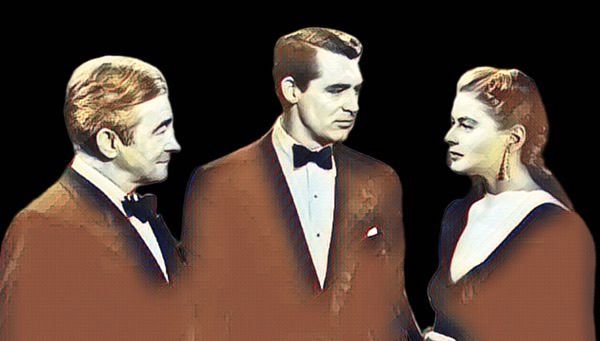
The story follows Alicia Huberman, shaped both by her father’s legacy and by a reputation that precedes her, and T. R. Devlin, the agent who recruits her and who, at the same time, becomes emotionally involved with her. That bond, however, never settles into anything stable or secure, because Devlin himself is the one who pushes her toward seducing Alexander Sebastian, the central figure she is meant to investigate. What emerges is not merely a love triangle, but a structure in which desire, resentment, and duty become impossible to disentangle.

This dynamic becomes even clearer when looking at the film’s central theme, trust. In Notorious, trust is never simple, and it almost always comes too late or in the wrong measure. Devlin struggles to trust Alicia, holding back his feelings and protecting himself, while Sebastian offers his trust openly and ultimately pays the price for it. At the same time, the film exposes Alicia’s need to be believed and recognized, in contrast to Devlin’s inability to fully open himself to love. That imbalance shapes not only the romance but the suspense itself.
Hitchcock described the story as a classic conflict between love and duty, but he frames it in a particularly cruel way. Devlin’s job is, essentially, to push the woman he loves into another man’s arms, turning desire into a strategic tool. The result is a triangle in which the most vulnerable character is not necessarily the most innocent, and the supposed villain, played by Claude Rains, emerges as a surprisingly human figure, someone who loves more directly and perhaps more deeply than the protagonist himself.
This structure deepens further when looking at Alicia’s position within the narrative. She is constructed as bait, used politically, exposed emotionally, and judged for precisely what the mission demands of her. Devlin places her in that position, refuses to take responsibility for it, and when she performs the role successfully, reacts with resentment. Alicia, in turn, realizes that her behavior, already subject to judgment, is now being exploited as a tool, and she fears not only failure but abandonment by the man who put her in that position. At the same time, she is tied to Sebastian, who genuinely loves her, making the situation even more unbearable.
The presence of Sebastian’s mother expands the psychological dimension of the film. She is not merely a supporting figure, but a center of control, guiding the decision to eliminate Alicia quietly. The chosen method, slow poisoning, brings danger into the domestic space, making it more intimate and more disturbing. This also connects to a recurring element in Hitchcock’s work, the mother figure as a force of control, charged with ambivalence, blending authority, affection, and repression.
Another element that runs through the film is alcohol, which appears early on as Alicia’s form of escape, a way of dealing with guilt, pain, and rejection. What initially seems like a character trait gradually takes on another dimension, eventually becoming literally poisonous when the coffee she is given replaces alcohol as the vehicle of destruction. Even the film’s central object, the uranium hidden in wine bottles, reinforces this association between consumption and danger, as if everything that is ingested carries some form of risk.
These elements are rooted in a specific historical context, yet they point to issues that extend far beyond it. By portraying government agents willing to exploit a woman to the extreme, even accepting the possibility of her death, the film exposes a morally ambiguous dimension that was not common in Hollywood at the time. The idea that patriotism can justify such choices is presented directly, without softening, which makes it all the more striking that the film was both produced and well-received so soon after the end of World War II.
Even as a spy thriller, Notorious avoids explicit violence, replacing it with a sense of threat built at a psychological level. Danger lies not in chases or physical confrontations, but in everyday gestures, ordinary objects, and relationships that slowly deteriorate. This choice creates a constant sense of unease that does not rely on spectacle, but on subtle shifts.

That structure did not remain confined to its time. Decades later, Mission: Impossible 2 (2000), directed by John Woo and starring Tom Cruise, revisits this same logic so directly that the line between inspiration and replication becomes difficult to ignore. The idea of a woman placed at the center of an operation that depends on seduction, the emotional triangle between agent, target, and intermediary, and the use of intimacy as a strategic tool all reappear in ways that closely mirror Hitchcock’s narrative, at times approaching a near scene-by-scene parallel.
The difference lies less in structure than in treatment. Where Notorious operates through ambiguity, discomfort, and emotional consequence, John Woo’s film transforms that same framework into an action spectacle, shifting the conflict outward. The reception reflects that difference. While Notorious was recognized from the start as a sophisticated and emotionally complex work, Mission: Impossible 2, despite its commercial success, has largely been seen as a stylized entry in the franchise, remembered more for its aesthetic than for its dramatic depth, which ultimately reinforces the density of Hitchcock’s original by contrast.
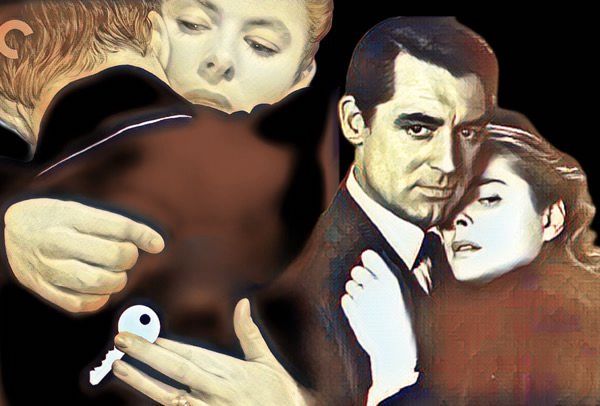
Within this logic emerges one of the most iconic sequences in film history, the kiss between Ingrid Bergman and Cary Grant, which became legendary not only because of their chemistry but because of how Hitchcock turned censorship into language. Faced with the restrictions of the Hays Code, which limited the duration of on-screen kisses, he constructed a fragmented sequence of embraces, interruptions, and resumptions, creating a prolonged sense of intimacy that bypassed the rule without directly breaking it. The effect captures precisely the nature of their relationship, built on incomplete closeness.

The film’s production history also helps explain its final form. The project began under David O. Selznick, went through casting disputes and script concerns, and only reached its full potential when Hitchcock gained greater control at RKO. That shift allowed him to shape the film with more autonomy and precision.
Critical reception at the time already pointed to something beyond a conventional thriller. The film premiered at Cannes, performed strongly at the box office, and was quickly recognized for its narrative and emotional sophistication. Over time, that recognition only deepened, leading to its inclusion in lists of the greatest films ever made and its preservation as a work of cultural, historical, and aesthetic significance.
This combination explains why Notorious is considered a classic. It is not only a matter of influence or technical mastery, but of how the film integrates its formal choices into a sustained exploration of trust, desire, and power. By refusing simplification and constructing characters who operate within ambiguity, Hitchcock created a work that remains recognizable, even eight decades later.
Descubra mais sobre
Assine para receber nossas notícias mais recentes por e-mail.

