
In the year of Marilyn Monroe’s centennial, there is a quiet irony in the fact that the major exhibition dedicated to her is organized precisely by the institution that, in her lifetime — and even after it — never recognized her in proportion to the impact she had on cinema.
Marilyn Monroe: Hollywood Icon, on view at the Academy Museum of Motion Pictures, is not merely a retrospective. It is, in practice, an attempt to reorganize the narrative around a figure that Hollywood consecrated as a myth, but never fully legitimized as an actress.
And perhaps it is impossible to look at this exhibition without that absence — the Oscar that never came, not even as a belated gesture — functioning as its underlying frame.
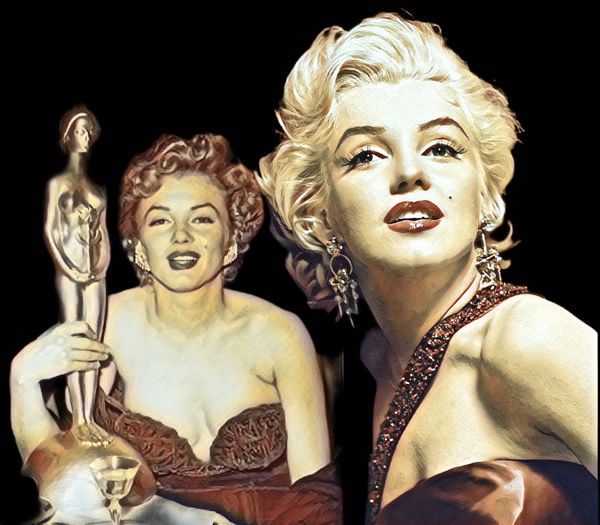
The Academy that preserves, but did not award
Marilyn Monroe was nominated for major awards, won the Golden Globe for Some Like It Hot, established herself as one of the biggest stars of the 20th century, and redefined the relationship between presence, camera, and desire. Still, she was never nominated for an Academy Award. Nor did she receive even a posthumous honorary mention.
This is not just an isolated omission. It is a historical pattern.
For decades, the Academy operated within a system that sharply separated what it considered “great acting” from what was seen as charisma, sensuality, or popular appeal. Marilyn, like other actresses before and after her, was pushed into the latter category, even when her work already pointed to something far more complex.
What we now recognize as persona construction, mastery of comedic timing, awareness of framing, and the use of one’s own image as language was, at the time, often reduced to a “type.”
The exhibition thus emerges as a belated corrective gesture, albeit without the symbolic weight of a statuette.
The exhibition as a reinterpretation
Organized by the Academy Museum, the exhibition is built on a fundamental shift: Marilyn is not presented merely as a product of the studio system, but as an active agent within it.
Born Norma Jeane Mortenson in 1926, she appears here as someone who deeply understood the logic of the industry and who knew how to build, adjust, and deploy her own image with a precision that few figures of her time achieved.
The exhibition brings together hundreds of original objects, including posters, photographs, production documents, letters, and rarely seen personal materials. More than illustrating a trajectory, this collection reveals what was often obscured: the degree of control and awareness Marilyn exercised over what the public saw.
This reading is reinforced by the presence of costumes that help map this construction over time. From her early work in Love Happy (1949) to material from her final and unfinished project, Something’s Got to Give (1962), these garments move beyond memorabilia to become evidence of a process.
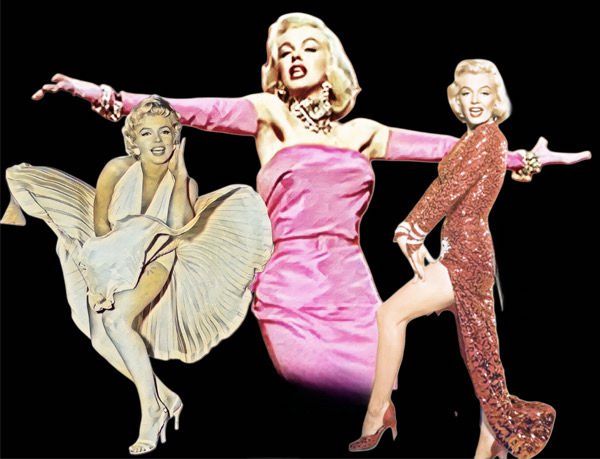
Among them are costumes designed by Orry-Kelly for Some Like It Hot and the iconic pink dress created by William Travilla for Gentlemen Prefer Blondes, perhaps the most recognizable element of Marilyn’s iconography — not as an isolated symbol, but as part of a consistent visual strategy.
Norma Jeane, Marilyn, and the authorship of the image
One of the most revealing aspects of the exhibition lies in how it highlights both the separation and the interdependence between Norma Jeane and Marilyn.
Accounts, documents, and testimonies reinforce what has long circulated as critical intuition: Marilyn was a creation. And, like any successful creation, it began to exist almost autonomously.
There are records that the actress herself referred to “Marilyn” in the third person.
Far from being a mere curiosity, this detail points to a sophisticated understanding of her own condition within the industry. Marilyn did not simply inhabit an image; she observed it, adjusted it, and negotiated it.
By foregrounding this dimension, the exhibition decisively shifts her from the position of a passive victim of the system to that of an active participant — even if that participation came at a clear cost.
The recognition that arrives, but does not repair
By organizing an exhibition of this scale, the Academy acknowledges, even if indirectly, what it failed to name when it mattered.
But this recognition has limits.
Because the Oscar, more than an award, is a historical marker. It defines narratives, legitimizes trajectories, and inscribes names into a certain idea of excellence.
Marilyn’s absence from that record cannot be erased by an exhibition, no matter how comprehensive or sophisticated it may be.
What the exhibition does — and perhaps this is its greatest merit — is make that absence visible.
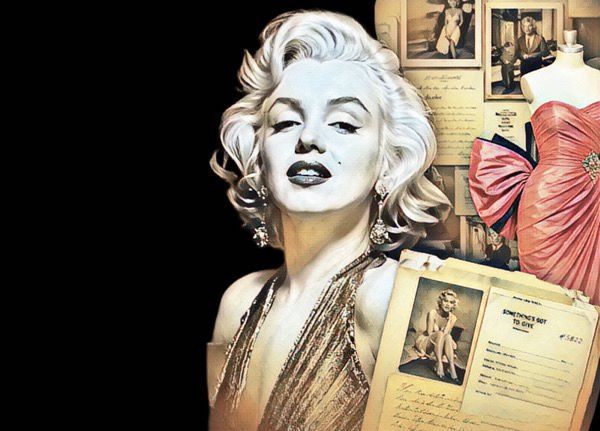
By presenting Marilyn as the author of her own image, as a strategist within a system that both consumed and amplified her, the exhibition does more than celebrate her trajectory. It reveals the gap between what Hollywood produced and what it was willing to recognize.
And in that sense, the Academy’s gesture is not merely commemorative.
It is also, albeit belatedly, a way of admitting that Marilyn Monroe never fit into the categories that tried to define her.
Practical information
The exhibition Marilyn Monroe: Hollywood Icon will be on view at the Academy Museum of Motion Pictures in Los Angeles as part of the celebrations marking the centennial of the actress.
It opens to the public on May 31, 2026, and runs through February 28, 2027, bringing together one of the largest collections ever assembled of objects related to Marilyn Monroe’s life and career.
The Academy Museum is located at 6067 Wilshire Boulevard, Los Angeles, California, in a complex that has become one of the leading institutions dedicated to the preservation and presentation of film history in the United States.
The museum is open from Thursday to Sunday, from 10 a.m. to 6 p.m., with extended hours on select days. Advance ticket purchase is recommended, particularly during the first months of the exhibition, when demand is expected to be high.
Descubra mais sobre
Assine para receber nossas notícias mais recentes por e-mail.


1 comentário Adicione o seu