
The origin of Widow’s Bay helps explain why the series feels so difficult to categorize, and at the same time, so assured in what it is doing. It is an original creation by Katie Dippold, a writer shaped in character-driven comedy through work like Parks and Recreation, who returns here to an idea she had been developing for years and pushes it into unexpected territory, where humor never cancels discomfort and horror never prevents laughter. This authorial foundation, not tied to a book or an existing intellectual property, allows the series to function almost as a tonal experiment, sustained by influences that range from Stephen King to the carefully calibrated unease of episodes like “Teddy Perkins” from Atlanta, and to the long tradition of stories set in small coastal communities that carry their own myths.
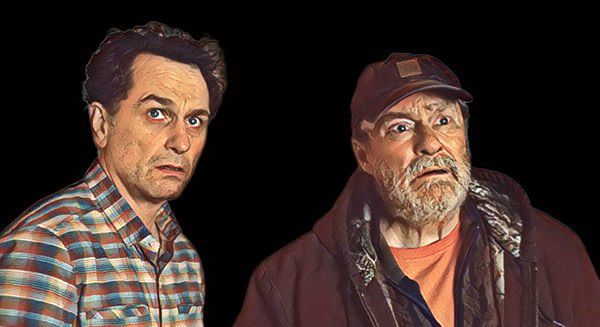
The fictional town that gives the series its name concentrates that creative ambition. Widow’s Bay is an island off the coast of New England whose identity is entirely built on folklore, generational storytelling, and a sense of isolation that is not only geographic. The attempt to turn it into a tourist destination, led by Mayor Tom Loftis, immediately exposes a structural contradiction. What should be an attraction reveals itself as an obstacle, because the local mythology does not operate as decoration but as something alive, persistent, resistant to any attempt at control. As one critical reading observes, the town initially presents itself as a cozy enclave, but quickly asserts itself as a place where the supernatural is not a gimmick or a marketing tool, but a destabilizing reality.
This point is essential to understanding the construction of the series. The conflict is not simply between skepticism and belief, but between the drive toward progress and the persistence of a collective memory that refuses to be reorganized. The narrative structure reinforces this by alternating between more self-contained episodes, almost like standalone stories, and a broader arc that gradually explores the origin of the forces binding the town to itself. In doing so, Widow’s Bay resists the now-dominant model of television as an extended film broken into chapters. Instead, it returns to a more episodic logic, closer to The X-Files or Buffy the Vampire Slayer, where individual stories expand the world while deepening the central tension.
The result is a rare balance between comedic register and horror atmosphere. The series does not treat horror as a stylistic garnish, but as something that structures the characters’ experience. In many moments, humor arises precisely from failed attempts to rationalize what cannot be explained, creating a constant sense of dislocation. The town always feels on the verge of revealing itself fully, but never in a way that brings comfort. Some episodes lean more heavily into classical horror, while others move toward the absurd, yet all sustain the idea that everyday life has been contaminated by something that cannot be contained.
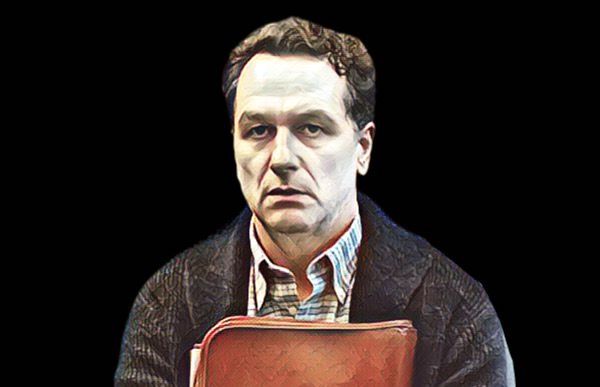
It is within this space that Matthew Rhys’ performance becomes central. He does not simply anchor the series; he translates its specific kind of humor with remarkable precision. His Tom Loftis is a man in constant negotiation with himself, someone trying to maintain an image of rationality while the world around him steadily dismantles it. Rhys works with a distinct physicality, a discomfort that appears in the body before it reaches language, turning each attempt at control into a small, disguised collapse. There is something almost involuntary in the way he reacts, as if the character is always one beat behind what is happening, and that is exactly what generates the comedic effect without ever undermining the sense of threat.
This quality is already noted in critical responses that highlight his skill in physical comedy and in shaping a character who struggles to keep composure as everything around him unravels, but what stands out even more is how he sustains humor and suspense simultaneously. There is no rupture between these registers. Laughter and fear emerge from the same source, which is the recognition that this man has no real control over what he is facing. Rhys understands this dynamic with rare clarity and turns the mayor into a point of balance for the series, someone who guides us through this world without ever fully mastering it.
Around him, the ensemble follows this tonal approach with confidence, creating characters that begin from recognizable archetypes and gradually reveal more complex layers. The town gains substance precisely through this collective construction, through the sense that each inhabitant carries a story capable of sustaining an episode on its own. Even so, Loftis’ trajectory organizes the viewer’s experience, because it is through his denial, through his insistence on rationalizing the irrational, that the series finds its shape.
In the end, what makes Widow’s Bay most compelling may be its refusal to fully explain itself. In a television landscape increasingly shaped by standardization, the series embraces discomfort, oscillation, and ambiguity. Not every creative risk lands with the same force, but there is coherence in the ambition it sustains. Like a town that seems to exist outside of time, it demands to be felt as much as understood. It is not a series that resolves itself in explanation, but one that lingers in the sensation that something continues to operate long after the episode ends.
Descubra mais sobre
Assine para receber nossas notícias mais recentes por e-mail.


1 comentário Adicione o seu