
For me, May the Fourth has never been just a play on words. There’s something very specific about the fact that one of the biggest franchises in cinema built its symbolic date around a pun that, by definition, shouldn’t last. And yet, it does.
May 4th endured because Star Wars has always been bigger than its own films. Before it became an official date, it already functioned as a collective gesture, a form of belonging. When fans began turning “May the Fourth be with you” into an annual celebration, they were less interested in formalizing a holiday and more in reaffirming a relationship that never depended on institutional validation.
Still, institutionalization came. And it says a lot about how the franchise has changed.

From a newspaper ad to a global date
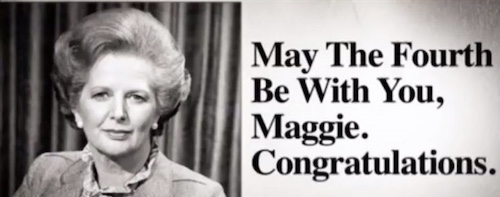
The most cited origin of the pun doesn’t come from fans, but from politics. On May 4, 1979, the London Evening News published an ad congratulating Margaret Thatcher on her election with the phrase “May the Fourth be with you, Maggie.” It was an opportunistic gesture, but a revealing one. Just two years after the release of A New Hope, Star Wars had already moved beyond cinema and into the cultural imagination to the point of being recognized outside it.
Decades later, that recognition would organize itself into tradition. Starting in the 2000s, fan communities began celebrating May 4th more consistently, until, in 2011, events organized in Canada helped consolidate the date as the modern Star Wars Day.
When Disney officially adopted May 4th in 2013, it didn’t create the date—it absorbed it. A move that would become standard in the years that followed: identify what already exists, amplify it, and turn it into a strategy.
2012: the deal that shifted the saga
A year before that official adoption, in October 2012, George Lucas sold Lucasfilm to Disney for approximately $4.05 billion. This wasn’t just a financial transaction. It was the transfer of a universe that had operated under an author-driven logic into a corporate structure built on continuous expansion.
The initial promise was clear: new films, a new trilogy, new stories. And for a moment, it seemed straightforward.
The Force Awakens, released in 2015, was received as a safe return. It reintroduced characters, mirrored familiar structures, and reconnected audiences with the experience of watching Star Wars in theaters. But that sense of safety already carried a limit.

Between repetition and rupture: the most unstable years
The sequel trilogy quickly became a site of tension. The Last Jedi attempted to break expectations, proposing a more ambiguous reading of heroism and of the saga’s own mythology. The divided response exposed something that had previously been diluted: Star Wars no longer had a unified center.
The Rise of Skywalker, in 2019, emerges as a response to that friction. In trying to reorganize the narrative and accommodate different audience demands, it ends up highlighting the structural problem of this new phase: the difficulty of balancing legacy and innovation within a fragmented plan.
The result is a trilogy that exists, but doesn’t hold together as a cohesive whole in the way the previous ones did.
Where Disney got it right: television and world-building
If the films met resistance, television was where Star Wars recalibrated.
The Mandalorian, released in 2019, didn’t just expand the franchise’s reach—it redefined its language. By shifting focus away from major events and toward peripheral stories, it restored a sense of adventure and introduced a more flexible, episodic relationship with the audience.
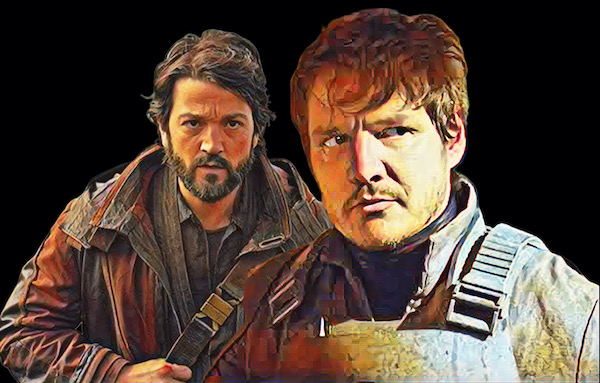
Andor pushes this even further. By minimizing overtly mythic elements and investing in a more rigorous political framework, the series repositions Star Wars within a more grounded register without losing its identity.
These projects demonstrate something essential: expansion doesn’t need to replicate the central formula to work. In many cases, it works better when it doesn’t.
What comes next: between cinema and curation
After slowing down film production following 2019, Disney appears to be restructuring the franchise’s future with more control. Announced projects include a new film centered on Rey, exploring the rebuilding of the Jedi Order, alongside other narratives that span different points in the timeline.
At the same time, the strategy feels more cautious. Less volume, more curation. A tacit acknowledgment that excess also wears things down.
On television, expansion continues, but already under the weight of an inevitable question: how far can this universe grow without losing density?
May 4th today
In this context, Star Wars Day stops being just a nostalgic celebration. It becomes a marker in time.
Looking at May 4th today is a way of understanding how the franchise has moved through different phases without ever becoming irrelevant. From author-driven creation to global product, from closed trilogy to expanded universe, from consensus to fragmentation.
And still, it remains.
Perhaps because Star Wars has never depended on a single way of existing. And May 4th, in all its simplicity, remains the best expression of that: an idea that began as an accident, was claimed by fans, and ultimately absorbed by an industry still trying to keep up with what this universe means.
May the Fourth endures, above all, as a collective gesture. And that’s something no strategy can fully manufacture.
Descubra mais sobre
Assine para receber nossas notícias mais recentes por e-mail.

