
On May 6, 2026, Sigmund Freud would have turned 170. More than eight decades after he died in 1939, few thinkers remain as present in the way we interpret emotions, human relationships, art, politics, culture, and even everyday language. Freud was not only the founder of psychoanalysis. He helped reorganize the very idea of what it means to be human.
Long before mental health became a constant topic in public debate, Freud was already proposing something that felt deeply unsettling in his time: the idea that we are not fully transparent to ourselves. Contradictory desires, repressed memories, unconscious impulses, and early experiences continue to operate even when we believe we control them rationally.
Today, concepts such as trauma, repression, denial, slips of the tongue, transference, and the unconscious circulate far beyond the clinic. They have become part of contemporary cultural vocabulary. Even those who have never read Freud recognize terms that originated directly from his work. It is difficult to think of another intellectual whose influence has simultaneously crossed medicine, literature, cinema, philosophy, cultural criticism, and social behavior with such intensity.
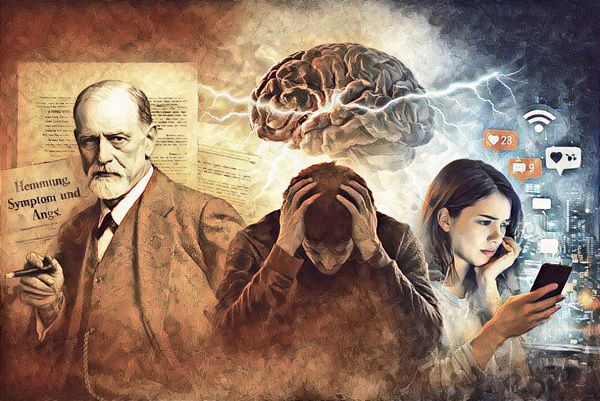
The man who displaced the center of consciousness
Freud was born in 1856 in Freiberg, Moravia, then part of the Austrian Empire, now in the Czech Republic. The son of a Jewish family, he grew up in Vienna, a city that would become not only his home but also the intellectual laboratory where he developed his theories.
Trained as a physician, he began his career studying neurology before moving toward something that did not yet have a clear name: an attempt to understand physical symptoms that seemed to have no organic origin. While observing patients diagnosed at the time as “hysterical,” Freud began to realize that psychic suffering could manifest in the body, and that repressed traumatic experiences continued to produce effects even without conscious access.
From that point on, a rupture emerges that would deeply shape the twentieth century. Freud proposes that consciousness is not sovereign. Human beings are not guided solely by reason, but also by desires, conflicts, and fantasies that escape rational control.
The idea feels almost obvious today precisely because it has become structural to contemporary culture. But at the time, it was profoundly unsettling. Freud dismantled the Enlightenment image of a fully rational individual and introduced a far more unstable vision of subjectivity.
Dreams, childhood, and desire: Freud’s revolutions
When Freud published The Interpretation of Dreams in 1899, he introduced one of the most influential works of the twentieth century. The book proposes that dreams are not random mental noise, but symbolic manifestations of the unconscious. More than interpreting dreams, Freud was attempting to formulate a new map of the human mind.
In the decades that followed, concepts such as the Oedipus complex, drives, repression, and infantile sexuality generated both fascination and scandal. Much of the resistance came precisely from Freud’s willingness to address what bourgeois society preferred to silence: desire.
Freud was a thinker deeply rooted in his time, but also someone who exposed its contradictions. In a society marked by moral repression and sexual rigidity, he placed sexuality, fantasy, and conflict at the center of human experience. This does not mean that all his formulations remain intact today. Many have been revised, criticized, or reworked throughout the twentieth century. Even so, the original rupture remains decisive.
Freud’s impact on cinema, art, and culture
It is almost impossible to fully measure the cultural impact of psychoanalysis. Twentieth-century cinema developed almost in parallel with Freudian theory. From German Expressionism to Alfred Hitchcock, from David Lynch to Darren Aronofsky, the idea that images can reveal hidden desires or internal conflicts runs through modern cinematic language.
Literature was also profoundly transformed. Writers such as Virginia Woolf, James Joyce, and Franz Kafka began to explore stream of consciousness, fragmented memory, and subjectivity in ways inseparable from the shifts introduced by psychoanalysis.
Even advertising, politics, and mass culture absorbed Freudian concepts. Freud’s nephew, Edward Bernays, used principles of psychoanalysis to help shape modern strategies of propaganda and public relations, connecting consumption to desire and fantasy.
There is a certain historical irony here: Freud not only influences culture. He helped create the contemporary way of interpreting behavior, image, and identity.
Freud in the twenty-first century: between critique, revision, and cultural permanence
In recent decades, Freud has also been the target of important criticism. Parts of contemporary psychology question the scientific validity of some of his theories. Feminist readings have revisited concepts related to female sexuality and family structures present in his work. Other scholars point to historical and cultural limitations within Freudian thought.
And yet, Freud remains.
He remains because his influence goes beyond being “right” in a strictly scientific sense. Freud transformed how we think about subjectivity. After him, the human being can no longer be understood solely as a rational subject fully conscious of itself.
Even the critiques of Freud often continue to operate within the terrain he helped establish.
And perhaps this is what explains his intellectual and cultural endurance 170 years after his birth. Freud did not merely create a theory. He introduced a lasting suspicion about what we say, what we desire, what we forget, and what we repeat.
A suspicion that continues to shape the twenty-first century.
Descubra mais sobre
Assine para receber nossas notícias mais recentes por e-mail.

