
Few series of the last fifteen years managed to create such an intense emotional bond with audiences as Outlander. In an era dominated by epic fantasy, superheroes, and high-concept thrillers, the production based on Diana Gabaldon’s books found a singular space precisely because it blended genres that, in theory, seemed incompatible. It was a historical drama. A fantasy about time travel. An obsessive love story. A narrative about war, violence, displacement, and belonging. And, at the same time, a deeply emotional melodrama.
When it premiered on Starz in 2014, Outlander seemed destined for a relatively specific niche: fans of Gabaldon’s books, readers of historical romance, and viewers drawn to the Scottish aesthetic that was dominating part of pop culture at the time. What happened instead was much larger. The series became an international phenomenon, boosted tourism in Scotland, created global fan conventions, and turned Caitríona Balfe and Sam Heughan into one of modern television’s most beloved fictional couples.
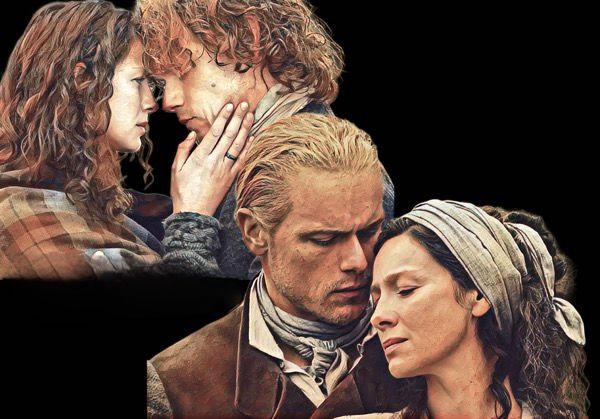
But perhaps the most curious aspect is that Outlander was never exactly “cool” in the traditional sense of prestige television criticism. Unlike series that dominated cultural conversations through irony or stylistic sophistication, it always operated through emotional intensity. Audiences were not watching only for the plot. They were watching for the relationship between Claire and Jamie Fraser.
The Claire and Jamie phenomenon
Much of the series’s success comes from the chemistry between Caitríona Balfe and Sam Heughan. From its first season, Outlander understood something many productions forget: epic romances depend less on grand dialogue and more on the feeling of intimacy between characters.
Claire Randall Fraser initially appears as a woman displaced between eras. A nurse during World War II, she passes through the stones at Craigh na Dun and ends up in eighteenth-century Scotland. What could have functioned merely as a fantasy device quickly became a reflection on female identity, autonomy, and survival.
Jamie Fraser, meanwhile, was constructed almost as a response to the classic romantic hero archetype. Strong and idealized, yes, but also vulnerable, emotionally open, and frequently placed in positions of fragility. The dynamic between them never depended solely on passion. It depended on recognition. Claire finds in Jamie someone capable of seeing her completely, including aspects of herself that her own time tried to repress.
That helped Outlander build an extraordinarily loyal female audience. The series understood early on something Hollywood often overlooks: women also want epic narratives centered on desire, politics, war, and sexuality, but from a different emotional perspective.
Scotland as a character and the cultural impact
There is also a visual and cultural factor impossible to ignore. Outlander transformed the Scottish landscape into an essential part of the viewing experience. The Highlands, the castles, the mist, the costumes, and the historical reconstruction helped create a very specific atmosphere, almost tactile in its beauty.
The tourism impact was real. Locations used in the series began receiving massive waves of visitors, and the so-called “Outlander effect” became a case study in Scottish tourism. The production also reignited international interest in Jacobite culture, Scottish clans, and eighteenth-century British history.
At the same time, the series was never only romantic escapism. It addressed colonialism, war, slavery, sexual violence, and historical displacement. Not always perfectly, it must be said. Over the years, Outlander received criticism for the repetition of traumatic scenes and for its recurring use of sexual violence as a dramatic engine. Even so, the production consistently tried to position itself as something more complex than a simple period romance.
How Outlander changed over the years
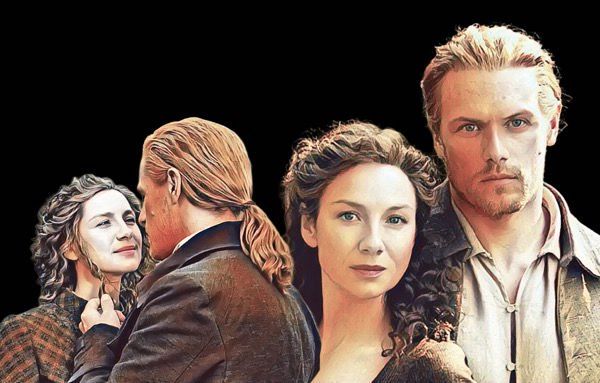
As happens with many long-running adaptations, Outlander underwent profound transformations as it progressed. The early seasons felt more intimate and concentrated. The focus rested almost entirely on Claire and Jamie’s relationship and on the constant threat created by the clash between historical eras.
Later, the narrative expanded. Wars arrived. Colonial America emerged. New family dynamics, adult children, political conflicts, and generational shifts became central. In part, this reflected Gabaldon’s own books, which are famous for their length and complexity.
But there was also an inevitable side effect: the natural exhaustion that accompanies very long series. Some viewers felt Outlander lost part of its original romantic tension as the characters aged and the story became more diffuse. Others saw precisely the opposite: a rare television story about a love that survives decades, ages, and continues to exist.
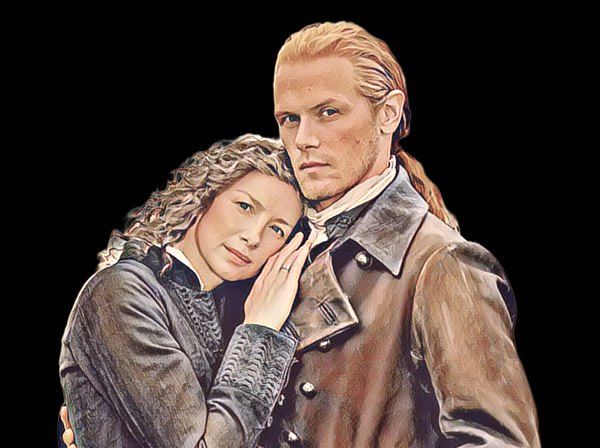
That may be the series’s greatest singularity. Outlander never treated romance as something limited to youth. Claire and Jamie remain passionately connected even when desire is no longer framed as adolescent idealization, but as a partnership built over an entire lifetime.
Why is Outlander ending?
The decision to conclude Outlander with its eighth season involves a combination of creative, industrial, and narrative reasons.
The first is relatively simple: by the time it ends, the series will have been on air for more than a decade. Productions of this scale become extremely expensive, especially because of cast salaries, historical recreations, and international logistics. In a television industry increasingly pressured financially by streaming economics, maintaining large-scale historical dramas indefinitely has become far more difficult.
There is also a narrative issue. Although Diana Gabaldon is still writing the books, the television adaptation began moving dangerously close to unfinished source material. Starz ultimately chose to end the story before the series entered the kind of creative limbo experienced by other adaptations that outpaced their literary origins.
At the same time, there is an unavoidable emotional component. Caitríona Balfe and Sam Heughan spent more than ten years inhabiting these characters. Both actors have expanded into film, producing, and other projects. A series this long requires an enormous emotional and physical commitment.
There is also a quieter but important factor: Outlander belongs to a specific generation of television. It was born before the full consolidation of the short-season streaming model, during a period when dramas could develop relationships slowly across lengthy seasons. Today, the market operates very differently. Shorter seasons, accelerated storytelling, and the constant renewal of catalogs make it harder for emotionally dense, long-form productions to survive.
The legacy of Outlander
Even as it approaches its conclusion, Outlander leaves behind a very specific mark on contemporary television.
It helped prove that female-centered romantic series could be ambitious, expensive, and globally relevant without abandoning emotional sensitivity. It also demonstrated that audiences still crave adult, complex, and enduring love stories in a television landscape often dominated by cynicism.
More than that, Outlander built something rare: a fan community that remained intensely engaged for more than ten years. Very few series survive that long, sustained not merely by plot twists, but by the audience’s emotional investment in its characters.
Perhaps that is what truly explains the phenomenon. Outlander was never only about time travel. It was about the desire to find a place — and a person — capable of surviving the inevitable transformations of life, history, and time itself.
Descubra mais sobre
Assine para receber nossas notícias mais recentes por e-mail.

