
Among the many crime series released on streaming platforms in recent years, few begin with a concept as unsettling as Legends. At first, the production could easily be mistaken for another thriller about international trafficking, undercover agents, and dangerous covert operations carried out in violent environments, but the first episode quickly makes it clear that its real interest lies beyond the tension of espionage itself. What the series seems determined to investigate is something far more uncomfortable: what happens to someone who spends too much time performing a character created to survive.
There is one specific line that practically organizes the entire narrative. At one point, Don, the head of the unit played by Steve Coogan, explains to the new agents the meaning of the word “persona.” For him, it is the false identity an undercover agent must construct to move through the criminal underworld without being exposed. A mask. A carefully elaborated role. An artificial personality capable of convincing dangerous criminals that the agent genuinely belongs in that world.
But the conversation quickly shifts direction when Don warns them that the persona only works if the infiltrator completely believes in it. Otherwise, the character begins to feel false, inconsistencies emerge, and the agent dies. Up to that point, the issue still seems almost theatrical: a performance must be convincing to function.
The real problem comes afterward.

Don explains that there is a second danger, far more disturbing than being exposed: the risk of the persona taking control. The risk that the agent may spend so much time living inside that fabricated identity that he can no longer return to who he once was. In other words, the danger is not simply deceiving others, but slowly beginning to believe in the mask itself.
It is precisely at that moment that Legends stops functioning merely as a crime series and begins to engage directly with fundamental concepts from psychoanalysis, analytical psychology, and even the history of art itself.
What Jung meant by “persona”
Although many people automatically associate the term “persona” with the generic idea of falseness or pretending, Carl Jung developed the concept in a much more complex way within analytical psychology. The word originally comes from Greco-Roman theater, from the masks worn by actors during performances. Jung transformed that image into a central psychological concept to explain the way individuals present themselves socially.
For him, the persona is the social identity constructed to mediate the relationship between the individual and society. It consists of the behaviors, images, codes, and characteristics we learn to sustain to move through collective life. It is not exactly a lie, nor is it necessarily hypocrisy. Above all, the persona is a structure of social adaptation.
No individual exists completely exposed before others. From a very early age, people learn that certain behaviors are valued while others must be hidden, repressed, or reorganized. A child quickly realizes which traits receive approval, which provoke rejection, which emotions may be expressed freely, and which must be controlled. Gradually, an organized identity begins to take shape, one that will eventually be presented to the world.
In this sense, the persona is not inherently problematic. Jung never defended the idea that people should live without social masks. That would be practically impossible. Human coexistence depends on some degree of symbolic organization of identity. There is a professional persona, a family persona, an emotional persona, and a public persona. To some extent, everyone performs roles continuously.
The problem begins when the individual becomes completely identified with that construction.
When the mask stops functioning as mediation and begins occupying all available psychic space.
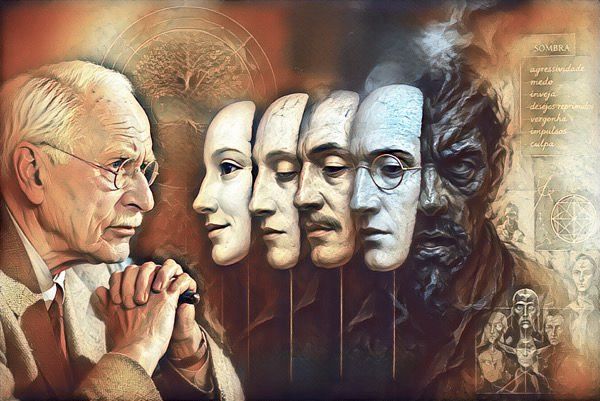
For Jung, every persona inevitably produces a shadow. Everything the individual considers incompatible with the image they wish to present to the world gets pushed into less conscious regions of the psyche. Aggression, fear, resentment, destructive impulses, fragility, envy, morally unacceptable desires, or any aspect incompatible with the organized identity of the persona begin to exist as repressed contents.
And perhaps the most important aspect of Jung’s theory lies precisely there: the shadow does not disappear simply because it has been repressed. On the contrary, the more rigid the social mask becomes, the greater the pressure exerted by the contents excluded from it.
Jung believed that whatever is not consciously recognized continues operating unconsciously. In many cases, it returns in invasive, compulsive, or destructive ways. A person may believe they have eliminated certain impulses or traits when, in reality, they have merely stopped perceiving them clearly.
That is precisely why excessive identification with the persona becomes dangerous. The more someone completely believes in their own mask, the more distant they become from recognizing the contradictory regions of their own subjectivity.
Freud, civilization, and the performance of identity
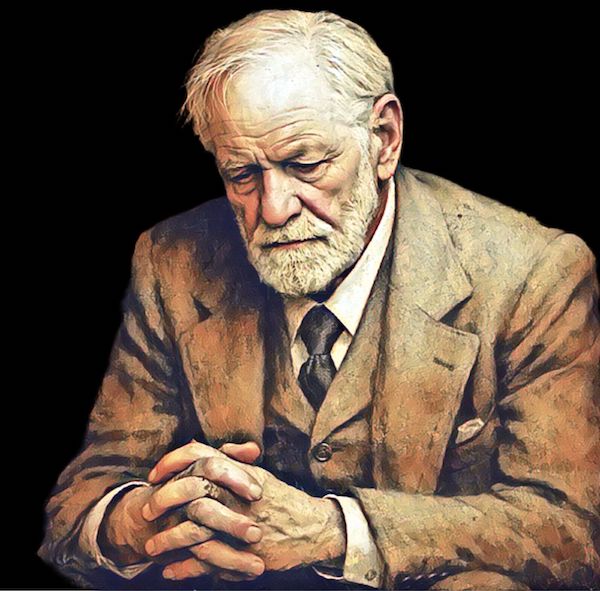
Although the specific concept of persona belongs far more to Jungian vocabulary, there is something profoundly Freudian about this discussion. Freud may never have developed a fully organized theory of the persona the way Jung later would, but nearly all of his work revolves around the tension between individual desire and social demands.
In Civilization and Its Discontents, for example, Freud describes the inevitable psychic price paid for existing within society. Civilization demands renunciation. It demands control over instinctual drives. It requires the partial repression of impulses incompatible with collective life. Individuals continuously learn to manage what they feel, desire, or fantasize about to occupy socially acceptable positions.
That means there is, already in Freud, a clear perception that social identity never fully coincides with unconscious desire.
The very structure of the ego implies a constant negotiation between external reality, social expectation, and instinctual drive. The Freudian subject is never fully transparent to itself. There is always division, contradiction, displacement, and conflict between what someone consciously sustains about themselves and what remains unconscious.
Lacan would radicalize this perception even further by arguing that the self is largely an imaginary construction produced through images and through the gaze of the other. Individuals learn who they are through external recognition. They learn to occupy symbolic positions. They learn to construct minimally coherent versions of themselves to exist socially.
In other words, there is inevitably some degree of performance within human experience.
And perhaps no era has pushed this further than our own.
Social media and the exhaustion of continuous performance
If Jung were writing about contemporary culture, he would probably find social media to be an almost radicalized example of the logic of persona. Today, there is constant pressure to transform identity into a stable, coherent, consumable, and permanently managed narrative.
People no longer simply live. They continuously organize an image of themselves.
There is a need to perform happiness, productivity, emotional intelligence, political awareness, professional success, emotional stability, self-care, authenticity, and even vulnerability in socially recognizable ways. Contemporary individuals often manage their own identity almost like an ongoing project of emotional branding.
And that is precisely where Legends becomes especially compelling as a psychological metaphor for contemporary life.
The undercover agents merely take to the extreme something that, on a smaller scale, perhaps everyone already does daily: adapting language, behavior, appearance, and emotional expression to survive within certain social environments.
The difference is that, in the series, failure carries immediate and literal consequences.
The shadow and everything the persona tries to hide
Perhaps the most important concept for understanding the psychological dimension of Legends is another central element of Jungian theory: the shadow.
For Jung, the shadow represents everything the individual refuses to recognize within themselves. Unacceptable desires, aggression, envy, resentment, destructive impulses, fragility, fear, violence, repressed sexuality, or any characteristic incompatible with the organized image the persona attempts to sustain.
The more rigid and perfected the persona becomes, the stronger the shadow tends to grow.
That happens because what is repressed does not disappear. It merely ceases to be consciously recognized. Jung believed that denied contents frequently return in invasive, compulsive, or destructive forms, especially when the individual excessively believes in their own idealized image.
And perhaps that is exactly what Legends dramatizes through its infiltrators.

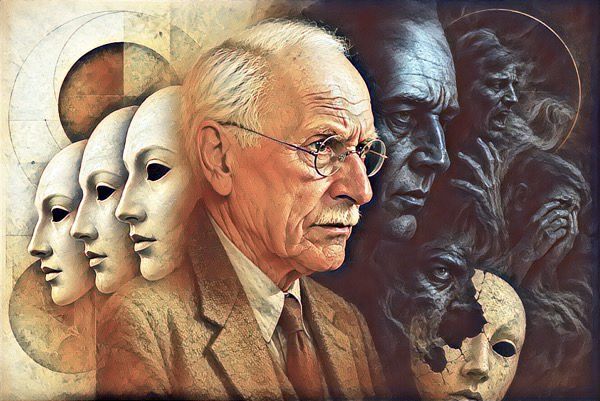
In order to convince dangerous criminals, these agents must access psychic regions normally kept under control. They must learn to lie without hesitation, sustain violence, manipulate other people emotionally, and inhabit morally degraded environments without constantly displaying discomfort. The criminal persona does not function merely as an external fantasy. It requires real contact with previously repressed internal contents.
That is precisely where Legends becomes almost unintentionally accurate to Jung’s theory. The agents are not merely pretending to be criminals. They must access psychic regions normally kept under control to make the performance believable. They must learn to sustain violence, manipulation, impulsiveness, and an apparent absence of guilt without continuous hesitation.
In other words, infiltration requires permanent contact with the shadow.
And the longer someone remains in that territory, the more difficult it becomes to distinguish what was merely performance from what has effectively begun reorganizing the subject itself.
That is where the series’s most disturbing danger truly lies.
The danger is not simply pretending to be someone else. The danger is discovering aspects of oneself that perhaps should never have been awakened in that way.
When Don warns that some agents “don’t come back,” what is at stake does not seem to be trauma alone. What the series suggests is something much deeper: the possibility that certain performances may structurally reorganize the subject itself.
Art, theater, and the ancient obsession with masks
Perhaps that is why art has historically been so fascinated by masks, characters, and divided identities.
The theater itself was born from the ritualistic experience of embodying another role before the collective gaze. Greek masks already symbolized something that went beyond simple acting. There was an understanding that performing another identity was never a superficial act. Every representation carried some potential for subjective transformation.
Shakespeare built entire tragedies around characters consumed by the social roles they sustained. Dostoevsky obsessively explored subjects divided between conflicting versions of themselves. Bergman transformed Persona into one of cinema’s most disturbing works about dissolving identity, psychic fusion, and the impossibility of separating the mask from the face.
Acting itself frequently inhabits that ambiguous frontier between technique and emotional absorption. It is no coincidence that countless actors describe particularly intense roles as experiences difficult to abandon completely once filming ends. There is a long artistic tradition built precisely around this question: to what extent can someone perform a role without being transformed by it?
In that sense, Legends merely reintroduces this discussion into the contemporary universe of espionage and institutional violence.

The risk of the mask attaching itself to the face
Perhaps Don’s speech feels so uncomfortable precisely because it touches something structural within human experience. There is always some danger in any identity constructed for social survival. There is always the possibility that the mask may attach itself too deeply to the face.
Psychoanalysis frequently encounters subjects who can no longer distinguish personal desire from incorporated function. People who spent decades sustaining necessary versions of themselves for family, work, marriage, social recognition, or emotional survival until they completely lost the ability to locate whatever existed before that character.
Jung believed that psychological maturity did not mean destroying the persona, but recognizing its limits. The process of individuation he described depends precisely on the ability to integrate contradictory aspects of one’s own subjectivity without becoming completely imprisoned by the social mask.
The healthy subject would not be someone without a persona, which would be impossible within collective life, but rather someone capable of recognizing that the mask represents only one part of psychic structure and not its totality.
Perhaps the true horror of Legends lies precisely in the opposite movement. The infiltrators gradually lose the ability to distinguish what belongs to the character from what belongs to their own desire. And once that boundary disappears, the subject slowly ceases to exist outside the role they learned to sustain.
That is precisely why the series understands something fundamental about identity that many contemporary narratives ignore. The greatest danger of performing a character for too long is not simply deceiving others. The real risk lies in slowly beginning to believe that the character is all that remains of you.
Descubra mais sobre
Assine para receber nossas notícias mais recentes por e-mail.
 miscelana.com