
When House of the Dragon introduced the historic rivalry between the Blackwoods and the Brackens during season two, it seemed only a matter of time before Alysanne Blackwood would appear in the series. I wrote about it myself back in 2024, convinced the character would already be introduced during the Battle of the Burning Mill. It never happened. And her absence stood out precisely because, within the logic of Fire & Blood, Black Aly was already an active part of that war.
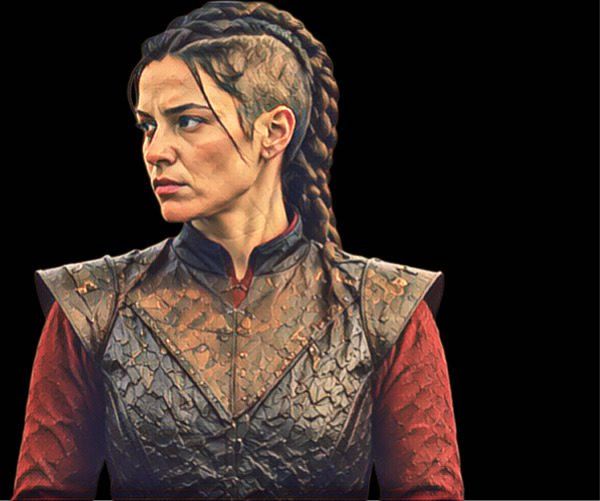
Now, the first official images from season three finally confirm Annie Shapero as the character. And HBO seems to understand exactly who Alysanne Blackwood needs to be.
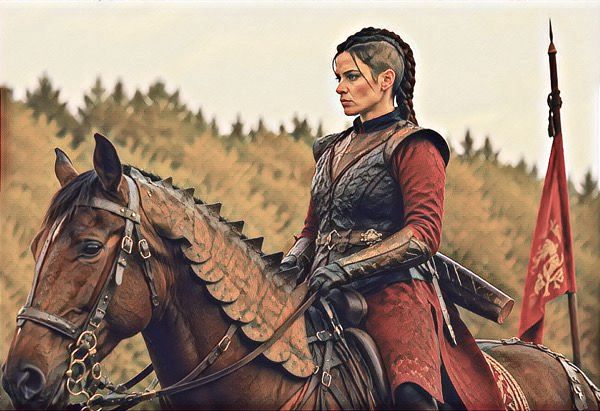
She appears already on the battlefield, armed, mounted, and visually tied to the devastation of the Riverlands. There is none of the more courtly aesthetic that dominated much of season two. Black Aly arrives as a direct consequence of the Targaryen civil war, almost as a reminder that the Dance of the Dragons was never only about dragons or succession, but about the complete collapse of Westeros itself.
According to Fire & Blood, Alysanne Blackwood, nicknamed “Black Aly,” was known less for beauty than for her fierce personality, sharp tongue, and exceptional skill as an archer, horsewoman, and hunter. George R.R. Martin describes her as tall, thin, marked by long black hair and an almost intimidating presence by the standards of Westerosi femininity.
During the civil war, House Blackwood supported Rhaenyra Targaryen while the Brackens sided with the Greens. The historic rivalry between the two families culminated in the Battle of the Burning Mill, one of the Riverlands’ most important conflicts. In the books, Ser Amos Bracken kills Lord Samwell Blackwood in single combat, only to die moments later when a sacred weirwood arrow shot by Alysanne pierces the visor of his helm. It was one of the moments readers most expected to see adapted, and it was ultimately left out of the television series.
Perhaps now it becomes clearer that the show deliberately reorganized part of the timeline in order to concentrate major Riverlands characters in season three, precisely when the war reaches a broader and more devastating scale.
Because Alysanne belongs far more to this phase of the story.
She is not a court intrigue character like Alicent Hightower or Mysaria. Her presence is tied to the military consequences of the Dance of the Dragons, to houses destroyed by war, and to the North beginning its march southward. That is why her arrival alongside figures like Roddy the Ruin and Benjicot “Bloody Ben” Blackwood feels so symbolic to readers of the books.
Alysanne also represents a rare kind of female character within Westeros. Martin never writes her as an ornamental figure or as a caricature of the “warrior woman.” She is fierce, sarcastic, impulsive, and deeply human. She actively participates in military campaigns, leads Riverlands archers, and witnesses the deaths of relatives and allies throughout the war.
The “gossip” of Westeros also questioned the closeness between Alysanne and Lady Sabitha Frey, another major Black commander during the Dance. The two women shared tents during military campaigns, fueling rumors within Martin’s own fictional historical narrative. It remains to be seen how interested House of the Dragon will be in exploring that relationship.
But Black Aly’s importance goes far beyond the battlefield.
Toward the end of the war, after Rhaenyra’s death and during Aegon II’s brief reign, Alysanne will be present in King’s Landing during the so-called Hour of the Wolf, when Cregan Stark arrives in the South determined to restore political honor to Westeros. It is in this context that one of Fire & Blood’s most beloved relationships begins.
Cregan Stark intends to execute Corlys Velaryon for treason, but Alysanne argues that his life should be spared in the name of peace. In return, she offers Cregan whatever he desires. The Lord of Winterfell asks for her hand in marriage.
Their union would become one of Westeros’ rare genuinely happy love stories.
At Winterfell, Black Aly would help rebuild regions devastated by the civil war and strengthen the bonds between North and South. Many of the men who marched south beside Cregan remained in the Riverlands specifically to help rebuild the kingdom after the trauma of the Dance of the Dragons. It is a more melancholic and deeply human dimension of the character that will likely be reduced or accelerated in the television adaptation.
And perhaps that is why it is so important for the series to fully understand her visual and dramatic power now.
Because Alysanne Blackwood was never simply another warrior in Westeros. She always functioned as a symbol of what remains after the dragons finish destroying everything.
Descubra mais sobre
Assine para receber nossas notícias mais recentes por e-mail.


1 comentário Adicione o seu