
A young peasant woman insisting on marrying for love was once something profoundly revolutionary. Even more so on the eve of the French Revolution, when a ballet dared to abandon kings, fairies, and aristocratic tragedies to place ordinary people, humor, and desire at the center of the stage. That was how La Fille Mal Gardée was born, first presented in July 1789, only days before the Storming of the Bastille permanently transformed the history of France.
More than two centuries later, the classic returns to Rio de Janeiro’s Theatro Municipal for a new season following the enormous success of its 2024 production.
Clara Paulino, director of Rio’s Theatro Municipal, believes the success of recent ballet seasons may not represent an entirely new phenomenon, but rather a shift in access to cultural programming, supported by initiatives such as more affordable tickets, educational projects, and a broader opening of the theater to different audiences.
“Perhaps it is not an increase in the public’s interest, but a question of how to offer this programming and make this space more democratic,” she said.
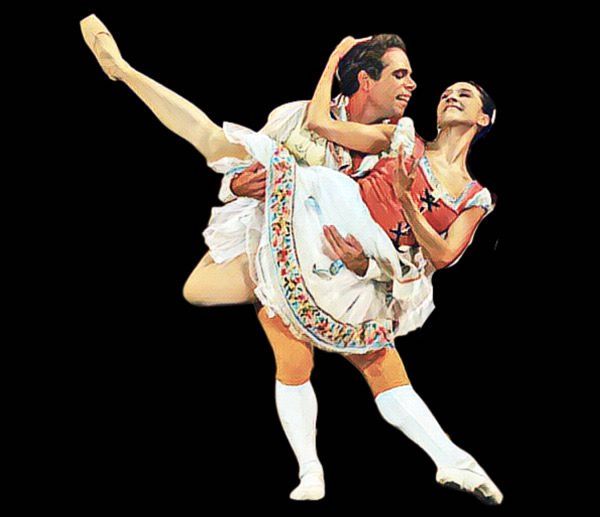
The challenge of making the difficult seem effortless
But there is a curious and very particular detail about La Fille Mal Gardée: despite its light, pastoral, and comic atmosphere, the ballet is far from simple for its dancers.
Quite the opposite.
The work is technically demanding and requires something rare within the classical repertoire. Beyond physical precision, performers must act, sustain the humor of the narrative, work with pantomime, facial expression, and comic timing while executing extremely complex choreography without showing any sign of effort.
Principal dancer Juliana Valadão explains that this balance is precisely one of the production’s greatest challenges. “We rehearse the technical side constantly, and then comes the balance between technical difficulty, lightness, and artistry,” she says. According to her, that adjustment is never truly finished. “After every performance, we keep refining things. It is an art form that will never be one hundred percent complete.”
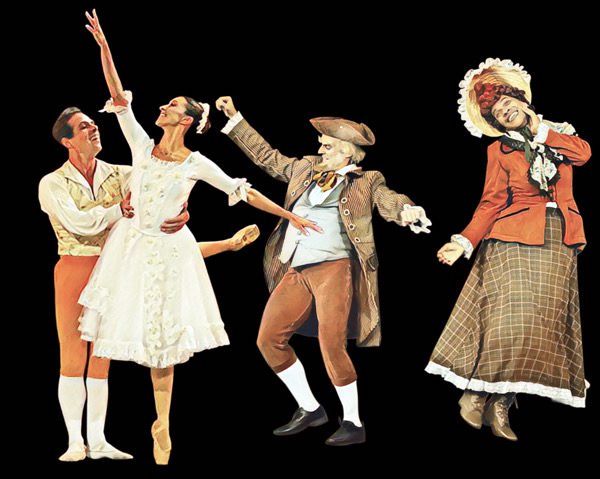
First dancer Cícero Gomes agrees that the central paradox of La Fille Mal Gardée lies in making something extremely difficult appear natural to the audience. “There is something particularly complicated about making such a light ballet look so natural onstage,” he explains. “You have to appear effortless while doing absurdly difficult things. But that is also where the pleasure is.”
Juliana points out that the ballet demands a rare combination of virtuosity and interpretation. “There are balances, quick and intricate steps, the ribbon work, the mime sequences, the mise-en-scène,” she says. “We are onstage almost the entire time, and the greatest challenge is overcoming exhaustion, because it can interfere with both the technical and artistic sides.”
For Cícero, that physical strain appears almost immediately. “One of the most difficult moments in the choreography is undoubtedly Colas’s first variation,” he says. “He enters the stage already performing an absolutely technical variation that pushes the body to the peak of exhaustion within the very first minute.”
According to Hélio Bejani, director of the Ballet of Rio’s Theatro Municipal, this balance between technique, musicality, and interpretation was also one of the priorities of the new production staged by Ricardo Alfonso. “Ricardo Alfonso’s version places special attention on interpretation beyond technique, with extraordinary musicality and a humor closer to the Brazilian personality, partly because he himself is South American,” he explains.
Bejani also highlights that, because it is a comedy, the company’s main challenge was finding naturalness onstage without turning the characters into caricatures. “The main focus was working on the dancers’ naturalness so they would not perform the characters in a caricatured way.”
Perhaps it is precisely this contrast between extreme difficulty and the appearance of spontaneity that transformed the ballet into one of the most beloved titles in dance history.
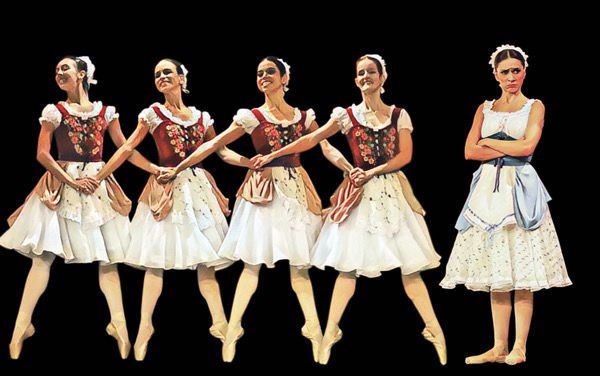
The anti-Giselle
Originally created by Jean Dauberval, La Fille Mal Gardée survived political revolutions and the transformations of classical ballet itself thanks to versions preserved in Russia. Decades later, Frederick Ashton would transform the work into a modern classic when he created his definitive 1960 version for London’s Royal Ballet.
It was Ashton who understood that the ballet’s lightness did not diminish its sophistication. Quite the opposite. Everything in the production must appear natural, delicate, and playful, even while remaining technically rigorous.
In the story, Lise is the daughter of Widow Simone, a landowner who dreams of marrying the young woman to Alain, the clumsy and childish heir of a wealthy family. The problem is that Lise is in love with the young peasant Colas. Through secret meetings, domestic confusion, and comic scenes, the ballet follows the heroine’s attempts to escape the destiny planned for her by her mother.
And perhaps it is precisely the humanity of these characters that continues to bring audiences closer to the work after more than 230 years.
“Lise is not a princess, not a fairy, not an ethereal being,” Juliana Valadão explains. “She is a normal person, full of personality. That is wonderful because it feels different.”
Cícero Gomes believes Colas also possesses that particularly human quality that allows each dancer to shape the role differently. “What makes La Fille different from other classics, beyond being one of the first ballets to place ordinary people at the center of the story, is exactly that,” he says. “The more naturalness you bring, the more alive the character becomes. Colas is a role that allows every dancer to create their own hero. There are endless possibilities.”
Bejani believes this emotional closeness helps explain why the ballet continues to attract new audiences even after more than two centuries. “The audience experiences the story as if they were part of it,” he says.
Unlike so many major classical ballets marked by tragedy, ghosts, and doomed romances, La Fille Mal Gardée builds its strength precisely through joy. In many ways, the ballet functions almost like an anti-Giselle, avoiding melodrama at all costs and preferring the audience’s laughter instead.
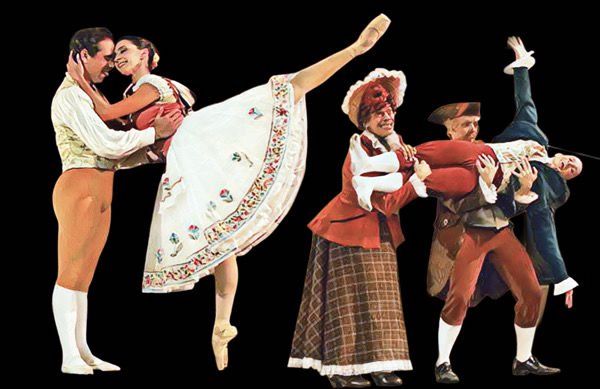
Why La Fille Mal Gardée still works
Paulino also believes part of the ballet’s enduring strength lies precisely in this narrative lightness and in the way audiences emotionally participate in the story. “Seeing Madame Simone trying to marry her daughter off to a wealthy young man while this mischievous girl is in love with a peasant makes the audience deeply involved,” she says.
The decision to open the 2026 ballet season with this title speaks directly to that brighter atmosphere. “The reason for choosing this work was truly to open the season with joy, with such a light and wonderful piece.”
That atmosphere also transforms the emotional experience of the performers themselves. “It is wonderful to dance a ballet where we are happy from beginning to end,” Juliana says. “It feels different from the more dramatic ballets, the ballets built around suffering. We step onstage lighter.”
Cícero especially highlights one of the most delicate and amusing moments in the story. “I do not really have a favorite scene because the whole story is delightful to tell,” he says. “But the scene where Lise is alone, dreaming about getting married and having children while Colas secretly listens and catches her in the act is incredibly funny.”
La Fille Mal Gardée brings together some of the Ballet of Rio’s Theatro Municipal’s rising performers and runs through May 24.
Descubra mais sobre
Assine para receber nossas notícias mais recentes por e-mail.

