
The final season of Hacks has become a succession of situations and opportunities Deborah Vance creates and exploits both to work around the consequences of her war against the system and to keep herself constantly visible. Even when there is a parallel thread for the supporting characters, Deborah remains the center of gravity. Everything inevitably circles back to her. Episodes do not always connect organically to one another, nor does her journey consistently feel like it is moving toward something clearly better or worse. And maybe that is precisely why “The Cube” ends up being one of the most melancholic episodes of Hacks. Because it understands something the series has repeated since the beginning, but now reveals without the protection of comedy: loving your work deeply does not necessarily mean you will be rewarded for it. Sometimes it simply means continuing to push forward while everything around you quietly collapses.
And it is interesting because, with the series so close to ending, Deborah and Ava seem to have finally found a kind of improbable balance. After seasons built on emotional warfare, resentment, manipulation, and dependency, there is now a strange calmness between them. But Hacks was never really about perfect endings. While Deborah approaches Madison Square Garden as if she is about to reach the last great validation of her career, Jimmy and Kayla are living the exact opposite experience: the moment when the dream begins to die in front of them.
The structure of the episode almost functions like a mirror. Deborah is literally trapped inside a suspended glass cube in Las Vegas while Jimmy and Kayla realize they are trapped too, only financially, emotionally, and professionally. And perhaps that is exactly where “The Cube” finds its emotional core.
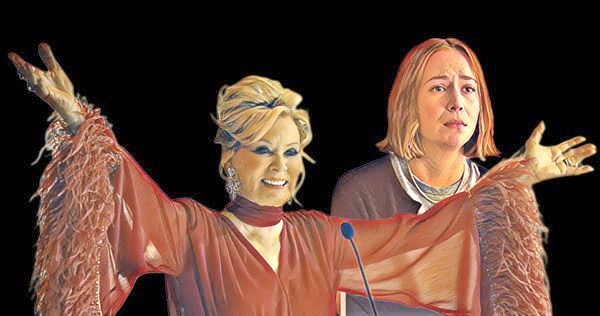
The entire sequence surrounding Deborah’s promotional stunt is absurdly exaggerated, if not for the fact that it also feels uncomfortably close to reality. Deborah is, after all, a celebrity, and the performative ego of American celebrities often operates like a survival mechanism. Anything is worth doing to remain visible.
Deborah’s self-aware humor remains sharp. We first find her discussing how she plans to enter Madison Square Garden: emerging from a glitter-covered coffin, gagged with a Schiaparelli piece, carried by Knicks dancers. It is the perfect metaphor and a perfect use of everything terrible that has happened to her in recent years as fuel to reinvent herself as even bolder. If it is revenge and self-affirmation, it is also somewhat ridiculous and even depressing. The excitement of constantly creating transforms everything into an event, a performance, a headline, a manufactured narrative. Even vulnerability has to be commercialized.
The original idea of using Katya as a “Deborah drag queen” is brilliant precisely because it exposes the artificial side of the character. When Katya says she cannot portray a contemporary Deborah because she is “a Deborah from the ’90s,” Hacks almost admits that Deborah herself remains emotionally trapped in that era. She still reacts to the world like someone who spent decades surviving humiliation from the industry, from men, from the press, and from audiences. She herself never truly moves forward.
Then the magic trick goes wrong, and Hacks makes the smart decision not to treat it merely as visual comedy.
Deborah decides to participate in a magician’s stunt in the middle of Las Vegas, but of course, it has to fail. A citywide blackout hits, the trick collapses, and Deborah ends up trapped for hours inside a giant glass cube suspended high above the Strip. It works not only as public humiliation, but as another perfect image of her career itself: a woman suspended somewhere between spectacle and disaster, trying to convince the world — and perhaps herself — that she still controls everything.
Ironically, the one person who does not panic, abandon her, or turn against her is Ava. Ava’s journey, perhaps, was never about “changing” Deborah, but about accepting herself as part of the universe of the star she spent so long criticizing. There is no discussion now about Deborah’s chronic narcissism. Ava’s support has become unconditional. She truly understands Deborah, and when she says Deborah is “crazy for her work” and that it is “fucking cool,” Ava finally recognizes something essential about Deborah that also applies to herself: the inability to exist without performing because work became the only emotional survival mechanism available to her. And I once again found myself wondering what happened to the reboot of Who’s Cooking Dinner, though that now seems irrelevant even to Ava herself.

Meanwhile, Jimmy and Kayla’s literal journey also grows in importance. Hacks spent years treating them as parallel comic relief, but the truth is that they always carried one of the most emotionally genuine relationships in the series. Two nepo babies who sacrificed everything for the idea of belonging to that industry despite constant obstacles. They represent the backstage reality of people who are not famous enough to transform failure into spectacle.
The scenes of them dismantling their office are devastating precisely because Hacks understands the quiet humiliation of professional failure without resorting to melodrama. From canceling their pickleball membership to working from Jimmy’s kitchen, sharing food, and realizing Michael Schaefer’s lawsuit could completely destroy the agency, it becomes impossible for them not to see that their dream simply did not work out.
Paul W. Downs deserves enormous praise here, both as showrunner and performer, because he uses Jimmy to deliver some of the strongest work of the series. Faced with everything collapsing around him, Jimmy finally admits something that had always been implicit: he never wanted to be an artist. His greatest talent has always been helping talented people exist. It is not defeat, but a clear understanding of his place within the system.
The character who changes the most, however, is Kayla. What began years ago as an almost cartoonish “insufferable nepo baby” has evolved into a surprisingly human character. When she admits she entered the industry simply to spend time with Jimmy, Hacks reveals something deeply sad about her as well: Kayla spent her entire life trying to transform affection into usefulness. And perhaps that is why the episode ultimately becomes less about success and more about exhaustion.
Deborah manages to sell out Madison Square Garden in ten minutes after her near-tragedy turns into a media spectacle. It is an apparently triumphant ending, but Hacks films it all with a strange sense of fatigue. As if the series understands how deeply absurd it is that a woman practically has to almost die publicly to sell tickets.
Meanwhile, Jimmy returns to Latitude, essentially starting over from scratch.
And maybe that is the cruelest contrast in the entire episode. Deborah can transform humiliation into marketing because she has already become a brand. Jimmy cannot. Some people can monetize their chaos. Others merely survive it.
“The Cube” ultimately becomes an episode about people who continue insisting even after recognizing the emotional cost of their own ambition. And Hacks understands something deeply painful about creative careers: sometimes loving your work does not improve your life. Sometimes it only makes you willing to suffer for it longer.
Descubra mais sobre
Assine para receber nossas notícias mais recentes por e-mail.

