
After creating a global phenomenon centered on teenagers, there is something equally ironic and clever about realizing that the Duffer Brothers now seem interested in asking what happens when those children grow old. Or rather: who those people become when the mystery still exists, but the body no longer responds the same way.
That is exactly where The Boroughs begins, Netflix’s new series created by Jeffrey Addiss and Will Matthews (The Dark Crystal: Age of Resistance) and produced by the Duffers, which has already earned the inevitable nickname: “Stranger Things for senior citizens.”
And honestly? The comparison is not wrong.
The story takes place inside an apparently peaceful retirement community in the New Mexico desert. One of those places that feels overly organized, overly quiet, where the promise being sold is comfort, safety, and the end of all worries. Naturally, that means something horrifying is hidden there.

When residents begin disappearing, and strange creatures start emerging through walls, corridors, and memory lapses, a group of elderly neighbors decides to investigate what is happening. The series quickly understands where its greatest strength lies: these are not simply “older versions” of young protagonists. They carry decades of grief, resentment, guilt, illness, loss, and the constant feeling that the world has already decided to discard them.
Even the soundtrack helps build that atmosphere of memory, nostalgia, and melancholy. Nora Felder, the music supervisor behind Stranger Things, reunited with the Duffer Brothers for The Boroughs and assembled a soundtrack featuring David Bowie, Bruce Springsteen, Santana, Siouxsie and the Banshees, Heart, and Bob Seger. The show literally opens with Bowie’s “Golden Years” as Alfred Molina’s Sam Cooper arrives at the retirement community.
And there is something incredibly symbolic about that choice. “Golden Years” does not function merely as cool nostalgia. It almost feels like a provocation. The idea of “golden years” here seems less like peace and more like a desperate attempt to convince those characters that there is still time left.
Maybe that is why Bruce Springsteen becomes another emotional backbone of the series. “Thunder Road” serves as the song that connects Sam to his deceased wife, Lilly, resurfacing throughout the season in moments tied to grief, memory, and farewell. Meanwhile, “Born to Run” closes the season almost like an emotional manifesto: these characters are still alive, still desiring, still failing, and still trying to move forward.
And that ties directly into the show’s central theme: refusing to portray elderly people as passive figures simply waiting for the end.
That is why the comparison to Cocoon became almost automatic. But maybe The Boroughs works precisely because it feels like a “reverse Cocoon.”
In Cocoon (1985), older people rediscovered youth, vitality, and something close to a cosmic second chance. Here, the horror comes from the exact opposite: the brutal awareness that time is running out. The monster in The Boroughs is not merely threatening to kill. It threatens to steal the one thing those characters already feel they are naturally losing anyway: time itself.
And that completely changes the emotional energy of the series.

If Stranger Things was about growing up too quickly, The Boroughs becomes a story about realizing there may never be enough time. Even at 70. Even at 80.
Of course, the Duffer Brothers’ DNA is everywhere. The atmosphere of government conspiracies. Flickering lights. Radios, static televisions, and strange signals. An unlikely group joining forces against something impossible. Horror that feels pulled straight out of Stephen King. The mixture of 1980s adventure with contemporary melancholy.
But there is also an important difference: The Boroughs seems less interested in pure nostalgia.
Critics have pointed to that as one of the show’s strongest qualities. Beneath the familiar packaging lies something more bitter and emotionally mature. The horror is not only supernatural. It is also the fear of irrelevance. Social invisibility. The cruelty with which elderly people are treated, even inside “luxurious” spaces supposedly designed for them.
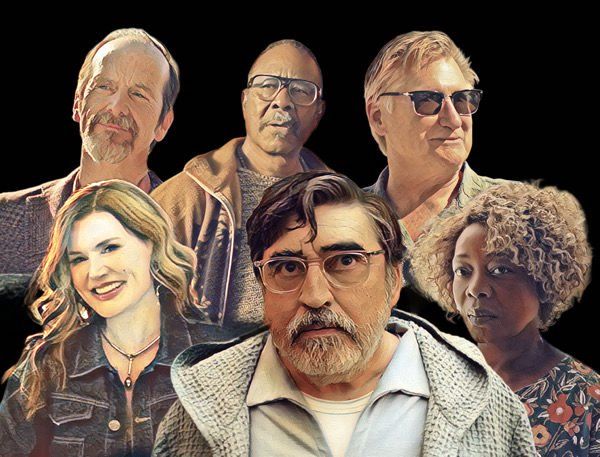
The cast helps enormously with that emotional weight. Alfred Molina leads the series as Sam Cooper, a recently widowed newcomer to the community, surrounded by names like Geena Davis, Alfre Woodard, Bill Pullman, Clarke Peters, and Denis O’Hare. The ensemble is so strong that several reviews argue the performances keep the series compelling even when the mystery itself occasionally feels familiar.
There is also something unexpectedly beautiful about the way the show treats older people as still deeply driven by desire. Not merely sweet survivors waiting for the end of life. Critics have highlighted exactly that: these characters sing Springsteen at karaoke nights, use recreational drugs, flirt, fight, have sex, hide secrets, and continue trying to understand who they are.
Maybe that is where The Boroughs finds its own identity.
Because it would have been very easy to turn the entire premise into a joke about old people fighting monsters. But the show mostly avoids that trap. Aging is not the punchline. It is central to the mythology itself.
And yes: some fascinating spoilers have already emerged regarding the supernatural side of the story.
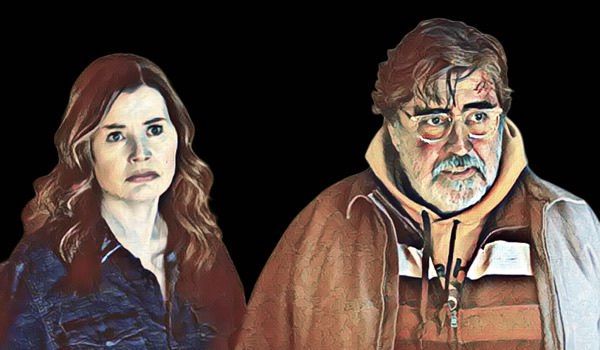
The season eventually reveals the existence of an entity known as “Mother,” discovered in the 1940s and linked to experiments, temporal manipulation, and creatures that feed on cerebral fluid to prolong life. The horror gradually evolves into a strange combination of aliens, time distortions, and humanity’s obsession with immortality.
Which means that, the further the series goes, the more it seems to replace the youthful adventure energy of The Goonies with something existentially sadder.
Because children believe they will live forever. Older people know they will not.
And maybe that is exactly what makes The Boroughs more interesting than simply “Stranger Things with old people.”
Descubra mais sobre
Assine para receber nossas notícias mais recentes por e-mail.

